


Introduction to the Acid Degumming Process in Edible Oils:
Acid degumming process in edible (Phosphoric Acid) oil conditioning is a widely used and simple method primarily applied in refining high-quality palm oil and coconut oil.
While it is economical and easy to implement, it also has some drawbacks. Approximately 400 to 1000 ppm is blended into the oil using a high-shear mixer during the process.
After this step, the oil moves directly to the bleaching stage for physical refining.
Process Steps:
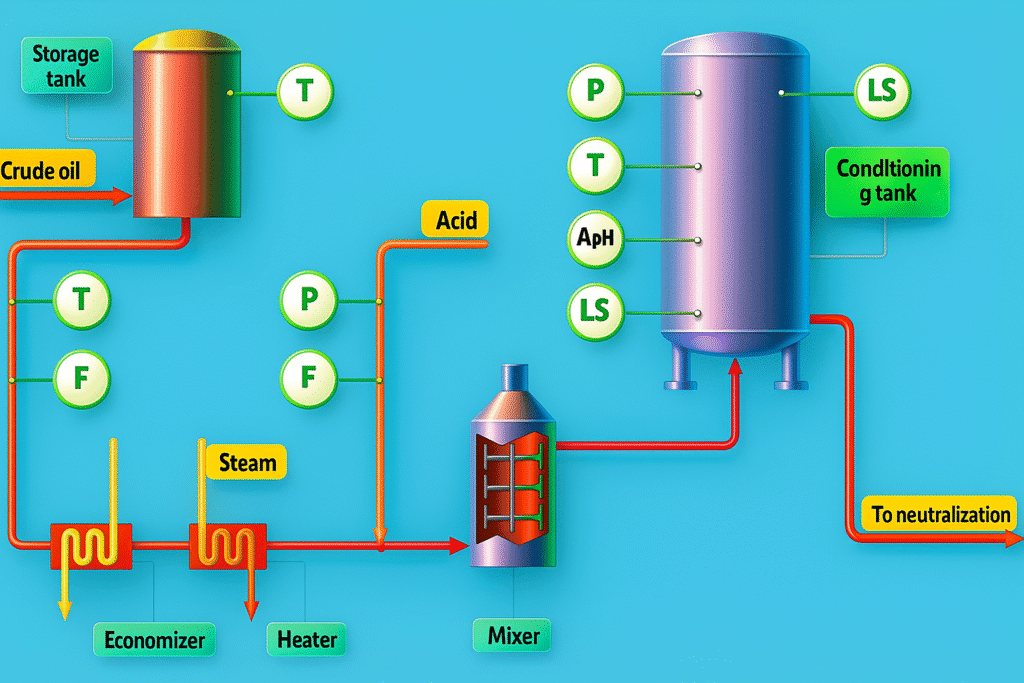
Acid Degumming process in edible oil. Let’s go through the step-by-step acid conditioning:
- The first step is to heat high-quality palm or coconut oil to 130°F-140°F (55°C–65°C).
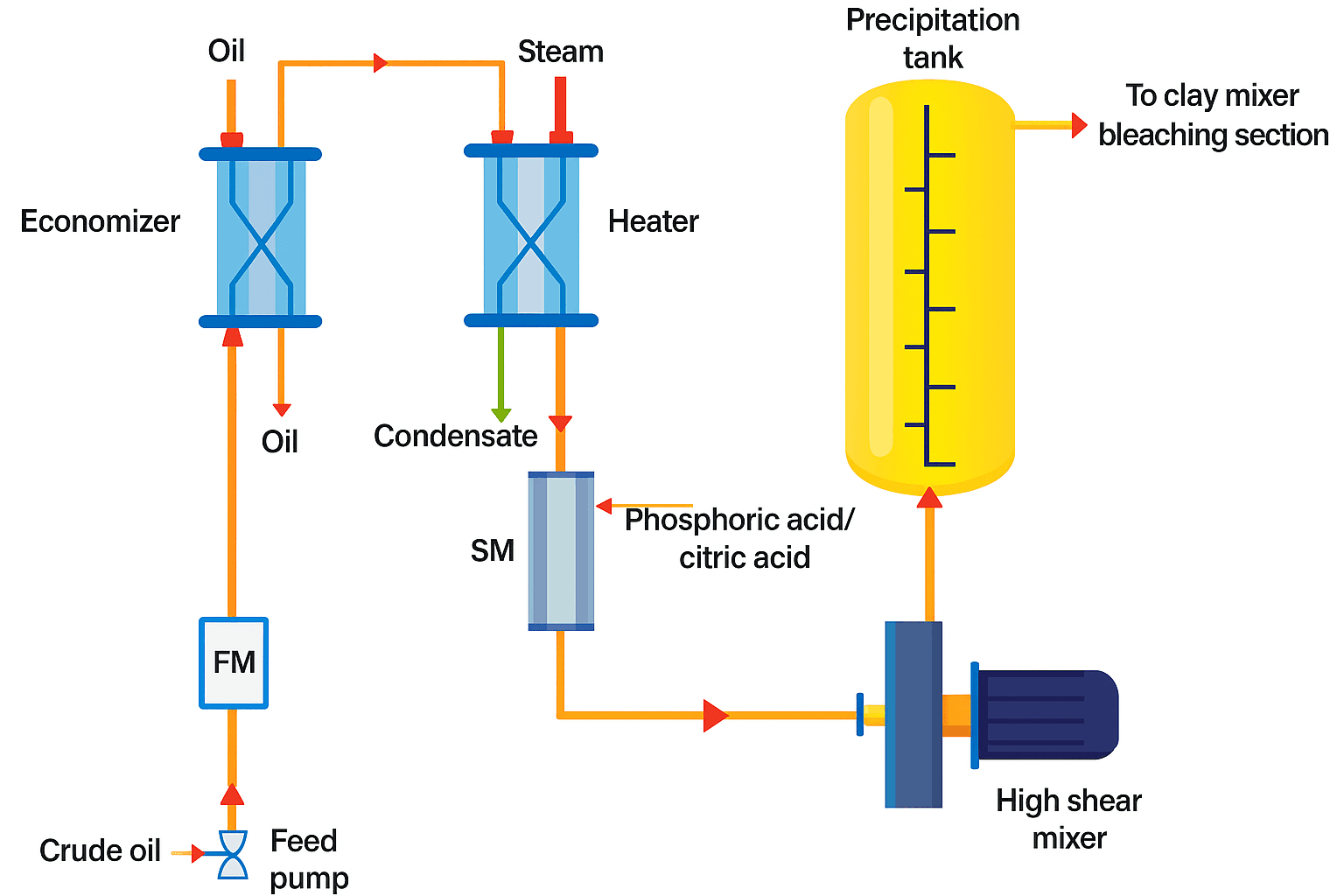
- Next, 400–1000 PPM of phosphoric acid is added to the crude oil. The oil and acid are thoroughly mixed using a high shear mixer. In some cases, citric acid is more effective and is preferred over phosphoric acid. For example, citric acid or even maleic acid is commonly used to treat canola oil.
Gentle Agitation:
- After mixing is complete, the oil-acid mixture flows into a retention vessel, often called the conditioning tank, which is gently agitated.
- The mixture is kept in the retention tank for about 15 to 30 minutes. During this time, phospholipids absorb water and separate from the oil because the metal salts from the phosphoric acid are not soluble in oil.
- It should be noted that the hydrated phospholipids are not removed from the crude oil before it goes through the bleaching or caustic neutralisation stage.
Although the Method is simple, it has some challenges:
One common problem is that the precipitated salts and hydrated gums can clog filter screens.
This is because the metal salts formed by the acid are insoluble and settle out. As a result, they can block filters during the bleaching process.
To prevent this, it is highly recommended to precoat filter screens with diatomaceous earth.
Acid Degumming Process in edible oil:
Standalone refiners often use this technique as a pre-treatment step to hydrate specific non-hydratable phospholipids before the actual refining begins.
While it is a cost-effective option, especially for seed oils, the results are not always ideal.
Moreover, refiners working with low-quality or difficult-to-refine oils often choose this method for its affordability, even though it is less effective than acid degumming.
Critical Control Points in Acid Conditioning:
- For the acid conditioning process to be effective, several factors must be carefully controlled.
- The main critical control points are:
- Oil temperature
- Amount of acid used
- Mixing efficiency between oil and acid
- Retention time after acid treatment
- Agitation in the conditioning tank. Let’s examine each of these points in more detail.
Oil Temperature: Acid Degumming process in edible Oils
If the temperature is below 50°C (125°F), the reaction between the acid and phospholipids slows significantly.
On the other hand, if the temperature exceeds 65°C (145°F), the acid may hydrolyse part of the crude oil, thereby increasing the free fatty acid (FFA) content.
Amount of Acid Added:
Generally, most refiners use 400–1000 PPM of phosphoric acid based on crude oil flow rate.
However, this standard dosage may not always be suitable, mainly when the crude oil contains a higher concentration of non-hydratable phospholipids. In such cases:
A lower dosage might lead to incomplete hydration.
A higher dosage may lead to unnecessary hydrolysis of the oil, thereby increasing refining losses.
To determine the correct amount of acid more accurately, refiners should analyse the crude oil’s calcium content.
Calculation for phosphoric acid:
- If crude soybean oil contains 100 PPM of calcium:
- Atomic weight of calcium = 40
- Molecular weight of phosphoric acid = 98
- Theoretical ratio: 2 moles of phosphoric acid react with 3 atoms of calcium
- Thus, 120 parts of calcium will react with 196 parts of phosphoric acid.
For 100 PPM Calcium:
However, in practice, the required phosphoric acid amount is often five to ten times higher than the calculated value.
This is mainly because:
- The acid reacts not only with calcium but also with other metals, such as magnesium and iron.
- Perfect mixing is difficult to achieve even with high shear mixers.
Therefore, it is essential to analyse each batch of crude oil to determine the correct acid dosage, as it can vary from batch to batch.
Mixing of Oil and Acid:
Proper dispersion is required because phosphoric acid and oil are immiscible; a high-shear mixer is necessary to create microscopic acid droplets within the oil.
This enhances the reaction surface area and boosts overall process efficiency. Insufficient mixing may cause
Partial hydration of non-hydratable phospholipids leads to an evaluated phosphorus level in the final refined oil.
Settling of unreacted acid, which can corrode equipment, even if it is made of 300-304 stainless steel.
Retention Time (Conditioning Time):
A minimum retention time of 25-30 minutes is necessary when using a high shear mixer.
Extending this time beyond the required limit does not improve hydration.
Excessive retention may cause acids and hydrated gums to settle at the bottom of the tank, making filtration of bleached oil more difficult later.
Agitation in the Conditioning Tank:
Vigorous mixing can cause emulsification, which may interfere with subsequent refining processes.
Acid Degumming: An Enhanced Approach:
Acid degumming is an improved version of acid conditioning that provides more effective phospholipid removal.
It is commonly used for seed oils or other difficult-to-refine oils. The process enhances acid conditioning by incorporating water into the treatment.
Here is how the procedure works:
Deionized water, typically at about 2% of the oil flow rate, is added to the oil acid mixture as it exits the high-shear mixer.
The mixture then passes through a static mixer before entering a hydration tank.
The hydration tank, similar to those used in water degumming, gently agitates the oil and acid water mixture for 20 to 30 minutes.
Centrifuge:
After this period, the oil is slowly pumped from the hydration tank into a centrifuge.
The centrifuge separates the heavy phase (acid-treated gums) from the light phase (treated oil).
For high-quality palm or coconut oil, water may be added just before centrifugation rather than earlier in the process.
One can clearly see that this method combines key elements of both water degumming and acid conditioning.
Critical Control Points in Acid Degumming:
The parameters to monitor in this process are essentially the same as those in the water degumming and acid conditioning methods.
However, additional care is needed when integrating water to avoid emulsification and achieve efficient phase separation.
By adopting acid degumming, refiners can achieve better impurity removal, improve oil stability, and minimize downstream processing issues, thereby enhancing overall product quality.

Comments are closed.