


Introduction:
The Batch deodorisation process for edible oil processing is one of the oldest refining techniques used to remove unwanted odours, flavours, and volatile compounds from vegetable oil.
This method, however, was gradually replaced by a continuous system. Still plays a vital role in small to medium oil refineries.
Types of Deodorisers:
There are several deodoriser manufacturers, but all deodorisers fall under the following three categories:
1. Batch Deodorisation Process
2. Semi-continuous
3. Continuous
Batch Deodorisers:
The batch deodorisation process was initially introduced in the oil industry during the middle of the 19th century, and the actual units were used around the 1890s.
In these units, the oil (especially coconut oil) was heated, and direct steam sparge was used.
Vacuum System:
The Batch deodoriser process, using a vacuum system combined with superheated steam stripping, was introduced in the USA during the late 19th century.
In the early 1900s, France developed the first high-temperature batch deodoriser equipped with a vacuum system and built from non-oxidising materials.
Several design modifications have been made to batch deodorisers since then, and they are still used in many oil processing plants worldwide.
Today, many modern plants use stainless-steel batch deodorisers to process vegetable oils and speciality products.
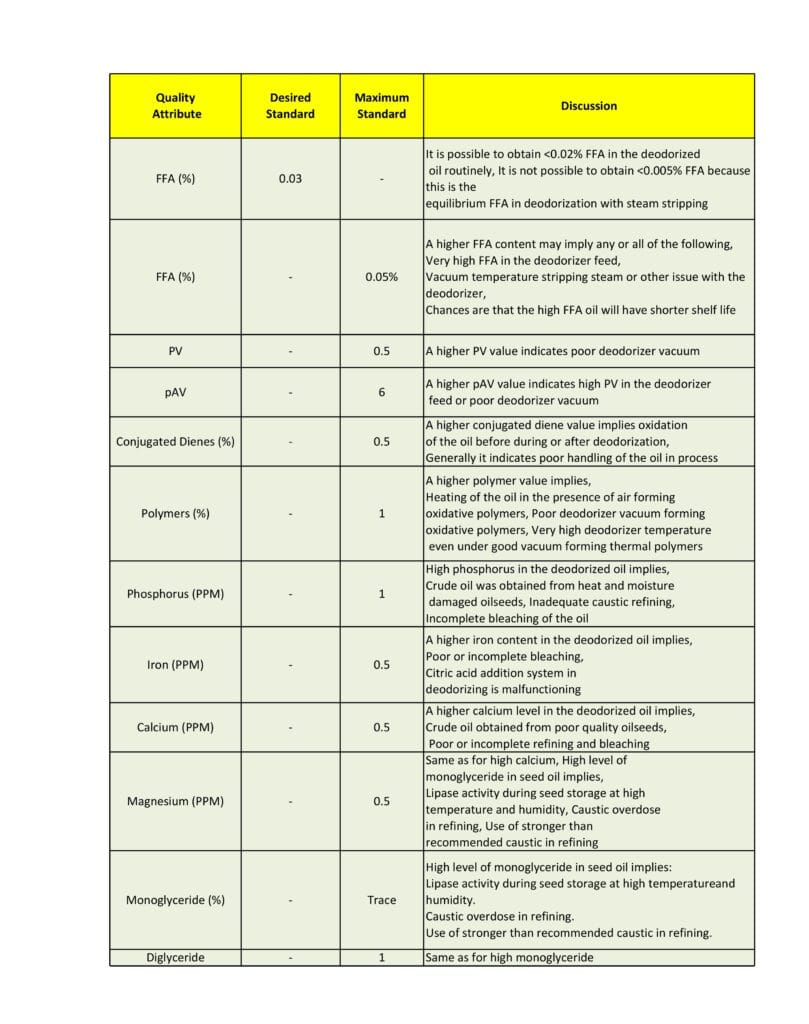
Typical Operating Steps in the batch deodorisation process for edible oil:
In this process (Batch Deodorisation Process), the oil is deodorised in several stages as outlined below:
- The vacuum is turned on.
- To begin the operation, operators charge a batch of oil into the deodoriser through a distributor ring fitted with nozzles.
- The oil is heated by using either steam or thermal fluid.
- The steam is at 450 PSI (32.7 kg/cm2).
- The deodoriser oil temperature should be set to 250°F (121.1°C) for deaeration.
- The deaeration step can take 30 minutes or longer.
- Next, they inject a small amount of stripping steam to agitate the oil and remove trapped air.
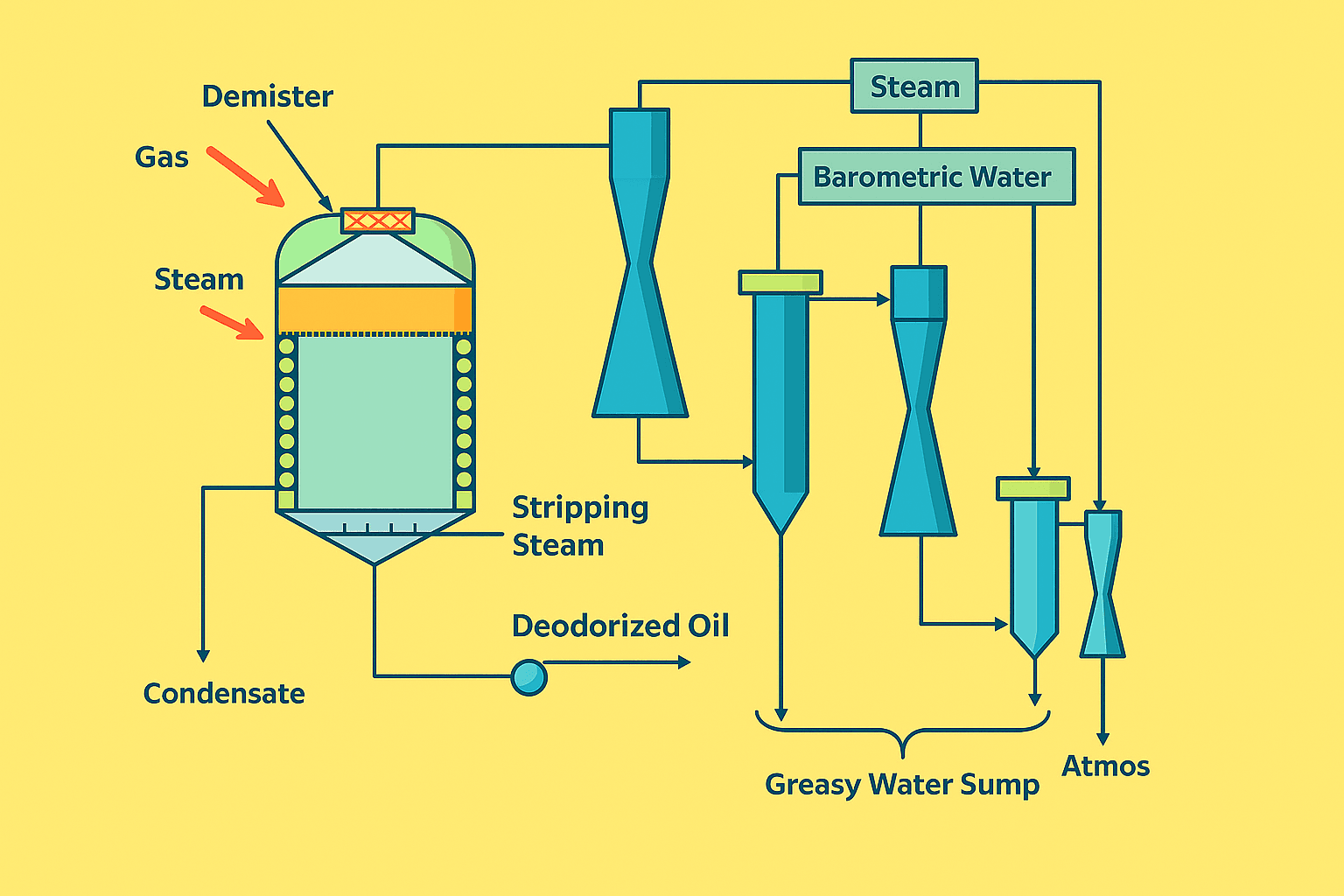
Stripping Steam: Batch deodorisation process for edible oil.
8. The volume of the stripping steam is increased after deaeration and as the oil temperature rises.
The amount of stripping steam at this time is generally
3% (2–4% in the older designs and < 2% in the newer designs).
9. DDeodorize temperature is maintained at 460–480°F (238–249°C).
10. Finally, the oil undergoes deodorisation for a specific period, determined by previous experience, until it reaches the desired quality.
11. The oil is cooled down to <290°F (143°C), and 50 PPM of citric acid is added into the oil to chelate (scavenge) trace metals such as iron, copper, etc.
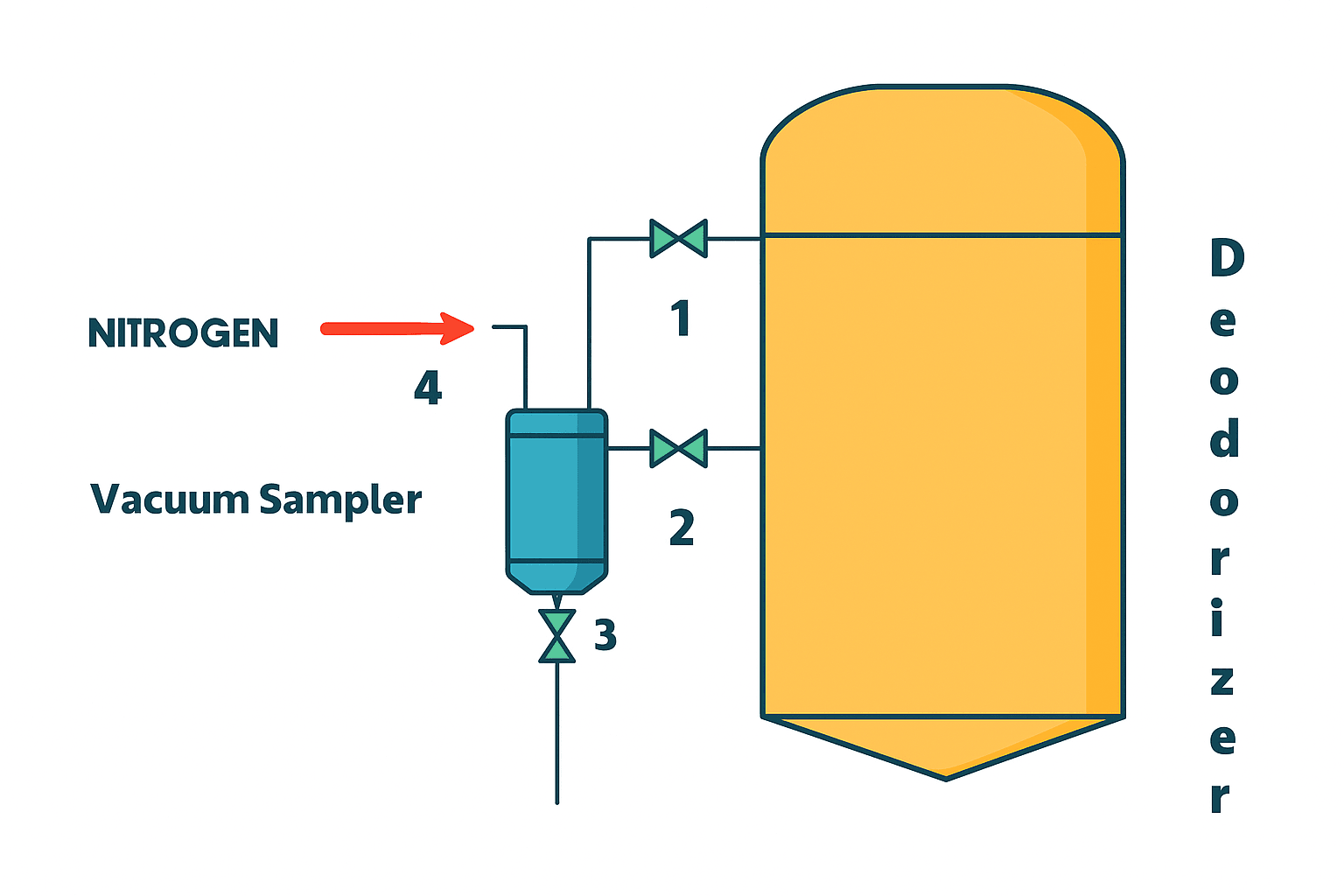
12. The Adeodoriserr sample is collected by using a specially designed sampler, as shown in Fig.
13. Stripping steam is shut off when the oil temperature reaches 120-125°C. There will be condensation of steam in the deodorised oil if the stripping steam is left on while the oil temperature drops below 120-125°C.
Cooling Of Oil:
14. The oil is cooled down in an external cooler and handled.
15. Antioxidant is added, sometimes before the oil is discharged from the deodoriser.
16. Alternatively, the antioxidant can be added as the oil is transferred to storage. An in-line mixer, such as a static mixer, can be used.
However, a high shear mixer is recommended.
Vacuum Sampler:
This is a tiny pressure vessel mounted on the side of the deodoriser, as shown.
There are four connections to the sampler.
The Step-by-Step Operation is described below:
1. First, check that all four valves are closed.
2. Then, after using thermally protected gloves and a face shield, open valve #3 with a bucket underneath to collect any oil residue from the vacuum sampler.
3. After that, leave valve #3 open.
4. Then, slowly open valve #4 and let some nitrogen flow through the sampler.
5. After that, close both valves #3 and #4.
6. After that, Open valve #1 to bring the sampler to the same vacuum as the deodoriser.
It will take only a second or two to equalise the vacuum between the two vessels.
7. After that, Close valve #1.
8. Then, Open valve #2 for a few seconds to allow the oil from the deodoriser to flow into the sampler.
9. After that, Close valve #2.
10. Crack open valve #4 very slowly to let nitrogen flow into the sampler to break the vacuum, and then close it.
Taking Vacuum Sampling:
- 11. After that, hold a thermally insulated safe sample collector at the bottom of the drain line.
- 12. After that, slowly open valve #3 and very slowly crack open valve #4 again.
- 13. Then, collect the oil in a safe sample collector.
- 14. After that, Close valves #4 and #2.
- 15. After that, chill the oil immediately in the laboratory.
- 16. Bubble nitrogen through it for 5–10 minutes while it is being chilled.
- 17. Then, analyse the sample.
- 18. Finally, make sure all four valves on the vacuum samplers are fully closed after collecting the sample.

Comments are closed.