


Quick Summary: Cooking Oils for Insulin Sensitivity:
Cooking Oils for Insulin Sensitivity describes how well your cells respond to insulin. Put simply, better sensitivity means your body uses glucose more efficiently; therefore, your pancreas works less hard and your long-term metabolic risk drops.
Over time, small food swaps, especially replacing saturated fats with unsaturated oils, can move the needle. Below, you’ll find clear evidence, friendly tips you can use this week, and short summaries of two recent studies that matter for real people.
What is Insulin Sensitivity? Oils insulin sensitivity primer:
Cooking Oils for Insulin Sensitivity measures the cells’ ability to take up glucose when insulin arrives.
Clinicians track this using HOMA-IR, fasting insulin, oral glucose tolerance tests, or the gold-standard clamp method.
Consequently, when researchers report lower HOMA-IR after a diet change, we read that better insulin action.
Importantly, diet changes rarely act alone; instead, they work together with activity, sleep, and body weight to shape metabolic health.
Which Oils Show the Strongest Evidence? Oils that improve Insulin sensitivity:
Extra virgin olive oil insulin sensitivity: EVOO evidence:
Extra virgin olive oil (EVOO) keeps appearing in high-quality trials. Not only does it deliver monounsaturated fat (MUFA), but it also brings antioxidants that reduce inflammation.
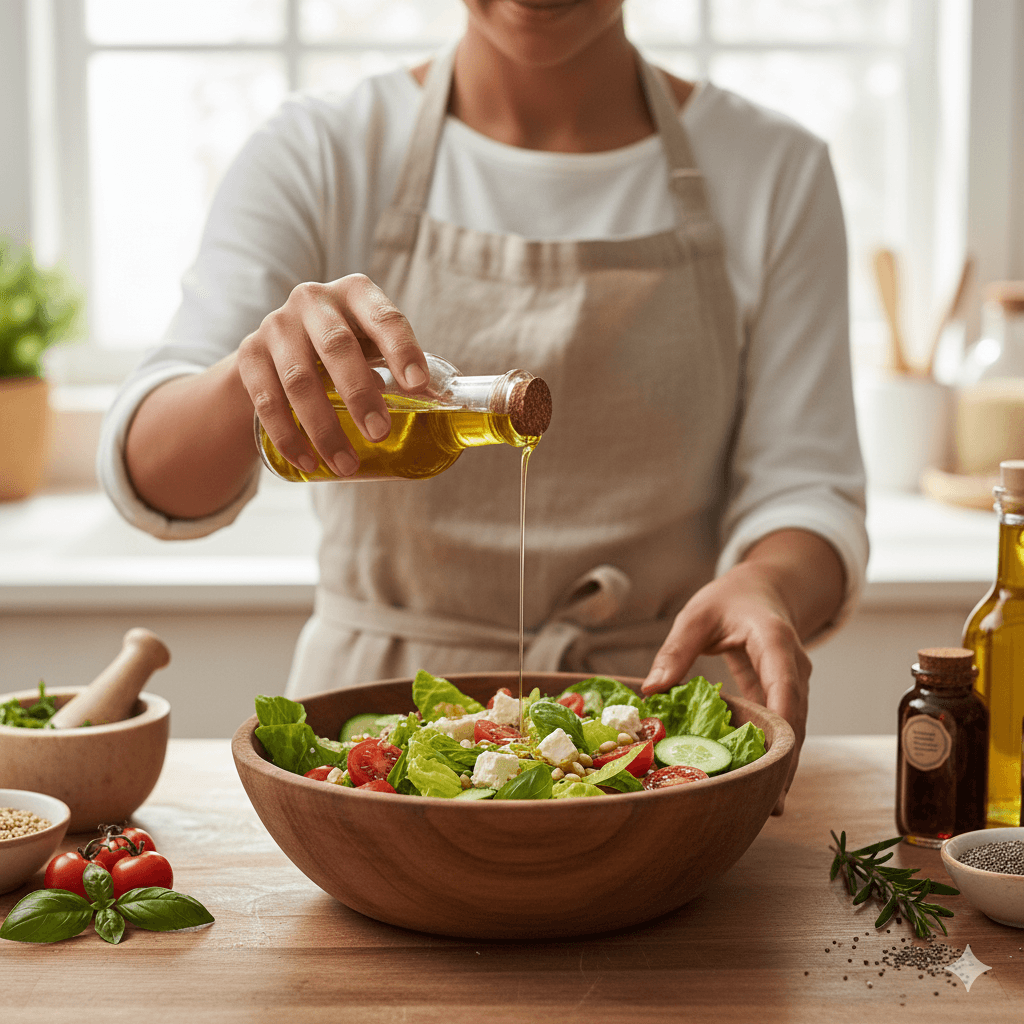
Consequently, many Mediterranean-style studies report improved fasting insulin and HOMA-IR when EVOO replaces saturated fats. In practice, use EVOO for salads, dressing, and low-heat cooking to preserve those active compounds.
Canola & high MUFA blends oil insulin sensitivity Canola evidence:
Canola and specially formulated high-oleic oils offer a favourable MUFA/PUFA balance. Trials that swapped better- or higher-SFA oils for canola often found reductions in fasting insulin and HOMA-IR.
Therefore, replacing spreads and cooking fats with canola or high-oleic sunflower makes practical sense for kitchens and food preparation.
Omega-3 oils & supplements oils insulin sensitivity: Omega-3 evidence:
Omega-3 fats from fatty fish and supplements show mixed but promising results.
In many people with metabolic dysfunction, fish oil interventions modestly improve insulin sensitivity.
However, effects vary with dose, duration, and starting health. Thus, include fatty fish twice weekly when possible, and consider supplements only with clinical guidance.
Other MUFA Oils (avocado, macadamia) Oils Insulin Sensitivity: Other MUFA sources,
Avocado and macadamia oils deliver MUFA and valuable micronutrients.
While long-term RCTs remain limited, short-term data and biological mechanisms suggest benefits when these oils replace saturated fats. So, swap rather than add, make these oils your replacement choice.
Oils to limit (high Saturated Oils, Industrial trans fats), oils, and insulin sensitivity: Avoid these:
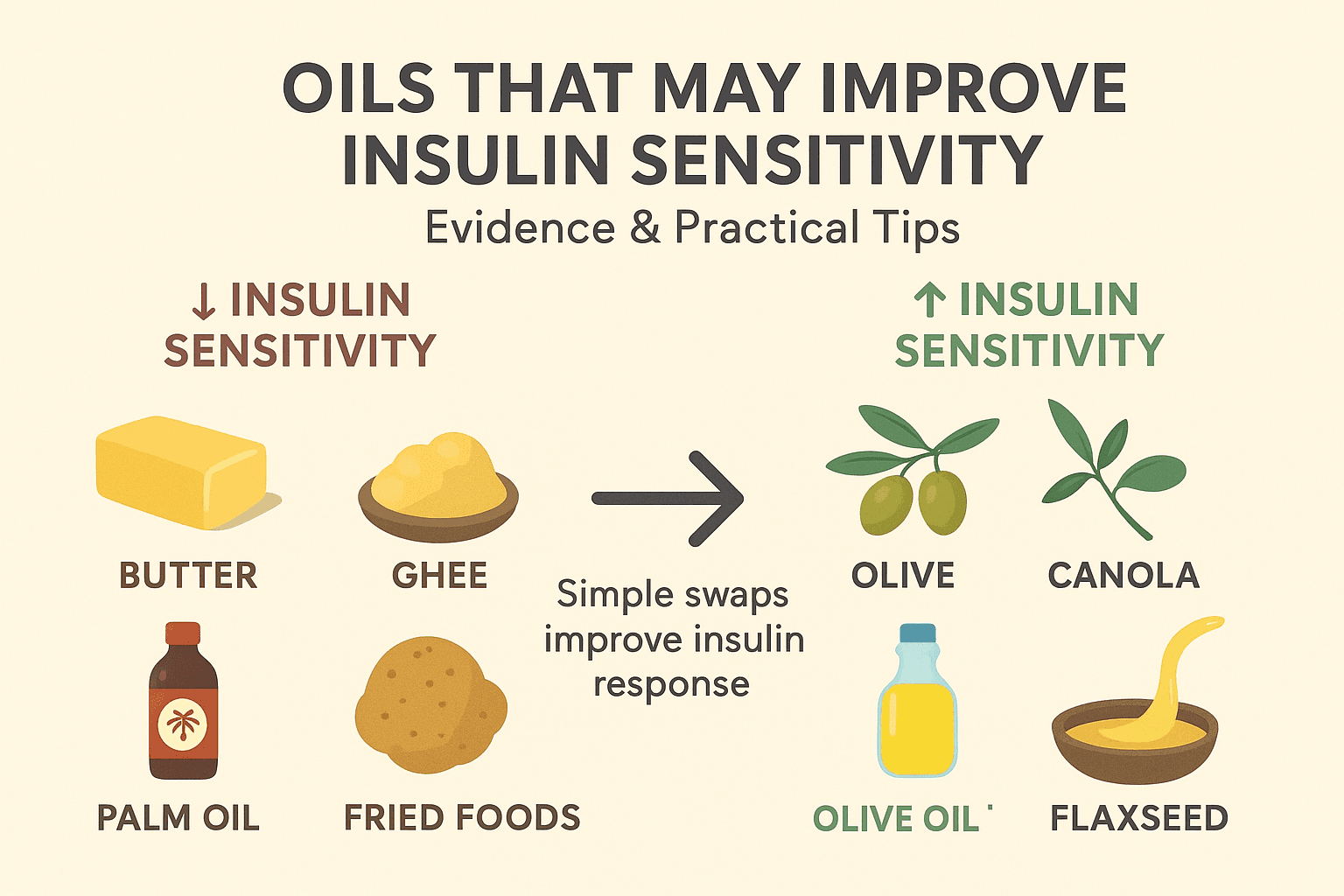
Industrial trans fats and excessive saturated fats (butter, ghee, palm oil) tend to worsen insulin signalling.
Likewise, repeatedly heated frying oils create oxidation products that promote inflammation.
Cooking Oils for Insulin Sensitivity: minimise these fats and choose unsaturated alternatives instead.
Table Oils to limit (High Saturated Oils, Industrial Fats):
| Oil Type/practice | Why Limit It | Practical Swap |
| Industrial trans fats | Raise inflammation and impair insulin action | Use high-oleic sunflower or refined canola |
| Butter/ghee/lard | High in saturated fat; linked to worse HOMA-IR | Use canola, avocado or EVOO |
| Palm oil (regular use) | High SFA; common in processed foods | Use high-oliec sunflower or refined canola |
| Reused frying oil | Produces oxidation products that harm metabolism | Avoid reuse; use fresh oil or air-fryer methods |
How is my work on oil’s insulin sensitivity mechanisms?
Cell membrane composition and insulin receptor function:
Fatty acids are part of cell membranes, thereby altering membrane fluidity.
When MUFA/PUFA dominate, membranes remain more flexible; as a result, insulin receptors move more freely and signal better—conversely, saturated fats Stiffen membranes and blunt receptor responses.
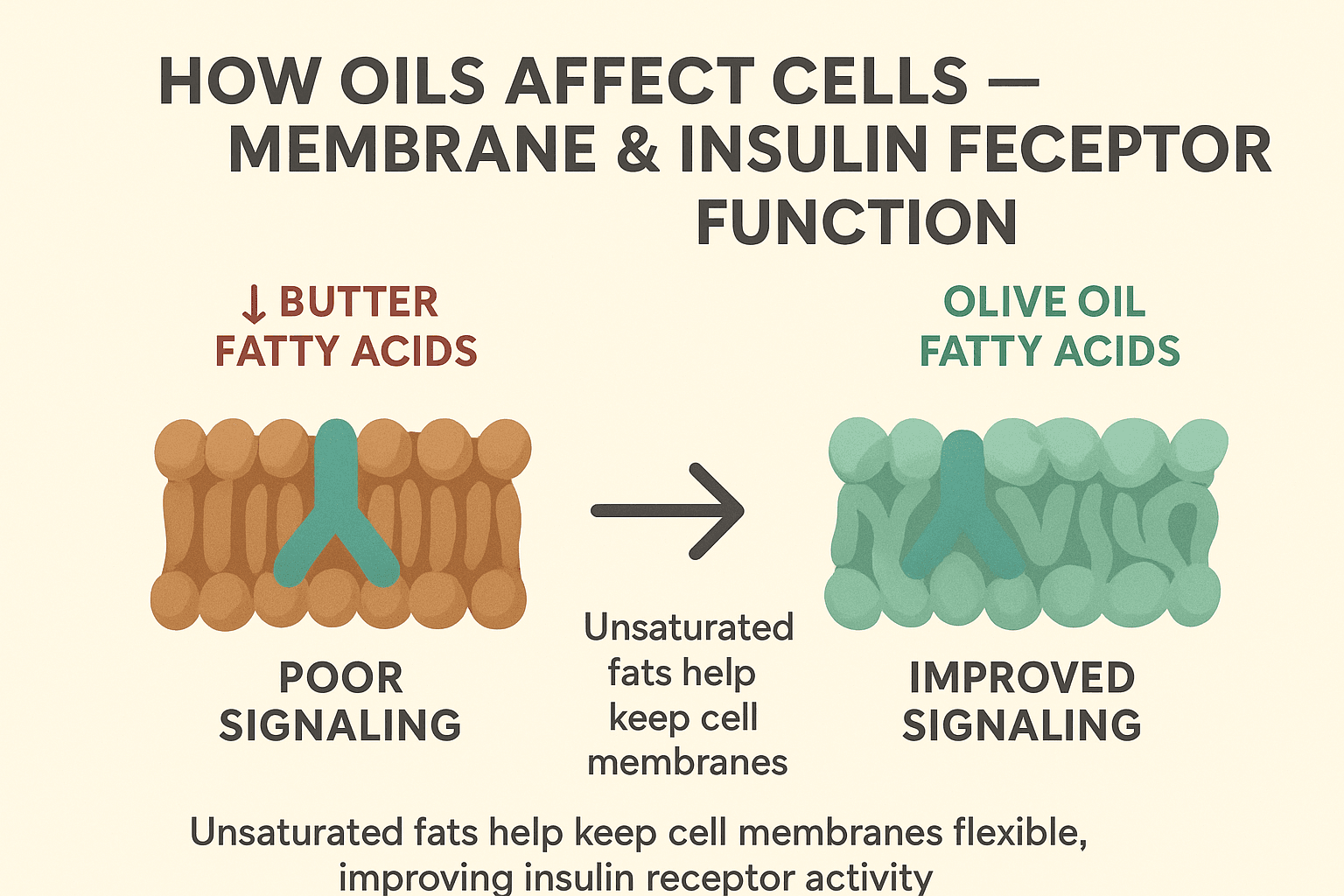
Therefore, improving the fatty acid metabolism in membranes directly supports insulin signalling and glucose uptake.
Table: cell membrane composition and insulin receptor functions:
| Mechanism | MUFA/PUFA dominant | SFA/trans dominant |
| Membrane fluidity | Increased receptors move freely | Reduce receptors less responsive |
| Insulin receptor signalling | Enhances phosphorylation/ action | Impairing signalling cascade |
| Inflammation | Lower membrane-derived inflammation | Higher pro inflammatory mediators |
Beyond membrane effects, unsaturated fats also reduce chronic inflammation and improve liver fat handling, both of which matter for whole-body insulin sensitivity.
Practical tips: How to use Oils to support insulin sensitivity. Oils’ insulin sensitivity: practical tips
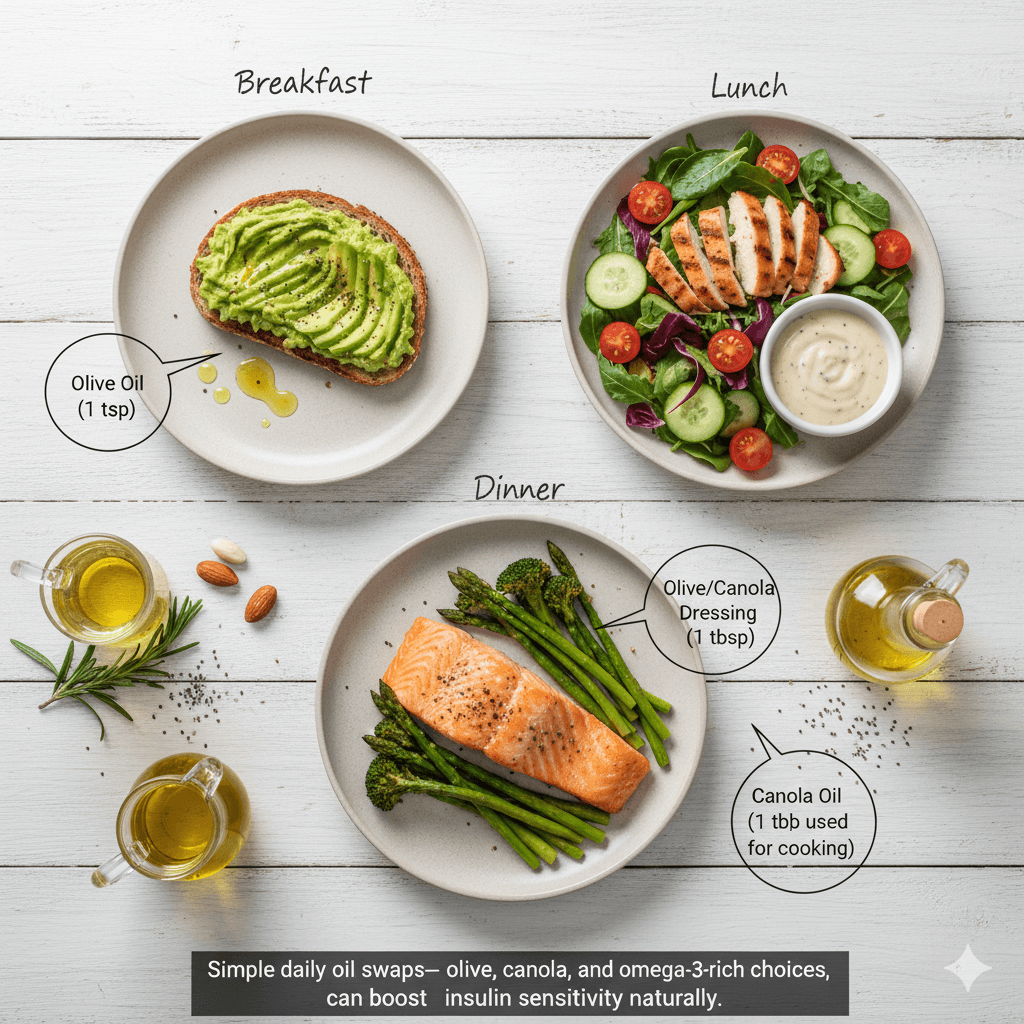
- First, replace saturated fats rather than merely adding new oils. Second, use EVOO cold or at low heat, and choose refined, high-oleic oils for high-temperature cooking.—third pear oil with fibre and protein to blunt post-meal glucose spikes. Fourth, mind that oil portions are calorie-dense, so measure rather than pour. Finally, adopt these swaps as part of an overall healthy pattern; They work best with weight control and regular activity.
Suggested servings and swaps oils insulin sensitivity: Servings.
Breakfast, lunch, dinner with recommended oils and portions:
Table breakfast, lunch, dinner, recommended oils, and portions.
| Meal | Example | Recommended oil & portion | Swap suggestion |
| Breakfast | Avocado toast or omelette | 1 tsp EVOO 1 tsp avocado oil | Replace butter or margarine |
| Lunch | Salad with fish/chicken | 1 tbsp EVOO dressing (vinegar + EVOO) | Replace creamy dressings |
| Snack | Yogurt + chia | 1 tbsp canola/high-oleic oil for sauté | Add an omega-3 source vs a processed snack |
| Dinner | Grilled fish + veg | 2 servings of fatty fish | Replace ghee/butter |
| Weekly | 2 servings fatty fish | Use EVOO to finish cooked dishes | Replace fried fish with grilled |
Recent research and clinical trials on insulin sensitivity:
Canola versus Olive Oil randomised trial in people with type 2 diabetes:
A randomised trial compared canola oil and extra virgin olive oil in adults with type 2 diabetes who replaced their usual cooking fats for several weeks.
The primary outcome focused on insulin resistance, HOMA-IR, and blood lipids. Results showed that canola users experience meaningful reductions in HOMA-IR & triglycerides compared with baseline, suggesting that the PUFA/MUFA balance in canola offered clinical benefits in this at-risk group.
In short, swapping saturated fats for canola or EVOO helped improve insulin markers when people adhered to the switch.
Practical Takeaway:
- For people with metabolic syndrome, substituting canola oil or EVOO for butter or ghee often reduces HOMA-IR within weeks to months.
- Omega-3 supplementation meta-analysis showing HOMA-IR improvement H3
- A recent systematic review pooled trials of long-chain omega-3 EPA/DHA supplements and tracked insulin resistance outcomes.
- Across studies, supplements produce a modest but significant reduction in HOMA-IR and fasting insulin, particularly in obese participants who begin with metabolic dysfunction.
- Notably, higher doses and longer trials delivered more apparent effects, suggesting that both dose and duration matter for clinical benefit.
Practical Takeaway:
- Add fatty fish twice weekly or consider clinically guided omega-3 supplements for people with elevated insulin resistance; Expected modest gains that stack with diet and activity change.
- Evidence caveats who benefit most from oils and insulin sensitivity: caveats (H2)
- People with obesity, metabolic syndrome, or type 2 diabetes tend to show the most significant improvements in trials.
- Healthy adults often show minor changes. Also, many studies combined oil swaps with broader diet shifts; therefore, oils were best as part of an overall healthy pattern.
- Finally, individual responses vary, so monitor biomarkers with Anna, as needed, and with a clinician.
Takeaway Oils Insulin Sensitivity: Final Recommendations:
To sum up, prioritise and saturated oils, especially EVOO, canola/high MUFA blends, and omega-3 sources while minimising trans fats and excessive saturated fats.
Replace rather than add; control portions; pair oils with fibre and protein; and pair these swaps with weight management and physical activity.
Is stored with one slap this week (for example, use EVOO instead of butter at breakfast) and build from there: small, consistent changes add up.
Disclaimer: The content on this website is for general informational and educational purposes only. It is not intended to provide medical advice, diagnosis, or treatment. Always consult a qualified healthcare professional, doctor, or dietitian before making any changes to your diet, exercise routine, or lifestyle. Reliance on any information provided on this site is solely at your own risk.
FAQ:
- Will switching oils alone reverse insulin resistance?
No, while replacing saturated trans fats with EVOO, canola, or omega-3 sources can improve insulin markers, oil swaps work best alongside weight loss, regular exercise, and with Anna’s fibre-rich diet.
In short, oils help, but they don’t act alone.
- Which single oil should I choose if I can only pick one?
Jews’ extra virgin olive oil (EVOO) for everyday use (salads, finishing, low heat cooking) because it combines MUFA with antioxidants.
However, rotating with canola or high-oleic oils for higher-heat cooking and including fatty fish (omega-3) twice weekly provides broader benefits.
- How much oil should I use per day to help with insulin sensitivity?
Aim for control portions roughly 2-3 tablespoons (30 to 45 ml) of added oil per day, adjusted to your calorie needs. Measure rather than pour, and pair oils with fibre and protein to blunt blood sugar spikes.
- Is it safe to cook with olive oil at high temperatures?
Use EVOO dressings, dressing, and low-heat cooking. For high-temperature frying, prefer refined high-oleic oils (such as canola or high-oleic sunflower) because they withstand higher temperatures better.
Also, avoid repeatedly reusing frying oil to limit the formation of oxidation products that harm metabolism.


Leave a Comment