


Introduction to Bleaching Process in Oils:
Bleaching Process in oils, Bleaching Earth/Fuller Earth/Clay
Bleachability>70% (Neutral canola)
Moisture<10%
The bleaching process in edible oil follows the water washing and vacuum drying. This is a physical process in which impurities in the oil, such as phospholipids, trace metals, color bodies, and oil decomposition products, are removed using an adsorbent.
The impurities and the active sites on the adsorbent are attracted to each other by van der Waals forces.

The amount of attraction depends on several factors, such as:
- The amount of electrostatic force on each of the impurities and the adsorbent.
- The size of each of the components.
- The distance between them or the degree of intimate mixing between the oil and the adsorbent.
- Porosity of the adsorbent particles.
- Additionally, the absorbent’s specific surface refers to its surface area per unit volume.
What is bleaching Earth in the Bleaching Process in oils?
In earlier days, the term Bleaching Process in oils and fats meant adding bentonite to the oil, stirring it for some time until the oil reached the desired color, and then filtering the bentonite out of the oil.
The primary concern in those days was the color of the oil. Later, the red color in soybean and cottonseed oils became important, and the oils were bleached to achieve the desired red hue.
Around this time, oil processors began to notice the green color in refined oil, especially in soybean oil and, in some instances, in cottonseed and sunflower oil.
Moreover, the chlorophyll gives the oil its green color, with two main types,
Chlorophyll A
Chlorophyll B
To address this, the Bleaching Process in the oil and clay industries developed acid-activated clay to lower chlorophyll levels in the oil.
Effectiveness of theacid-activatedd
The effectiveness of the acid-activated clay has improved over the years.
The vegetable oil industry also learned that the carotenoids present in the oil, which contribute to the refined oil, can be heat-bleached in the final step of oil refining.
Refining the deodorization process.
Therefore, the oil refiners began to ensure that the soybean oil was reduced to the desired level, and allowed the remaining higher in the refined oil to be removed by heat bleaching during the deodorization process.
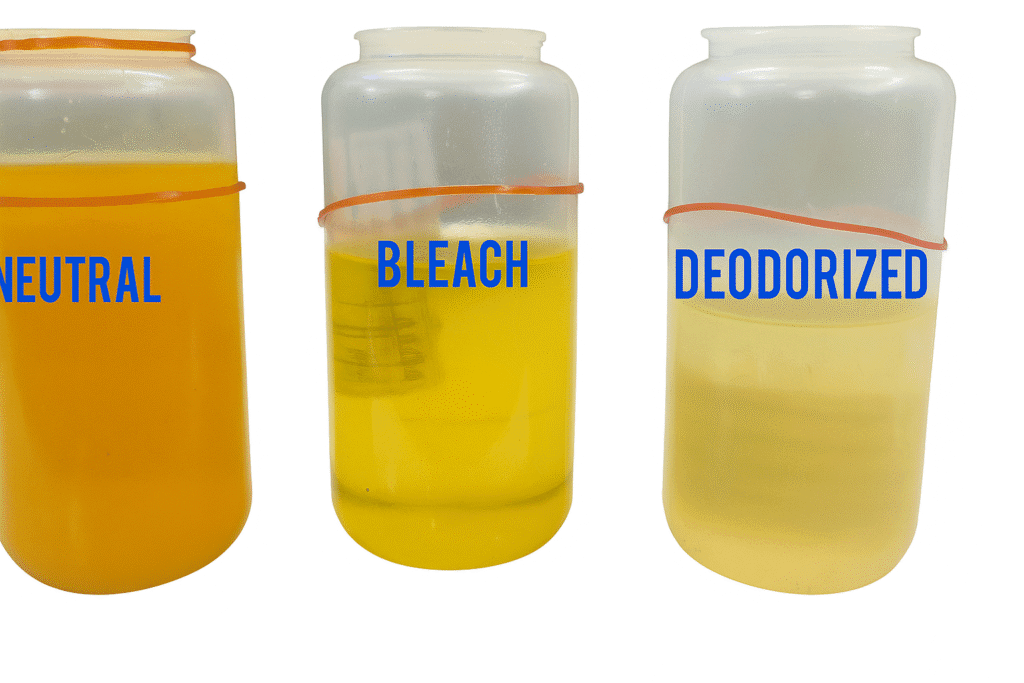
Extra Usage of Fuller Earth in the Bleaching Process of oils:
Bleaching Process in edible oil. The oil refiners also discovered that using an excess of bleaching clay to reduce the red color was not only unnecessary but also harmful to the oil, as it reduced its storage stability.
Furthermore, in the field of advanced analytical techniques, researchers began companies in bleaching clay manufacturing and oil processing, and USDA Research uncovered the true meaning of the phrase “bleaching vegetable oils.”
They learned that bleaching the oil reduces many impurities that are detrimental to its stability.
Today, bleaching is understood not only to make the oil appear lighter in color but also to improve its stability.
Practical Application in the QC lab:
Sample: Crude Canola beach with fuller’s Earth and fuller’s Earthed carbon.
Sam 1 (2% Fuller earth):
Sampl 2 (2%, FE/AC 90/10):
Sample 3(2%, FE/AC,95/5).
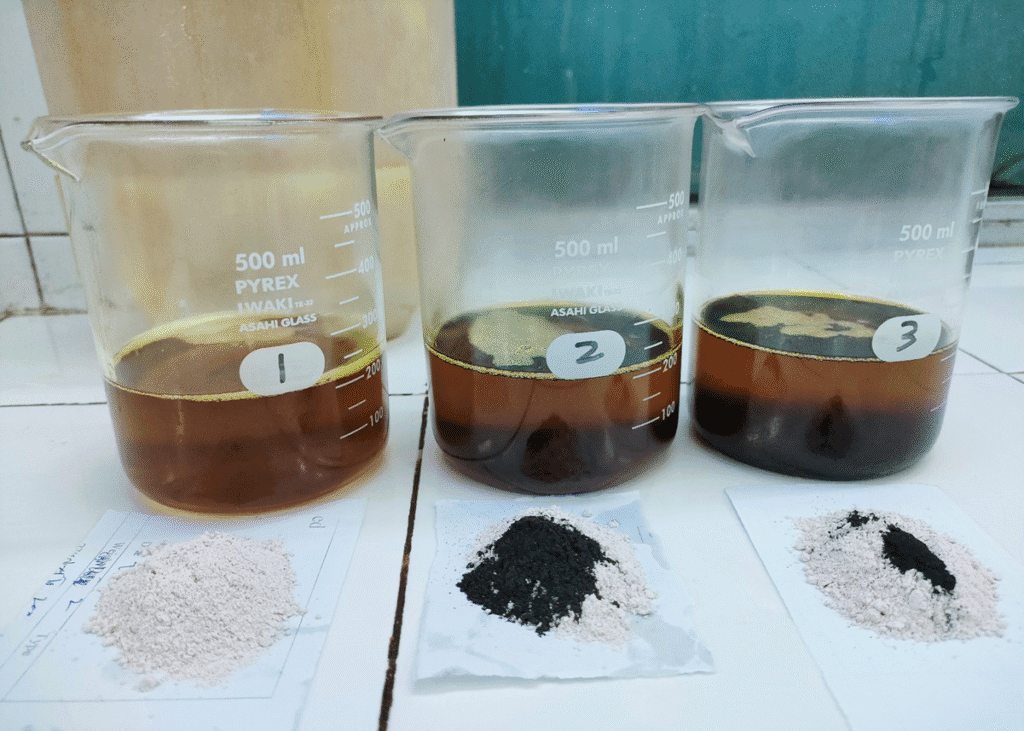
1A (2% Fuller earth):
Sample 2A (2%, FE/AC 90/10): Sample 3A (2%, FE/AC 95/5).
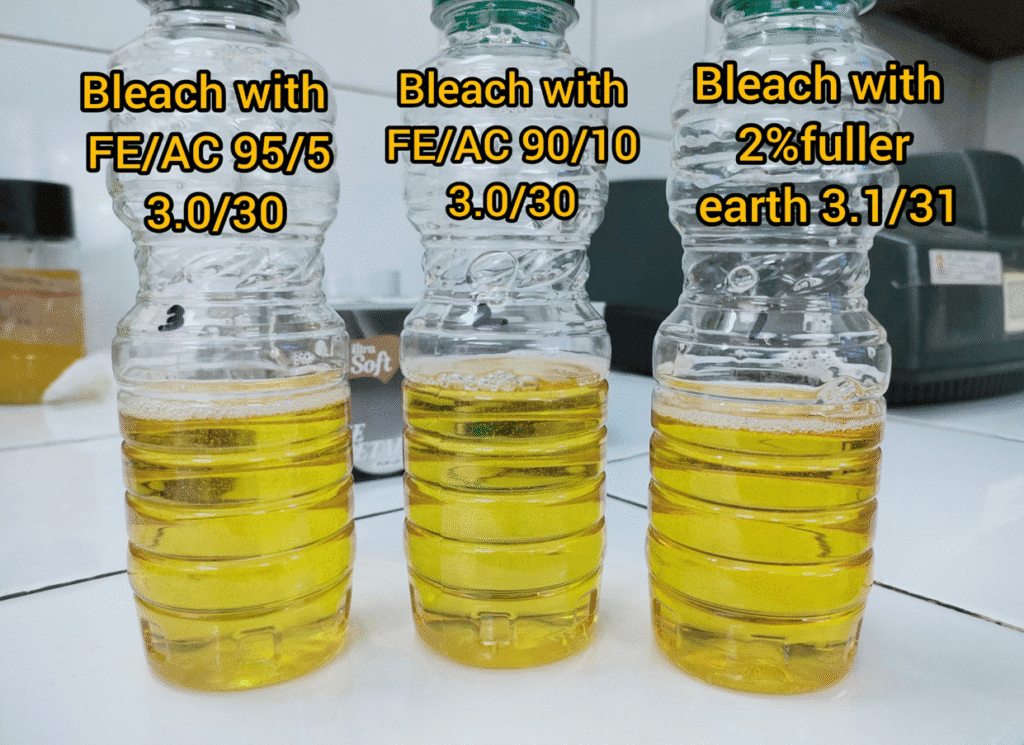
Color (Lovibond) sample 1 Sample 2 Sample 3
Manual 2.6/26.0 2.5/25 2.5/25
Digital 3.1/31 3.0/30.0 3.0/30.0
Bleaching performs the following beneficial functions:
Reduces the chlorophyll:
1. Bleaching Process in oils reduces the chlorophyll and some of the other color bodies present in the oil. High chlorophyll levels in the oil are undesirable for appearance and photooxidative stability.
Reduces trace metals:
2. Bleaching Process in oils reduces trace metals such as calcium (Ca++), magnesium (Mg++), iron (Fe+++), sodium (Na+), etc.
Reduces the level of non-hydratable phospholipids:
3. Bleaching Process in edible oil reduces the level of non-hydratable phospholipids in the refined oil.
Removes decomposition products:
4. Removes decomposition products, such as aldehydes, ketones, polymers, non-triglycerides produced for oil oxidation, etc.
Loses some of its Natural antioxidants:
The researchers found that the oil loses some of its natural antioxidants in the bleaching step. This factor becomes particularly significant, mainly when technicians breach the oil.
1) Improperly,
2) Excessively,
3) Under atmospheric conditions. Besides the loss of antioxidants, the chlorophylls present in the oil undergo oxidation at acidic pH and in the presence of oxygen.
The decomposition products of the chlorophylls make the oil ten times more prone to photooxidation.
The oil processors need to take all the necessary steps to ensure proper bleaching of the refined oil.
General Operating Steps in Bleaching:
As discussed at the beginning of this article, the Bleach Process in edible oil is a physical process where the impurities in the oil are adsorbed by an adsorbent (bleaching clay, silica, activated carbon, etc.).
Through the physical force of attraction between the adsorbate and the adsorbent (impurities in oil). Effective adsorption and removal of the oil impurities.
Bleaching depends on the following factors:
1. Degree of intimate contact between the bleaching medium and the oil
2. Oil temperature
3. Time of contact.
The water-washed oil is treated with acid-activated clay at elevated temperature. Moreover, keep the process under a vacuum to protect the oil from oxidation.
The oil and the clay are brought into intimate contact through mechanical mixing. Some equipment manufacturers use steam agitation instead of mechanical mixing. In the author’s Judgment, mechanical mixing is a better option.
Bleaching Process:
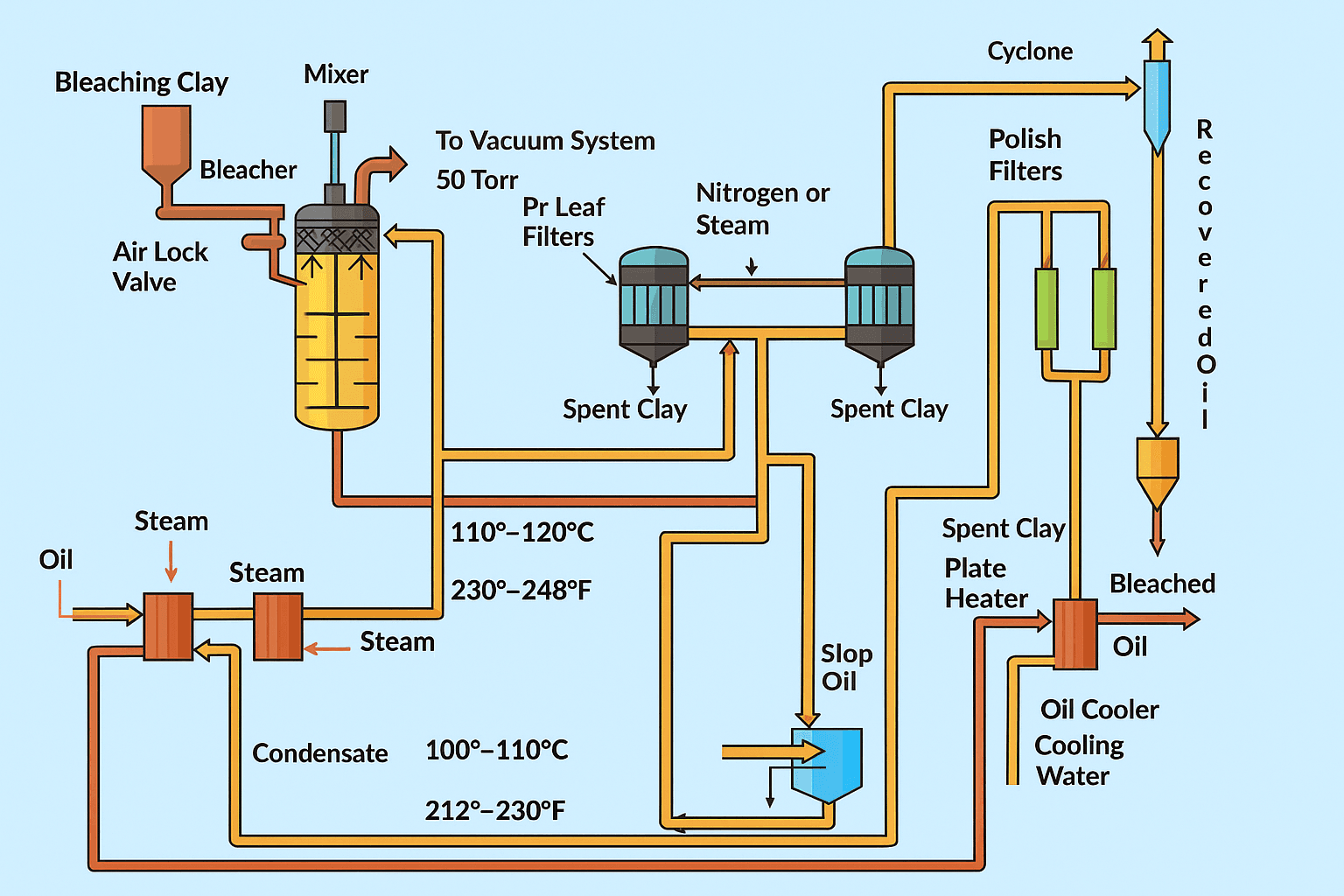
Additionally, the process keeps the oil and bleaching clay in contact for 30-45 minutes. In addition to the clay, a small amount of citric or phosphoric acid is added to the oil, which improves the removal of trace metals.
Many modern refineries use silica pretreatment followed by bleaching clay treatment. This procedure appears to be highly effective at removing trace metals and phospholipids from the oil.
The Bleaching Process in oils, bleached oil is filtered through leaf filters with stainless steel mesh screens, cooled, and stored.
Alternatively, the oil is sent directly to the following processing step, such as hydrogenation, winterization, or deodorization.
Vacuum Bleachers:
Today, all modern plants include a vacuum bleacher as a standard feature. Moreover, the system operates in either batch or continuous mode.
The results from the batch or continuous bleacher are similar. Many older installations are still using an atmospheric bleaching process.
Traditionally, the bleach process in edible oil used water-washed, vacuum-dried oil as feed for the vacuum bleacher, with the operator adding only bleaching clay, which could be either acid-activated or neutral.
Acid-activated clay is more effective at removing color bodies and trace metals from the oil, as discussed earlier.
The neutral clay is gentle on oils and is used to treat animal fats and oils processed under the “Organic” label.
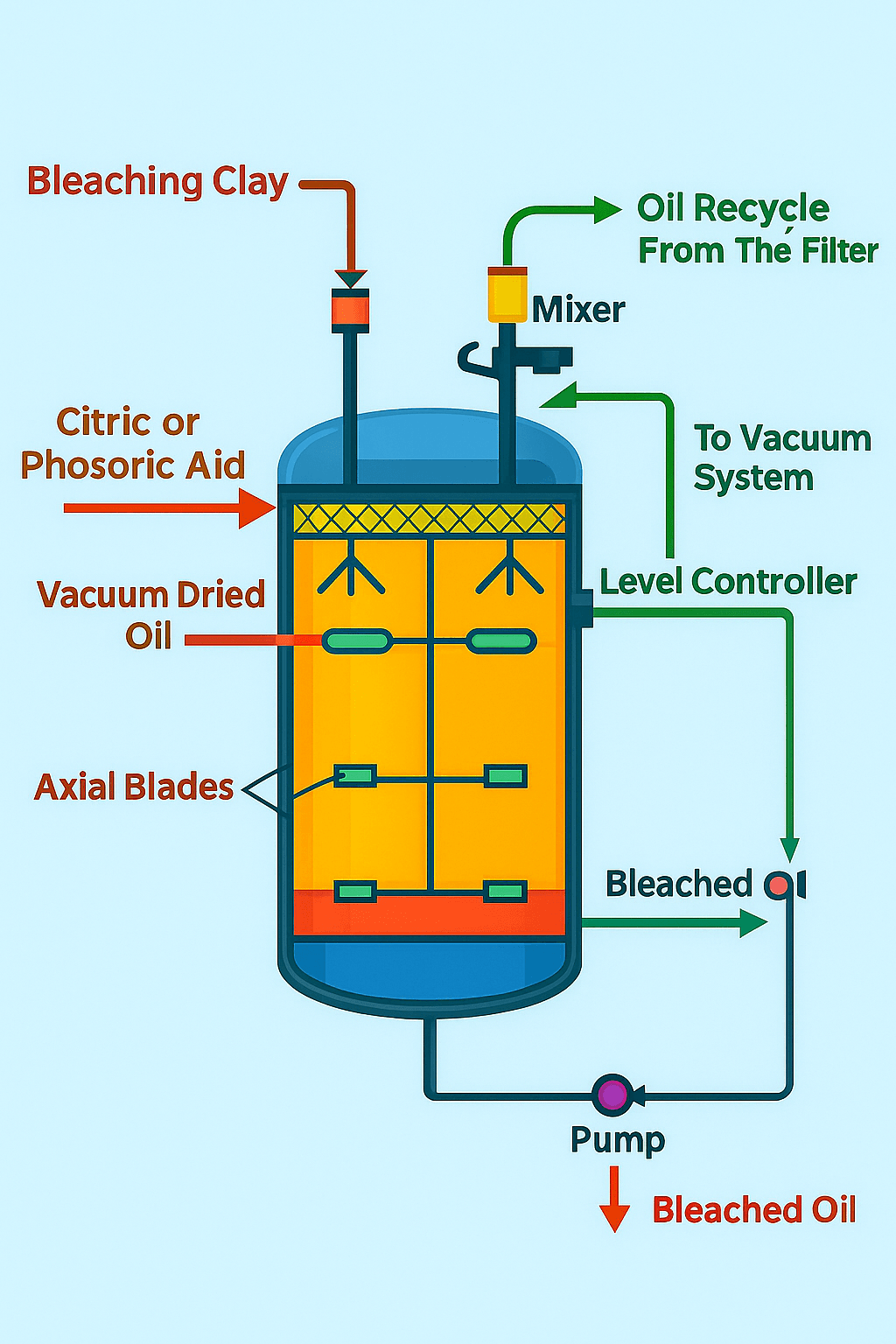
The step-by-step procedure for the dry bleaching process is outlined below:
- First, the water-washed and vacuum-dried oil is pumped through a plate-and-frame heat exchanger, where heat from the outgoing bleached oil is recovered.
- Then, the oil passes through a plate-and-frame heater, where it is heated to 100–110°C (212–230°F).
- The oil is then introduced into the vacuum bleacher through a distributor with spray nozzles.
- Furthermore, operators keep the absolute pressure in the vacuum bleacher below 50mm of mercury.
- Meanwhile, operators maintain the oil temperature between 100 and 115.
- After that, the top-entry agitator operates at high speed (typically 120 RPM).
- Typically, operators add acid-activated clay, usually 0.5% or less of the oil, directly into the bleacher.
- Clay usage can be higher for oils produced from poor-quality crude, such as naturally darker-colored oils like cottonseed oil or palm oil.
- Next, the operator maintains contact between oil and clay for about 30-45 minutes.
- Then, after, the oil is filtered through a pressure leaf filter, which is normally pre-coated with diatomaceous clay.
- After that, the filter screens are pre-coated with diatomaceous Earth.
- After that, the filtered oil is recycled back into the bleacher until the oil is clear, as determined by a filter test.
- Then, the process sends the oil through a polishing filter, followed by a plate-and-frame heat exchanger to preheat the incoming oil.
Cooling Filtrations & Drying:
- First, the water-washed and vacuum-dried oil is pumped through a plate-and-frame heat exchanger, where heat from the outgoing bleached oil is recovered.
- Then, the oil passes through a plate-and-frame heater, where it is heated to 100–110°C (212–230°F).
- The oil is then introduced into the vacuum bleacher through a distributor with spray nozzles.
- Furthermore, operators keep the absolute pressure in the vacuum bleacher below 50mm of mercury.
- Meanwhile, operators maintain the oil temperature between 100 and 115 °C.
- After that, the top-entry agitator operates at high speed (typically 120 RPM).
- Typically, operators add acid-activated clay, usually 0.5% or less of the oil, directly into the bleacher.
- Clay usage can be higher for oils produced from poor-quality crude, such as naturally darker-colored oils like cottonseed oil or palm oil.
- Next, the operator maintains contact between oil and clay for about 30-45 minutes.
- Then, the oil is filtered through a pressure leaf filter, which is normally pre-coated with diatomaceous clay.
- After that, the filter screens are pre-coated with diatomaceous Earth.
- After that, the filtered oil is recycled back into the bleacher until the oil is clear, as determined by a filter test.
- Then, the process sends the oil through a polishing filter, followed by a plate-and-frame heat exchanger to preheat the incoming oil.
Cake:
- Sometimes cake can remain on the screens after vibrating them. This happens more when the filter is not completely dry.
- It is recommended not to use any metal scrapers or plastic scrapers with rough edges. Additionally, always use a plastic scraper with a smooth, rounded tip and apply it gently to dislodge the cake from the screen surface.
- Nitrogen or steam blowing creates some oil mist at the end of the oil drain step. The oil mist and droplets pass through a cyclone or other separation device, where the oil is separated from the gas.
Next, the system collects oil from the recovery oil tank, transfers it to the slop oil tank, and processes it.

Comments are closed.