


Chemical Refining Process Oil:
Firstly, processors worldwide commonly use chemical refining processes for oil, especially seed oils.
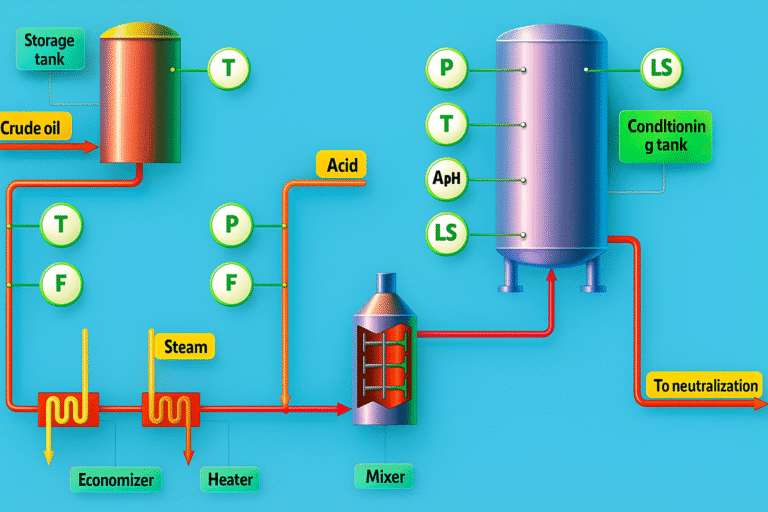
First, the crude oil undergoes pretreatment with phosphoric acid, followed by neutralisation with an alkaline sodium hydroxide solution.
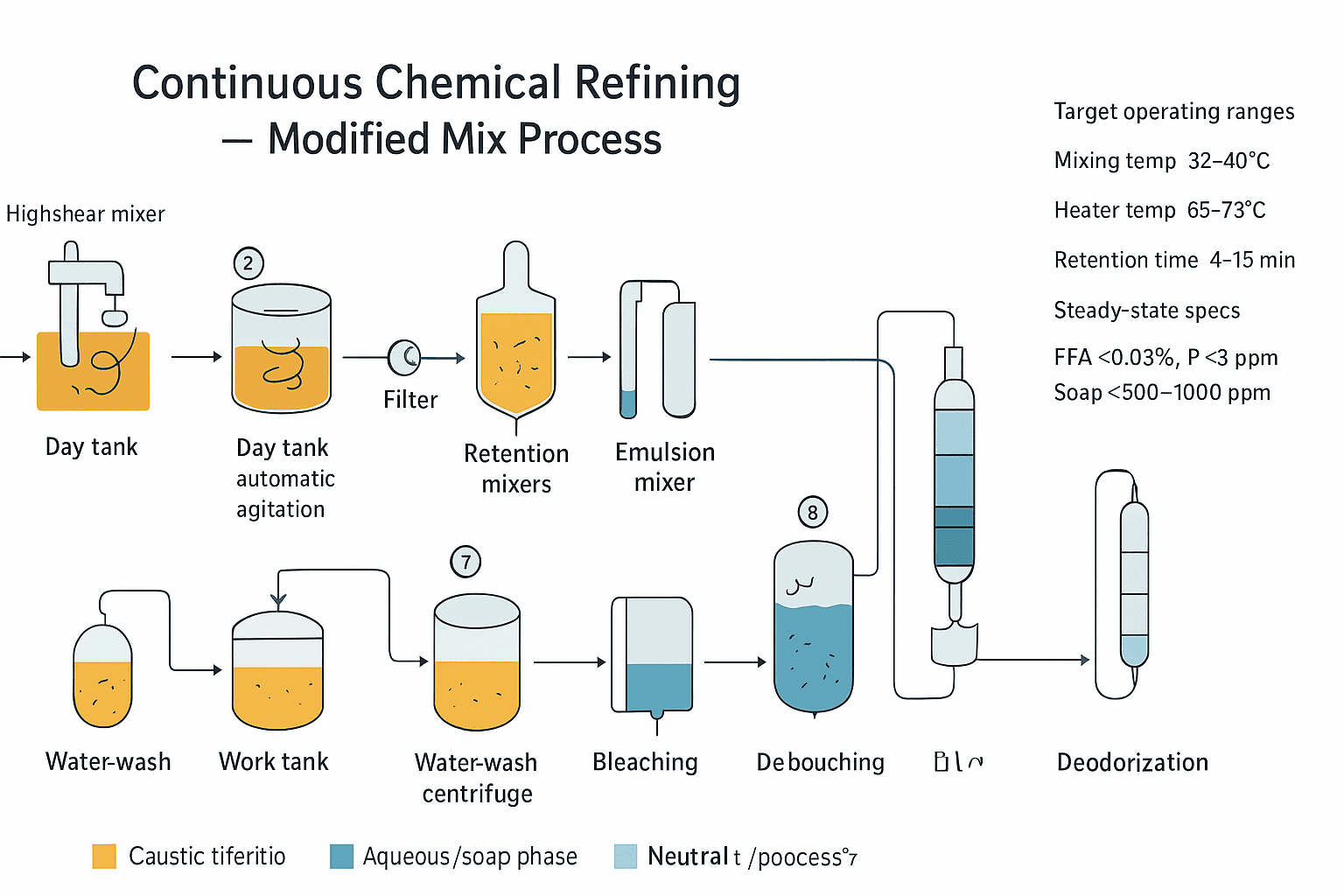
As sodium hydroxide reacts with the FFA in the crude oil, it produces soap, which is then separated from the refined oil in a primary refining centrifuge.
Afterwards, the remaining soap is removed from the oil by water washing, and the oil and water then separate in a water-washing centrifuge.
This System is particularly suitable for enriching the following Oils:
- Crude soybean oil
- Drummed soybean oil
- Drummed canola oil
- Crude as well as drummed sludge oil
- Crude as well as drummed cottonseed oil
- Crude sunflower oil
This system isn’t suitable for Palm oil or coconut oil, as mentioned before.
Both palm oil and coconut oil are low in phospholipids and don’t require chemical refining.
Still, the chemical refining process more effectively reduces trace elements and phosphorus in these oils; Moreover, it offers better control over final oil quality.
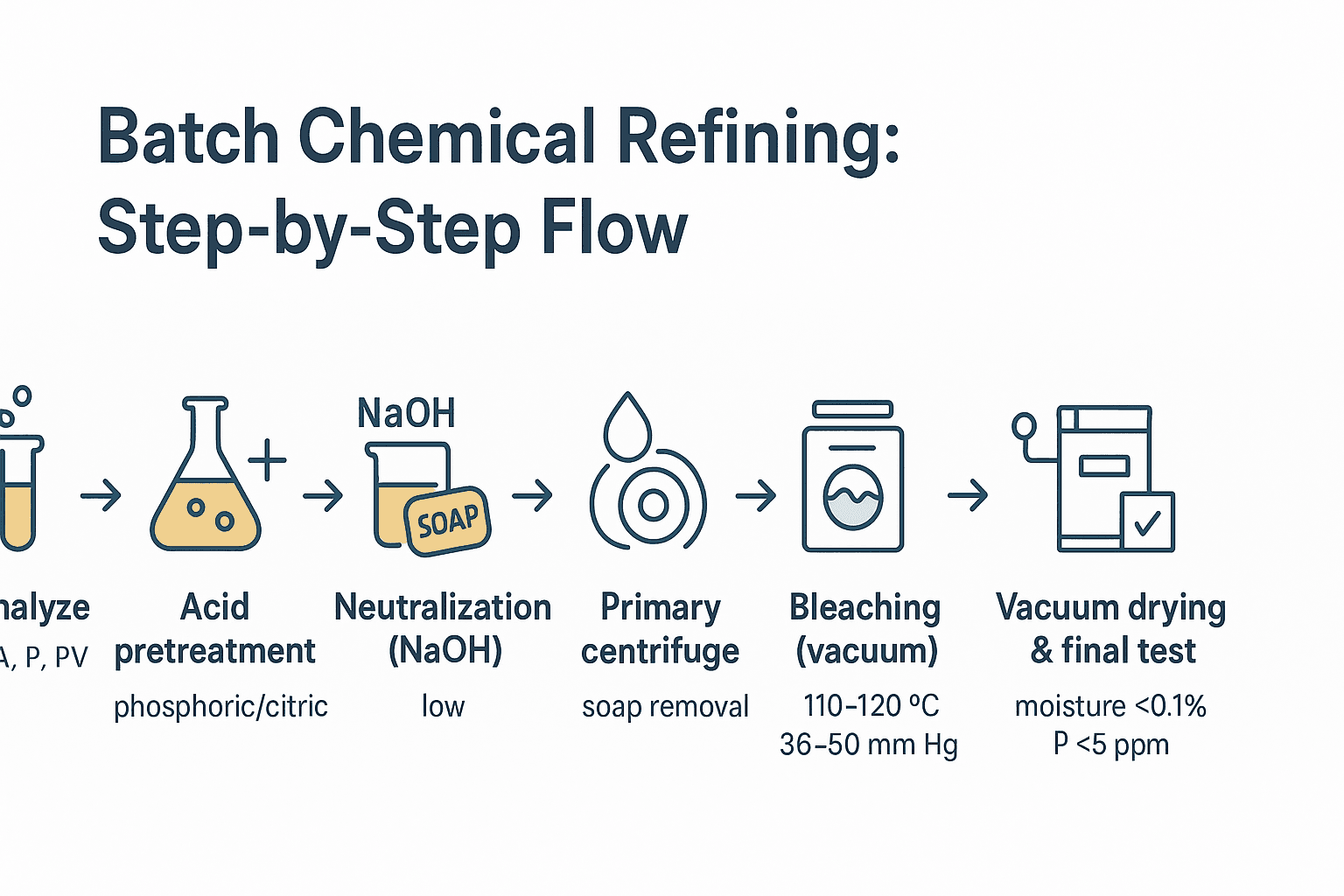
Batch Refining Process:
Chemical refining process in oil is the oldest system for chemically enriching vegetable Oils.
However, the system can produce high-quality oil but may contain higher levels of trace contaminants, such as phosphorus and trace elements, compared to the nonstop chemical refining process.
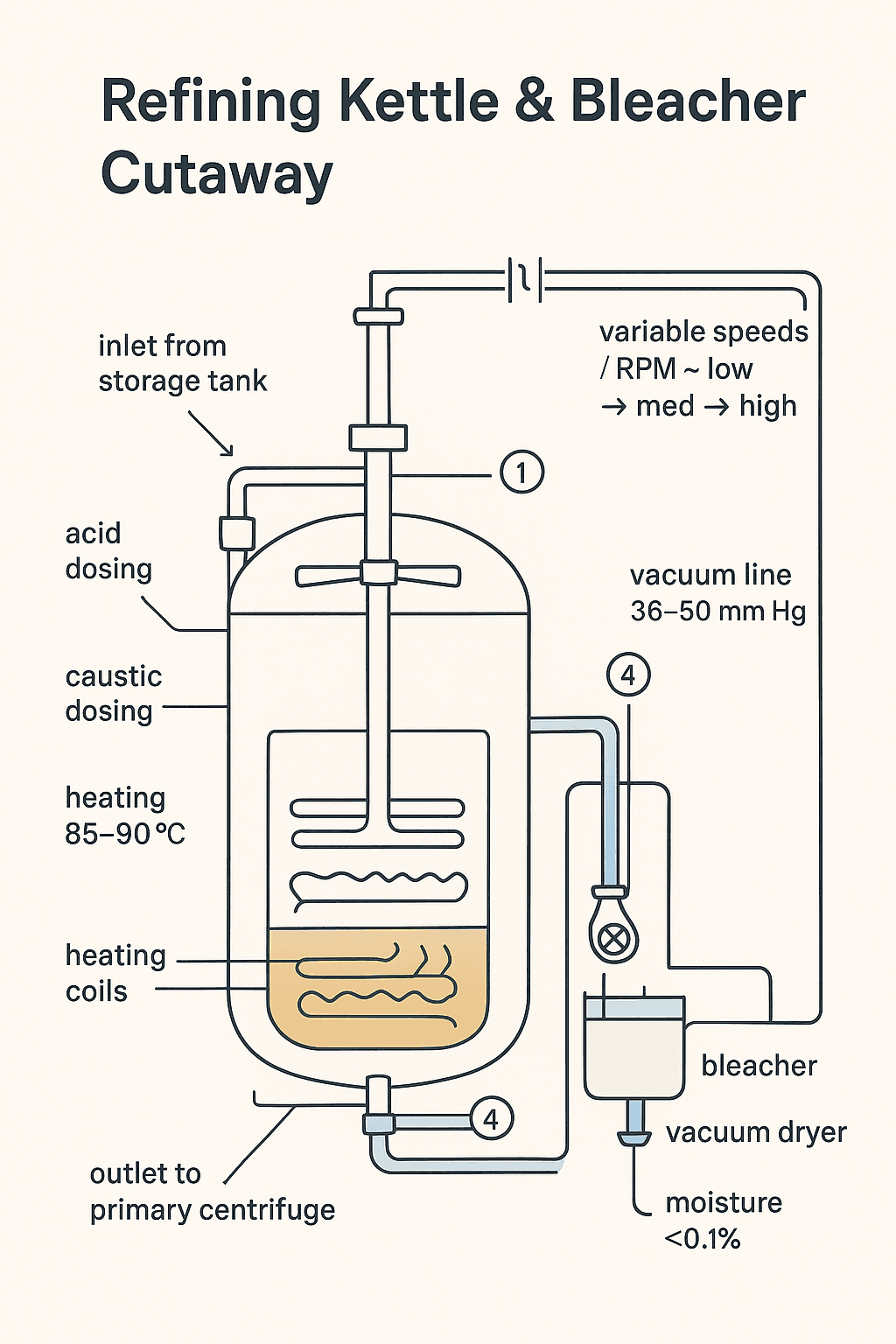
Figure 1 shows the schematic view of a batch reactor vessel. The vessel must be a pressure vessel if it is used for dulling.
In addition to refining and water washing.
The following section explains the step-by-step procedure for the batch refining process:
Crude Oil from a storage Tank
Crude oil from the storehouse tank is analysed for FFA, humidity, and contamination, refining loss, and lab bleach colour.
Overall, the refining loss system for crude oil depends on the crude type.
Lab bleach colour is a predictor of the glossed oil colour. Generally, after repeated use, the factory’s oil appears noticeably lighter than the lab-bleached sample.
Therefore, a darker colour than the lab-bleached colour in the factory-produced oil indicates process-related issues that should be investigated and corrected.
The measured amount of crude oil:
Collected in a refining kettle and equipped with a top-entering kinder with variable speed. Bumpers are used to help whirlpool conformation.
Acid-pretreatment of the crude oil:
This is veritably common in this process. Similarly, small demand shops usually use batch refining.
Acidulous strength
Caustic strength and the amount of caustic treated depend on and are discussed later under Caustic Strength under Continuous Caustic Refining.
The required amount of acidic solution is added to the oil. Acidulous results and the crude oil are mixed at low agitator speed to avoid emulsification.
The neutralisation temperature is 95–104°F (35–40°C) for seed canvases. (Palm oil or coconut oil tends to confuse this process.)
Check for the FFA in the oil at the end of the response. It should be 0.01–0.02, expressed as Oleic acid. Check the oil for phosphorus content as well. It should be <5 PPM.
Heating Of Oil:
First, the oil is heated to 185-195°F (85-90 °C), and then 15% hot water is added to the refined oil. Hard water makes it difficult to remove the cleaner from the refined oil.
The agitator speed is increased to facilitate intimate mixing between the refined oil and water, enhancing cleaner junking.
Next, the operator switches off the agitator and allows the soap in the oil to settle to the bottom of the tank.
Sample of Oil:
Collect a sample of oil from the top and analyse it for soap.
Still, drain the soap stock and rewash the oil if the soap is >1000 PPM.
The water-washing and soap-drainage process is continued until the content reaches 400 PPM. It will be seen later that the soap-in-water-washed oil from the nonstop process is generally 100 PPM.
The amount of soap in the water used to wash oil in a batch process could be reduced further by repeated water washing, but the oil loss would be extremely high.
The oil is also treated with 1–3 of acid-activated complexion(for nonstop acidulous refining, the typical complexion operation is< 1) and blanched under vacuum at 230–248 °F(110 °–120 °C).
Agitation & Chemical addition: chemical refining process oil
Chemical refining process in edible oils:
- First, the agitator speed is set at maximum (roughly 120 revolutions per minute, RPM).
- The operating pressure for vacuum bleaching is 36–50 mmHg. However, most batch-refining systems worldwide are old and use atmospheric bleaching.
- To achieve better de-aeration, the oil should be circulated through the pump at the bottom of the bleacher vessel and the distribution ring at the top.
- It is recommended to add 50–100 PPM of citric acid (or phosphoric acid) in addition to the bleaching. This helps chelate trace metals and reduce the oil’s phosphorus content. Some of the acid reacts with the soap in the oil, hydrolysing it.
Final Testing:
Chemical refining process in edible oils:
- The oil is analysed for bleached oil colour, phosphorus, soap, and chlorophyll. These analyses must be performed to confirm the quality of the bleached oil before it is filtered.
- The bleached oil can be sent directly to the hydrogenation plant; however, if it is sent, the oil must be dried in a vacuum dryer to a moisture content of <0.1% before deodorisation.
Critical Control Points in Batch Refining: chemical refining process oil.
| Troubleshooting Physical Refining Process | ||
| Symptom | Probable Cause/Causes | Recommended Solutions |
| Phosphorus >5PPM | Make sure the high shear The mixer is working properly | Check the crude oil for Phosphorus content and it must be <750 PPM. Increase acid treatment |
| Low Phosphoric acid dosage | Check for calcium and magnesium content and adjust the amount of acid | |
| Improper dispersion of phosphoric acid into the oil | Agitator in the contact residence The tank is not working properly | |
| Contact time between the oil and the acid might be short | Excessive contact between oil and air. Crude oil PV is high due to: 1. High PV in the incoming oil, 2. Crude oil has been stored for too long 3. Excessive aeration of the crude oil during unloading and storage | |
| Find the source of air that comes in contact with the oil and stop it. Do not use the atmospheric bleacher | Excessive contact between oil and air. Crude oil PV is high due to: 1. High PV in the incoming oil, 2. Crude oil has been stored for too long 3. Excessive aeration of the crude oil during unloading and storage | |
| Excessive contact between oil and air. Crude oil PV is high due to: 1. High PV in the incoming oil, 2. Crude oil has been stored for too long 3. Excessive aeration of the crude oil during unloading and storage | Contact time between the oil and the clay may not be adequate due to: 1. Short contact time 2. Poor mixing conditions | |
| Low bleaching temperature | Increase temperature | |
| Excessive contact between oil and air. Crude oil PV is high due to: 1. High PV in the incoming oil, 2. Crude oil has been stored for too long 3. Excessive aeration of the crude oil during unloading and storage | Find the source of air that comes in contact with the oil and stop it. Do not use the atmospheric bleacher. | |
Bleach Oil:
| Bleached oil is high in: Iron, Calcium Magnesium | Same reason as for high phosphorus | Correcting the phosphorus issue generally resolves the high trace metal issue |
| In freshly bleached oil: PV>0 as sent to the storage tank | Poor vacuum | Increase vacuum |
| Excessive contact between oil and air | Find the source of air and eliminate it, 1. Be vigilant about the crude oil PV, 2. Reduce storage time, 3. Use bottom loading for the crude oil storage tanks | |
| Bleached oil not cooled | Cool the oil to <40°C | |
| pAV>4.0 | Poor vacuum | Increase vacuum |
| Excessive contact between oil and air. Crude oil PV is high due to: 1. High PV in the incoming oil, 2. Crude oil has been stored for too long 3. Excessive aeration of the crude oil during unloading and storage | Excessive contact between oil and air. Crude oil PV is high due to: 1. High PV in the incoming oil, 2. Crude oil has been stored for too long 3. Excessive aeration of the crude oil during unloading and storage |
CCP:
Several critical control points for the batch refining process are analogous to those in the nonstop acidulous refining process. You can see the alternative points of departure below.
Agitator Speed & Bleaching complexion: chemical refining process oil
Firstly, the agitator must be operated at three speeds: low for neutralisation, medium for water washing, and high for bleaching.
Then, the process requires a much more advanced lozenge of dulling complexion compared to the continuous acidulous refining process.
This is because the refined, water-washed oil contains high levels of a cleaning agent. Phospholipids help reduce some of the bleaching effect, so not all of the added complexion is effective at dulling the oil.
Later, in this chapter, the section on nonstop chemical refining will discuss this aspect in more detail and clarify its practical implications.
Refining Loss: Refining loss in the batch process is significantly higher than in the nonstop chemical refining process.

Comments are closed.