


The Critical Control Points Deodorization of Edible Oils:
The Deodorization of edible Oils has the following CCP points.
Incoming Oil Quality:
- Incoming oil quality.
- Deaeration.
- Heating the oil for deodorization.
- Operating pressure (vacuum).
- Operating temperature.
- Amount of steam.
- Batch size or oil flow rate.
- Citric acid addition.
- Cooling the deodorized oil before storage.
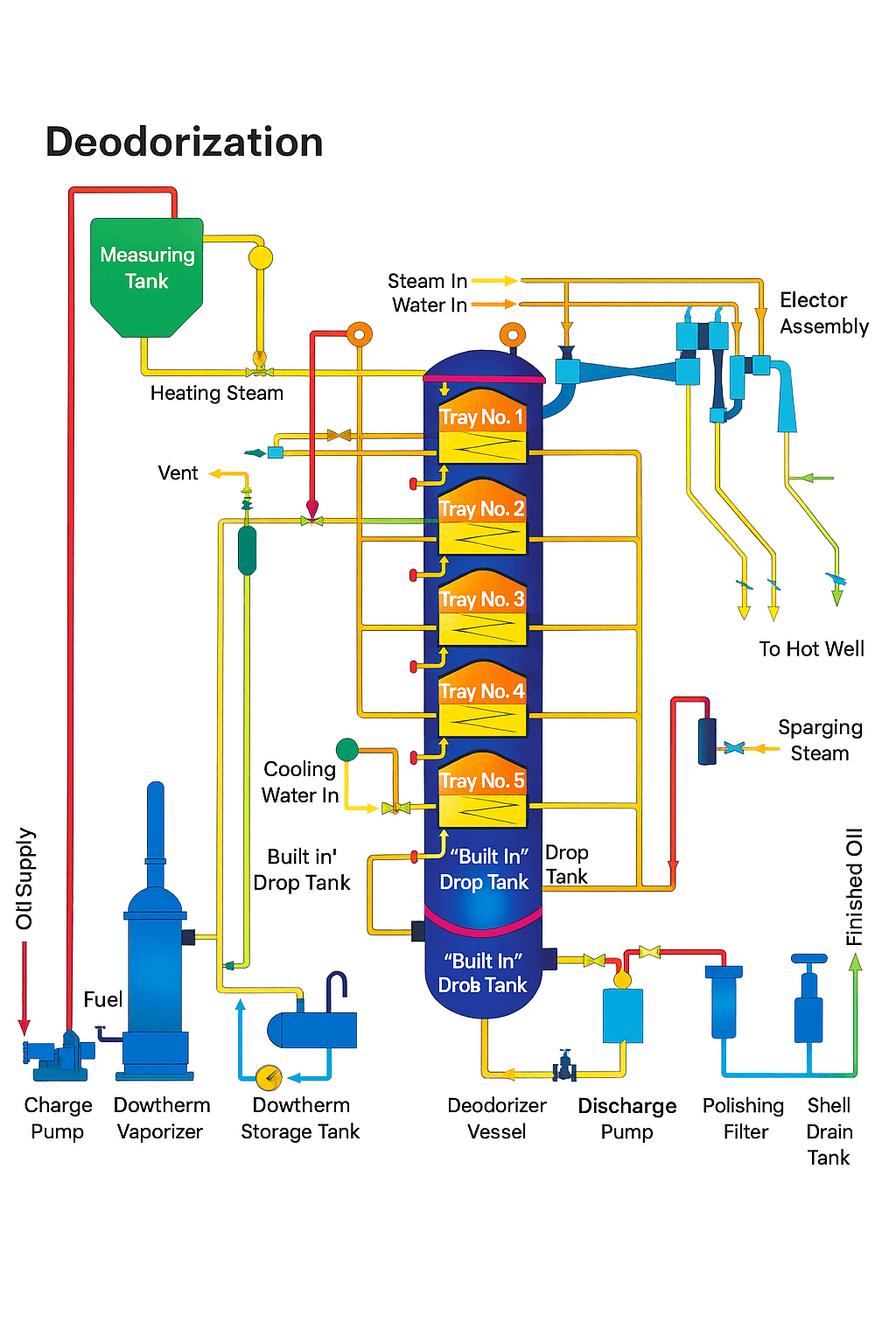
Incoming Oil Quality for Deodorization of Edible Oils:
For the Deodorization of edible oils, the Deodorizer must process the oil under standard operating conditions and deliver high-quality products.
Feed oil quality plays a significant role in determining the performance of the deodorization of edible oils.
Feed oil (RB) quality to the deodorizer varies in terms of FFA and Lovibond color, depending on the type of oil, but they all must be low in certain trace impurities without exception.
Such as:
Oil Quality:
For the Deodorization of edible oils, the oil quality should follow.
- Phosphorus (in seed oils) <1 PPM
- Chlorophyll <30 PPB
- Iron <0.5 PPM
- Calcium <0.2 PPM
- Magnesium <0.2 PPM
- Nickel (from hydrogenation) Trace.
Palm oil or palm olein will not be able to meet the above standards on phosphorus on
regular basis because the oil is normally refined by physical refining process and the typical phosphorus in the refined oil is 3 PPM and can be higher.
Chlorophyll Reduction:
However, it is essential to note that, for the Deodorization of edible oils, the deodorizer does not reduce chlorophyll.
Therefore, if the feed to the deodorizer is high in chlorophyll, the deodorized oil will remain green.
Phosphorus cannot be reduced in the deodorizer either. However, another issue with the deodorizer feed concerns high phosphorus levels.
Hydrolysis Reaction:
This involves the following phenomena:
Some hydrolysis of the oil occurs during deodorization.
The FFA produced in the oil by the stripping steam is removed immediately, along with the FFA in the incoming oil. This is why deodorized oil always has a low FFA content.
However, if the phosphorus, which is part of the natural emulsifier, is present in high amounts in the oil, some additional hydrolysis occurs, and the FFA is deodorized.
Oil can reach a higher-than-normal equilibrium value seen at lower phosphorus levels in the RB oil.
Phosphorus & FFA:
This phenomenon has been observed during the deodorization of edible oils such as corn or cottonseed oil with high phosphorus content, where the deodorizer could not reduce the FFA below 0.07% (the standard is 0.03–0.05%).
Some similar experiences have been reported by oil processors handling palm oil, sunflower oil, and soybean oil.
High phosphorus content of the oil is most likely the driver in those cases.
Deodorizer Vacuum System:
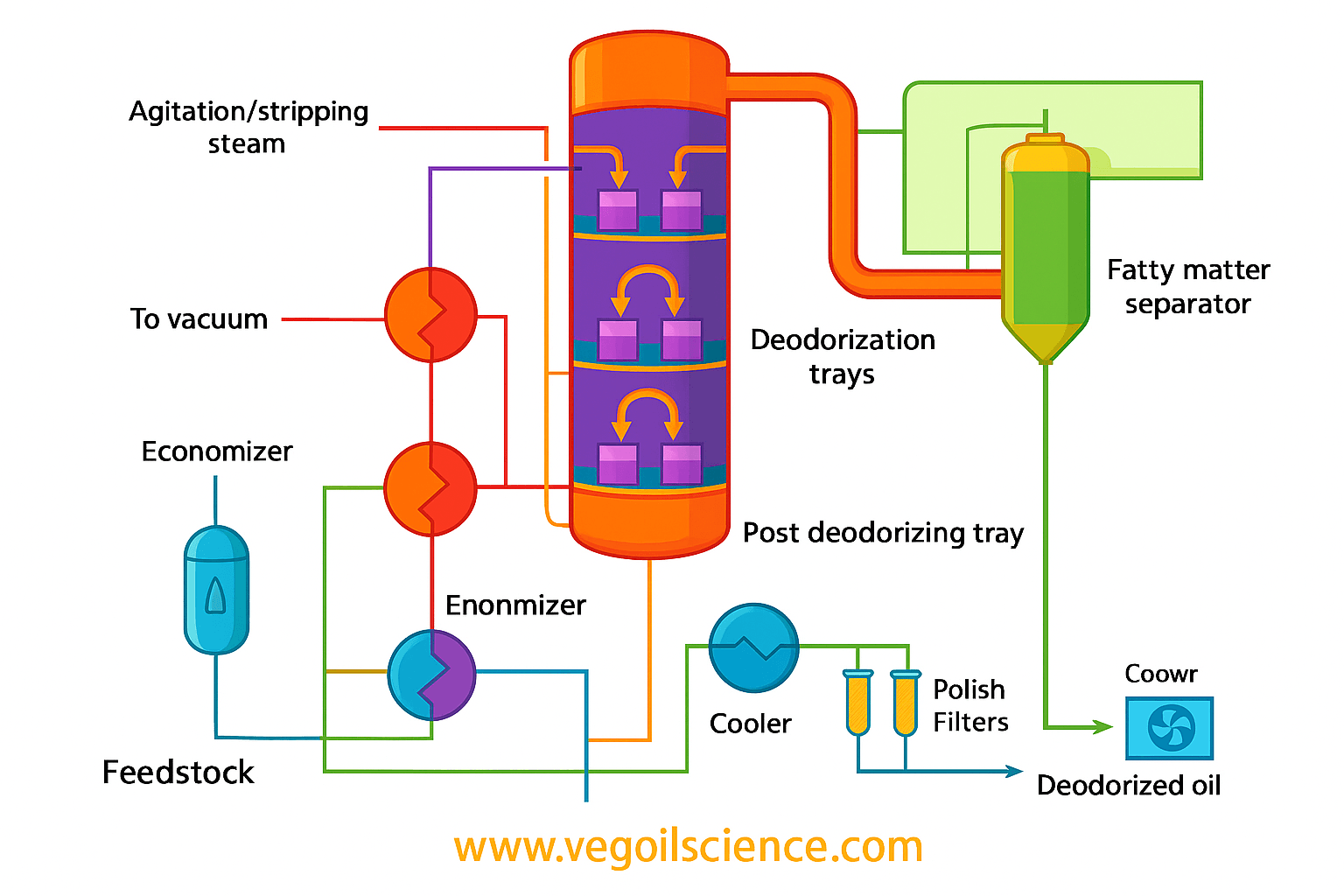
For the Deodorization of edible oils, the deodorizer vacuum system is designed to handle a certain amount of condensable (FFA and other volatile oil decomposition products, plus the stripping steam) and non-condensable gas (dissolved air) per hour.
If the FFA level in the deodorizer feed oil is high, the following steps would be necessary to reduce it.
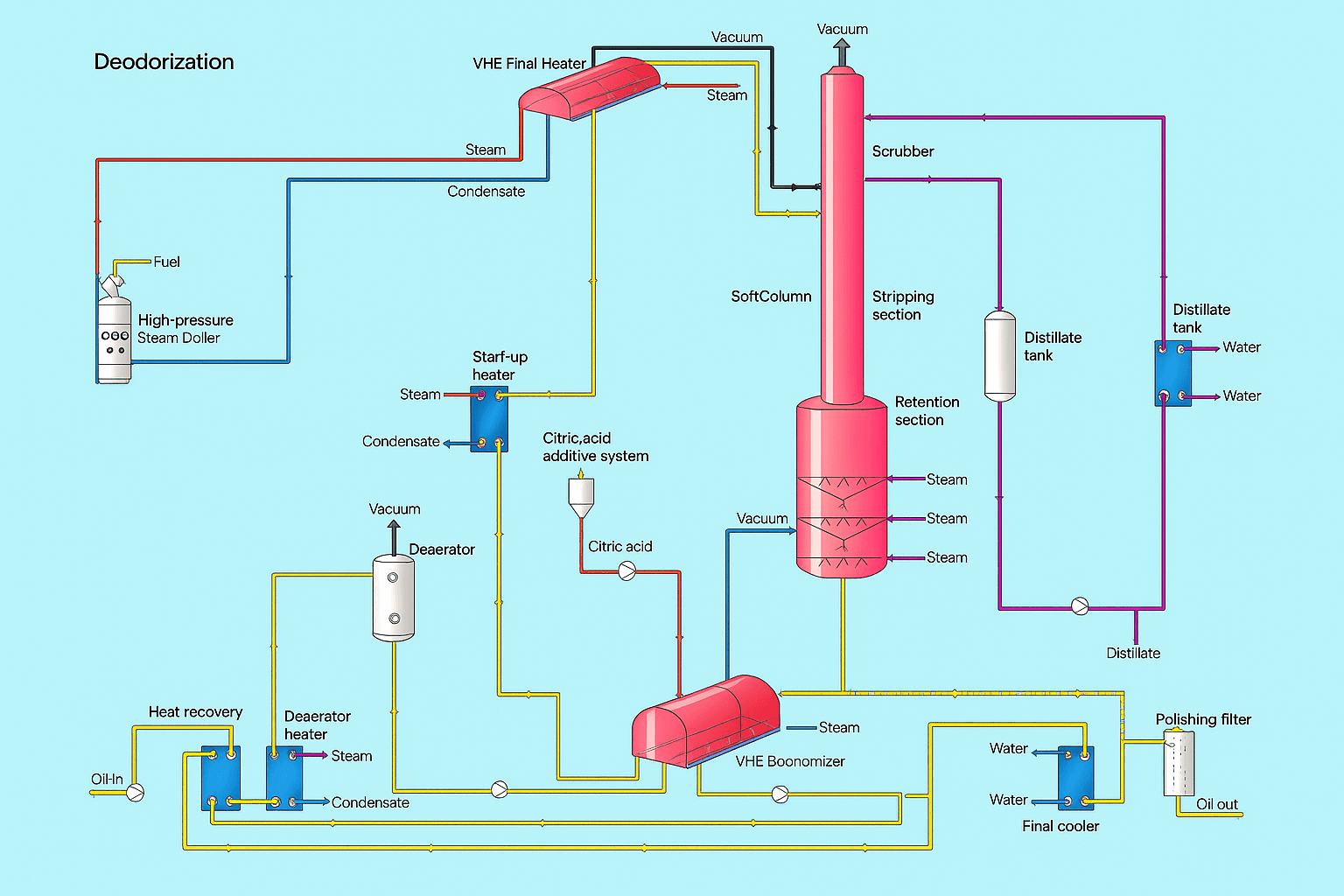
Increase the residence time in the deodorizer.
Moreover, you can increase the deodorizer temperature while ensuring the oil remains undamaged.
In addition, you can extend residence time while raising the deodorizer temperature.
This reduces deodorizer throughput and increases oil loss in the distillate.
The net result is higher product costs.
Deaeration of the Oil before Heating It for Deodorization:
The oil must be deaerated before it is heated to the heat bleaching or deodorization temperature.
Tdeaerated is to remove dissolved oxygen from the oil to prevent oxidation and the formation of oxidative polymers, and to remove dissolved moisture from the oil.
This is accomplished through the following Steps:
- Next, heat the oil to 80-90 °C and distribute it through a ring and a nozzle into the de-ereator, which operates under the same vacuum as the deodorizer.
- In a batch deodorizer, the vacuum is pulled before the oil is heated.
- In a semi-continuous deodorizer, this is done in the de-aerator tray, which is maintained at the same vacuum as the deodorizer.
- A continuous deodorizer uses a separate de-aerator vessel under full vacuum as the deodorizer.
Deaeration temperature:
Deaeration temperature and vacuum are both very critical for the final oil quality.
Dissolved air under poor vacuum and at 285°F (140°C) or higher produces oxidative polymers in the oil.
This process is aggravated if the deodorizer feed oil contains high phosphorus due to poor refining and bleaching.
High Oxidative Polymers:
High oxidative polymers have the following negative impacts:
• Produce poor flavor stability in the deodorized oil.
• As a result, this can quickly foul both the heat bleacher and the deodorizer system.
Without this step, the oil must not be heated further during deodorization, as this will seriously oxidize or even scorch it, making it unusable.
3. Heating the Oil for Deodorization:
Therefore, heating the oil before deodorization is crucial to the process. The oil must be deaerated as mentioned above.
Seed oils high in polyunsaturated fatty acids can serideaeratedmerize at 149°C in the presence of air.
Furthermore, most of these compounds are oxidative polymers that severely compromise the oil’s flavor stability.
Even oils like palm oil or palm olein must be deaerated before heat bleaching to protect the oil against oxidation. This is why deadeaerateds critical.
Deaeration of the oil:
Deaeration of the oil has another necessary consequence for palm oil or palm olein. Beta carotene and other carotenes in these oils are heat bleached (except for red palm oil) in the heat bleacher and the deodorizer.
Consequently, when oxygen is present, it oxidizes these compounds, causing color fixation that deodorization cannot remove.
The oil remains darker after deodorization. This also increases the yellow color of shortening when measured on the Hunter Color machine.
4. Operating Pressure (Vacuum):
In fact, deodorizers operate at low absolute pressure and high temperature.
It must be apparent from the discussion in the previous section that raising the oil temperature increases the vapor pressure of components, such as FFA and other volatile compounds.
The absolute pressure in the deodorizer must be lower than the combined vapor pressure of these components so that they will distill from the oil.
Low operating pressure (vacuum):
Low operating pressure (vacuum) in the deodorizer must be maintained at all times. A higher-than-normal operating pressure (lower vacuum) reduces the deodorizer’s ability to remove odoriferous compounds from the oil.
Poor vacuum in the deodorizer can arise from:
1. Poor performance of the vacuum ejector.
2. A possible air leak in the system.
Oxidize and polymerize the oil:
In either case, there is more air in the system that can oxidize and polymerize the oil.
Using excess stripping steam may exceed the vacuum system’s capacity to condense the vapor.
This can result in poor vacuum and, hence, poor-quality oil due to an overloaded vacuum system.
Therefore, it is recommended that the vacuum be maintained at or below the manufacturer’s maximum operating pressure.
Continuous………… Following Post Part-02 link, for Deo Process, Link


Comments are closed.