


Overview:
In that context, Natural Antioxidant Ascorbyl Palmitate serves as an oil-soluble, food-grade antioxidant that works exceptionally well in combination with tocopherols.
Oxidation shortens shelf life, degrades nutritional quality, and produces off-flavours in edible oils and fats.
Consequently, refiners and brand owners rely on antioxidants to slow that degradation and protect product value.
Importantly, it delivers clean-label appeal while stabilising unsaturated oils during storage and distribution.

How Natural Antioxidant Ascorbyl Palmitate Prevents Oxidation in Edible Oils:
Ascorbyl palmitate interrupts the radical chain reaction that causes rancidity.
First, it scavenges reactive oxygen species; then, it generates tocopherols, thereby extending the effect of vitamin E.
Thus, manufacturers often use it to protect colour, aroma, and nutritional value.
Benefits of using Natural Antioxidant Ascorbyl Palmitate in oil refining and processing:
Beyond its role in oxidative protection, this ester supports cleaner labelling. Moreover, it proves versatile, as you can incorporate it into frying oils, salad oil blends, and special fat formulations where lipid stability and consumer perception are key considerations.
Chemical Nature & Function of Natural Antioxidant Ascorbyl Palmitate:
Ascorbyl palmitate forms when Ascorbic acid, vitamin C, esterifies with Palmitic acid. The esterification reaction imparts lipid solubility, allowing the molecule to distribute into oil phases rather than remaining water-bound. Therefore, it reaches the sites where lipid peroxidation begins.
Structure, solubility, and stability of Natural Antioxidant Ascorbyl Palmitate:
Chemically, Ascorbyl Palmitate contains a hydrophilic ascorbate head and a hydrophobic palmitate tail. As a result, it dissolves in oil at typical defining temperatures. However, solubility improves when pre-dissolved in a warm oil stream or a minimal amount of ethanol for industrial dosing. Additionally, because it originates from vitamin C, customers perceive it as a natural antioxidant option.
Mechanism of Action and Synergy with Tocopherols:
Mechanically, Ascorbyl Palmitate reduces peroxyl radicals and donates hydrogen to stop propagation steps. Moreover, it can regenerate oxidised tocopherols, meaning that the combined use yields better protection than either antioxidant alone. Therefore, formulators routinely pair Ascorbyl Palmitate with tocopherol concentrates to achieve robust, synergistic protection.
Use and recommended dosage of Natural Antioxidant Ascorbyl Palmitate in oils and fats:
Correct dosing ensures performance while avoiding unnecessary costs or sensory impacts. Below are practical dosing guidelines and application tips across common oil types.
Optimum Dosage Levels of Natural Antioxidant Ascorbyl Palmitate in Different Oils.
Typical industrial dosages of Natural Antioxidant Ascorbyl Palmitate range from 100 to 500 ppm, depending on oil unsaturation, storage conditions, and whether additional antioxidants (like tocopherols or citric acid) are used.
Highly unsaturated oils, such as flaxseed or high-linoleic blends, often require higher concentrations, whereas stable oils like palm or coconut oil perform well at lower levels.
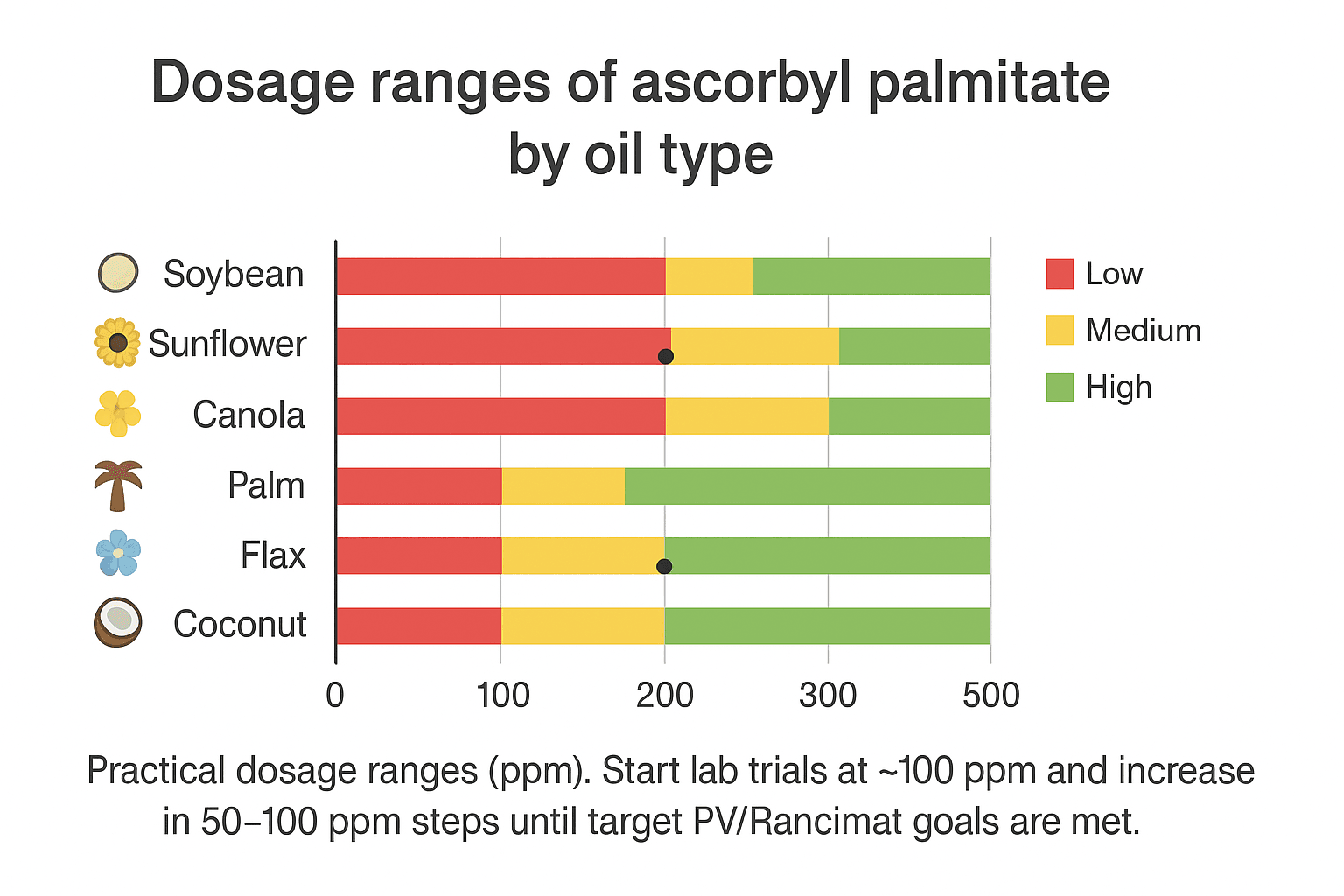
A practical approach is to begin laboratory testing at 100 ppm, increasing in 50-100 ppm steps until the desired peroxide value and Rancimat stability targets are achieved.
Practical Dosing Table (Example):
| Type of Edible oil | Recommended dosage range (ppm) | Remarks/Notes |
| Soybean oil | 150-350 ppm | High in PUFA; May require tocopherols for best effect. |
| Sunflower oil | 150-400 ppm | Excellent response to ascorbyl palmitate to cover all blends. |
| Canola / Rapeseed oil | 150-350 ppm | Moderate unsaturation; Start at 200 PPM for balanced protection. |
| Palm oil | 50-150 ppm | Naturally stable; Low dosage sufficient. |
| Flaxseed or high-linoleic oil | 300-500 ppm | Very prone to oxidation; Higher range advised. |
| Coconut oil | 50-100 ppm | Low PUFA; Antioxidant mainly for shelf-life extension. |
Natural Antioxidant Ascorbyl Palmitate Application is Stage and Mixing Techniques:
Practical Application Guidelines:
- Add Ascorbyl Palmitate after bleaching and before deodorisation, if possible, because heavy deodorisation can volatilise labile antioxidants.
- In practice, dissolve the antioxidant in warm oil (50-70°C) to ensure uniform dispersion.
- Alternatively, use a concentrated premix with tocopherols for simple metering.
- Finally, maintain vigorous mixing for at least several minutes to avoid localised overdosing and cake formation.
Stability and Compatibility of Natural Antioxidant Ascorbyl Palmitate During Processing and Storage:
Understanding interactions with heat, metal ions, and other additives prevents performance loss and unexpected sensory changes.
Thermal and Oxidative Stability of Natural Antioxidant Ascorbyl Palmitate in Edible Oils:
Ascorbyl palmitate withstands moderate refining temperatures, yet high-temperature deodorisation (e.g., prolonged exposure above 200°C) may reduce its activity.
Therefore, when oils undergo severe thermal treatment, expect diminished residual antioxidant and plan dosage accordingly.
On the other hand, during ambient storage, ascorbyl palmitate maintains its antioxidant capacity and effectively slows peroxide formation.
Rancimat and peroxide expectations:
In accelerated Rancimat testing, blends containing ascorbyl palmitate and tocopherols typically exhibit longer induction times than tocopherols alone.
Meanwhile, PV trends under shelf conditions often reveal lower peroxide accumulation over several weeks.
Interaction of Natural Antioxidant Ascorbyl Palmitate with Metals and Other Antioxidants:
Trace metals like iron and copper catalyse oxidation, so chelation or metal control complements antioxidant use.
Significantly, ascorbyl palmitate works best with tocopherols but may underperform alone when metals are high.
Thus, combine metal-removal steps (e.g., effective bleaching) with antioxidant dosing to maximise benefit.
Practical Implementation and Troubleshooting:
Here are practical suggestions to help production teams implement ascorbyl palmitate efficiently and avoid common pitfalls.
Common Issues and Solutions When Using Natural Antioxidant Ascorbyl Palmitate:
First, if you observe inconsistent antioxidant distribution, check your mixing time and temperature; poor dispersion often leads to hotspots and uneven shelf life.
Second, if sensory panels detect off-notes after dosing, reduce dosage or switch to a tocopherol/ascorbyl palmitate blend.
Third, if peroxide values continue to climb rapidly, verify metal content and re-examine bleaching and degumming performance.
Troubleshooting checklist:
- Verify mixing temperature (50–70°C) and time (≥5 minutes in line).
- Confirm antioxidant supplier purity and storage (dry, <25°C).
- Test for trace metals and adjust bleaching if necessary.
Case Study: Effectiveness of Natural Antioxidant Ascorbyl Palmitate in Reducing Peroxide Value:
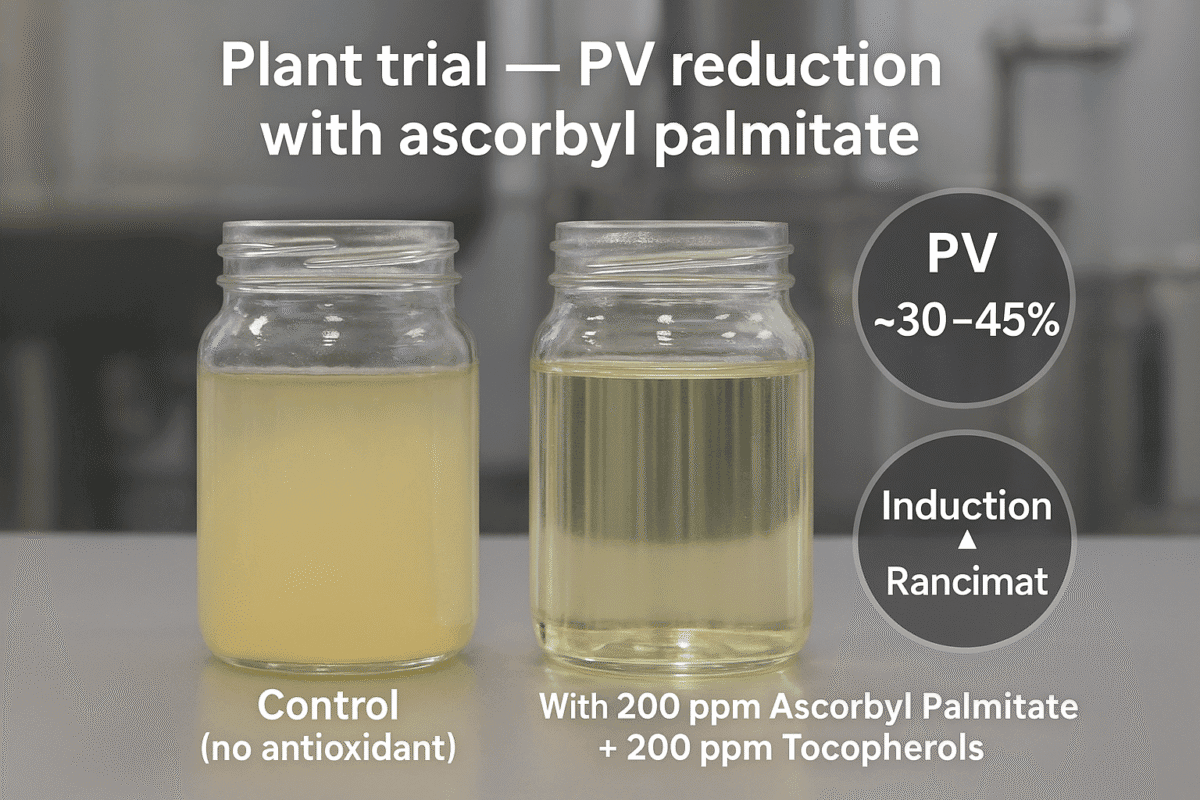
In one plant trial, adding 200 ppm ascorbyl palmitate plus 200 ppm mixed tocopherols lowered PV by ~30–45% versus control after 8 weeks at 25°C
Meanwhile, sensory panels rated aroma and taste more favourably. Therefore, trial data often justify the extra cost of the ingredient, particularly for premium oils.
Modern research-based data:
Synergistic role of Natural Antioxidant Ascorbyl Palmitate with tocopherols:
Recent studies highlight the synergistic action of Natural antioxidant ascorbyl palmitate when used with tocopherols (vitamin E).
This combination significantly enhances oil stability by regenerating oxidised tocopherols and extending their antioxidant effect.
According to accelerated oxidation trials (e.g., Rancimat & Schaal over tests), blends of ascorbyl palmitate with mixed tocopherols increase the induction period and reduce peroxide value more effectively than either antioxidant alone.
The ratio of ascorbyl palmitate to tocopherols is critical; Modern formulations often achieve optimal performance within a 1:2 to 1:4 ratio, depending on the base oils’ natural tocopherol content.
This synergy makes it particularly suitable for high-unsaturation oils such as sunflower, canola, or soybean, where oxidative stress is more severe.
Optimisation and stability findings from modern studies:
Modern research also focuses on refining dosage & evaluating long-term stability.
Scientists have observed that the natural antioxidant ascorbyl palmitate remains stable under moderate refining deodorisation conditions but may degrade above 210 °C.
To preserve antioxidant potency, formulators are advised to add it post-bleaching or just before findeodorizationion.
Additionally, stability depends on oil composition, trace metals, and moisture. Studies show that maintaining low iron levels maximises the efficacy of ascorbyl palmitate.
Researchers conclude that its most successful application involves integrating process control, antioxidant energy, and post-edit optimisation to achieve consistent protection against oxidation.
Safety, Regulations, and Labelling of National Antioxidant:
Regulatory-compliant clients with clear labelling can sell key products across markets.
Natural antioxidant ascorbyl palmitate: global regulatory limits and safe use of natural antioxidant ascorbyl palmitate.
| Aspect | Details |
| Regulatory acceptance | Regulators generally accept ascorbyl palmitate as a permitted antioxidant within specified limits; For instance, Codex and many national authorities list it under vitamin antioxidant categories. |
| Regional compliance | Always check regional rules (FDA, EFSA, local food codes) for maximum permitted levels and approved applications. |
| Typical safe limit | In practice, staying within 500 ppm keeps you well inside common regulatory thresholds for most edible oil users. |
Labelling and clean label claims:
Label as “ascorbyl palmitate” or “antioxidant (ascorbyl palmitate)” depending on local labelling rules.
Furthermore, because it is derived from vitamin C and our natural fatty acid, marketing teams can often present it as a “natural antioxidant” when rules permit full stops.
Labelling end consumer transparency of antioxidant ascorbyl palmitate:
Transparency helps build trust. Therefore, include the functional purpose on technical data sheets and ensure product labels accurately reflect the ingredient list.
Also, provide usage and storage guidance to downstream Packers to avoid degradation before the product reaches consumers.
Conclusion: Future of Natural Antioxidant Ascorbyl Palmitate:
Overall, ascorbyl palmitate provides a practical, standard, consumer-friendly antioxidant option for many edible oils and fats.
Because it combines oil solubility with vitamin-derived chemistry, it often complements tocopherols and improves measurable oxidative stability.
For formulators, the key steps involved proper dosing trials, good mixing practice, and metal control during refining.
Consequently, when brands seek cleaner labels and reliable shelf life, Natural Antioxidant Ascorbyl Palmitate offers a scalable solution that balances performance, safety, and consumer perception.


