


Introduction of Physical vs Chemical Refining:
In the global oil industry, two primary refining methods dominate: physical vs chemical refining. Each process has its own advantages, operating principles, and cost implications.
Refining is the heart of edible oil processing, transforming crude oils into safe, stable, and high-quality products.
Understanding their distinctions helps refiners make informed decisions based on oil type, free fatty acid (FFA) level, and production scale.
Both methods aim to remove impurities such as phospholipids, pigments, and volatile compounds.
However, the route and efficiency differ. Let’s explore each step, from degumming to deodorization, and discover how these two refining paths impact product quality, economy, and sustainability.
Physical vs Chemical Refining Overview:
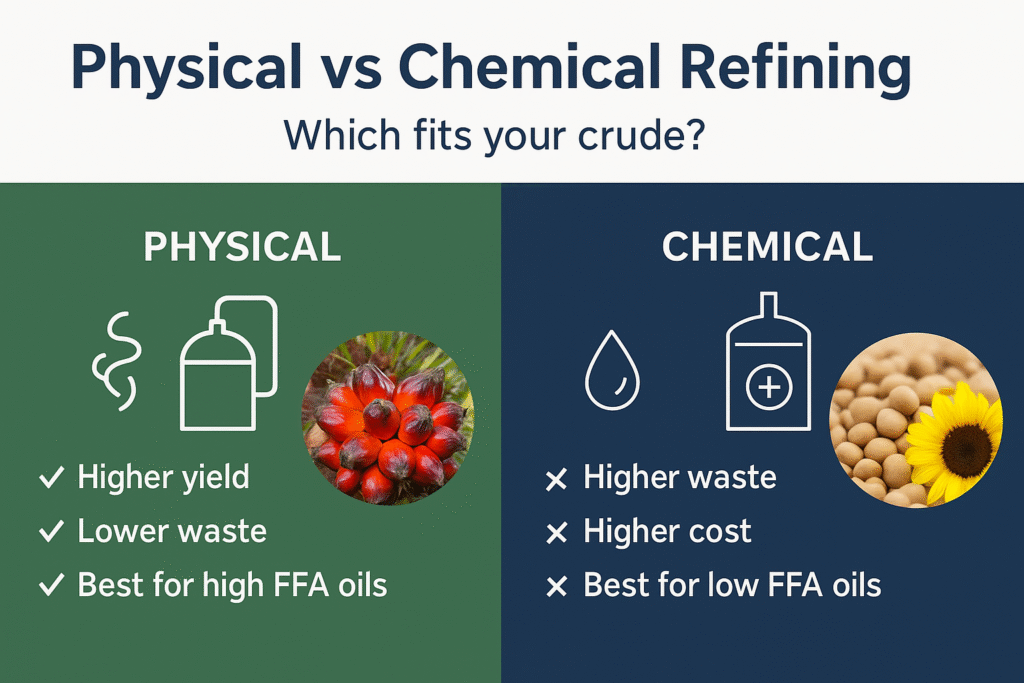
The terms physical vs. chemical refining refer to two refining approaches that achieve similar goals through different mechanisms.
In chemical refining, free fatty acids are neutralized using alkali (caustic soda), forming soapstock that is later separated. Conversely, physical refining removes FFA by direct steam distillation during deodorization.
Chemical refining is better suited to oils with lower FFA content (e.g., soybean, sunflower, and canola oils).
On the other hand, physical refining is preferred for high-FFA oils like palm, rice bran, and fish oils due to its higher yield and lower chemical consumption.
In industrial settings, choosing between these methods involves evaluating oil characteristics, available equipment, and environmental regulations.
The modern trend favors physical refining due to lower effluent and improved recovery, yet chemical refining remains vital where oil stability or phosphorus levels are high.
Physical vs Chemical Refining Process Steps:
Both refining types follow similar stages: degumming, neutralization (or pretreatment), bleaching, and deodorization, but differ in their sequence and mechanism.
Degumming and Neutralization Differences:
In Chemical Refining, degumming removes hydratable phospholipids with water or acid, followed by caustic treatment to neutralize FFA.
This step produces soapstock, which is later split or recovered as acid oil.
In Physical Refining, acid degumming and washing remove both hydratable and non-hydratable phospholipids.
After drying, the oil proceeds directly to bleaching and deodorization, where FFA are distilled under vacuum.

Bleaching and Deodorization Variations:
Both processes use bleaching earth to adsorb color pigments and residual impurities.
However, deodorization plays a critical role in physical refining – it serves as the final FFA removal step.
High vacuum and a temperature range of 240-260°C help achieve excellent oil quality without generating caustic waste.
Chemicals Used in Both Refining Methods:
| Step | Chemical Refining Chemicals | Physical Refining Chemicals |
| Degumming | Water, Phosphoric Acid, Citric Acid | Phosphoric Acid, Citric Acid |
| Neutralization | Caustic Soda (NaOH) | — |
| Washing | Hot Water | — |
| Bleaching | Bleaching Earth, Activated Carbon | Bleaching Earth, Activated Carbon |
| Deodorization | Steam (for stripping) | Steam (for FFA removal) |
Physical vs Chemical Refining Advantages and Limitations:
When comparing physical vs chemical refining, several advantages and drawbacks emerge that influence refinery design and cost structure
Advantages of Physical Refining:
No soapstock formation, leading to higher yield.
Lower effluent load and better environmental performance.
Reduced chemical handling and waste disposal costs.
Limitations:
- Requires high-quality degumming to prevent catalyst poisoning.
- High FFA oils can lead to distillation losses if not properly controlled.
Advantages of Chemical Refining:
- Better color control and stability in certain oils.
- Flexible process, suitable for various crude qualities.
Limitations:
- Generates soapstock that requires disposal or recovery.
- Higher chemical and water use increase costs and effluent load.
Each method has industrial value, and the optimal choice depends on the oil type, desired specifications, and environmental compliance requirements.
Cost Comparison Between Physical and Chemical Refining:
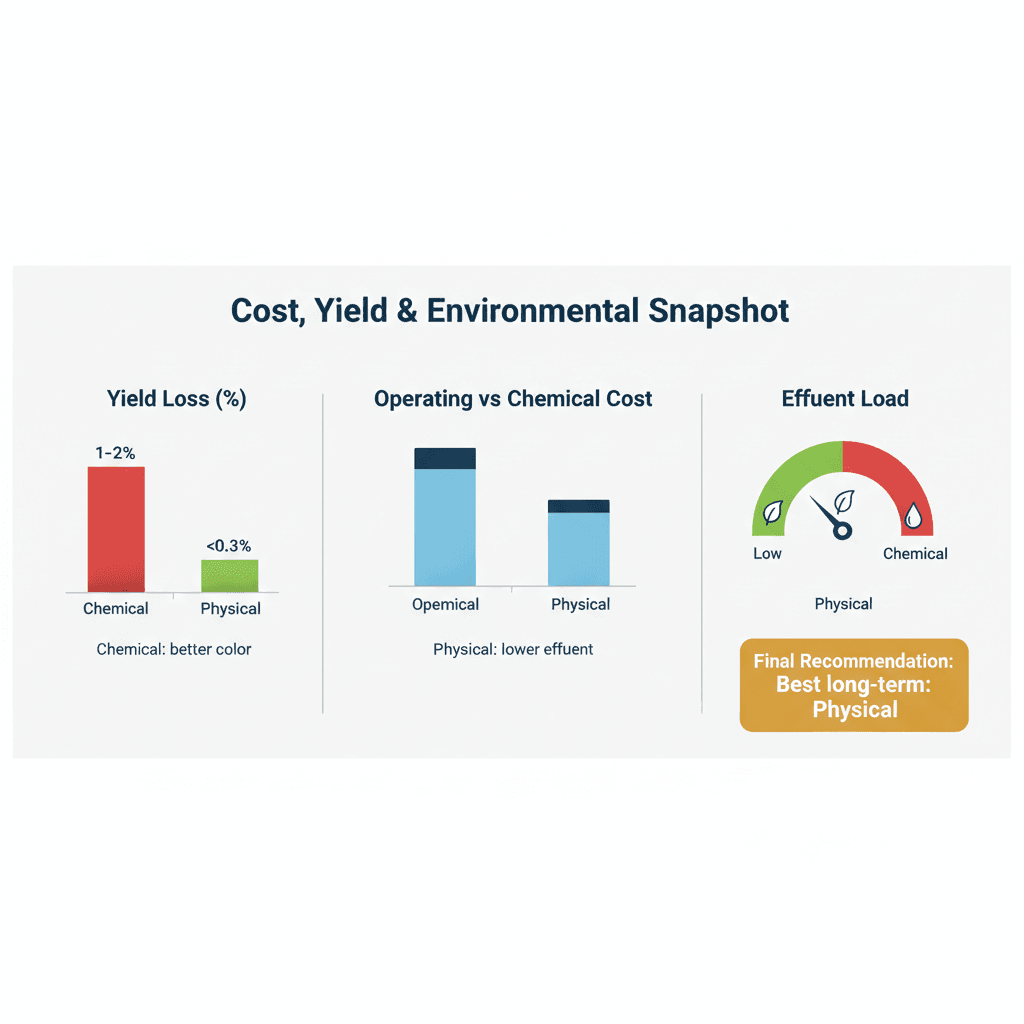
Cost plays a significant role when deciding between physical vs chemical refining. Although the capital cost of physical refining is slightly higher, operational savings often offset it over time.
Cost Comparison Table:
| Parameter | Physical Refining | Chemical Refining |
| Capital Cost | Moderate to High | Moderate |
| Operating Cost | Lower (less chemical use) | Higher (more reagents, water) |
| Energy Consumption | Moderate | Slightly lower |
| Chemical Cost | Minimal | High (caustic, acid, water) |
| Maintenance Cost | Moderate | Moderate |
| Yield Loss | <0.3% | 1-2% (soapstock loss) |
| Effluent Treatment Cost | Low | High |
| Overall Economics | More economical long-term | Suitable for small setups |
Interpretation:
Physical refining offers better yield and lower operating expenses, especially for high-volume plants.
Meanwhile, chemical refining requires less technical control but results in higher effluent management costs.
Quality Parameter and Final Oil Characteristics:
Refined oil quality depends heavily on process control. In physical vs chemical refining, differences appear in color, stability, and trace contaminants.
- Color: Chemical refining provides a slightly lighter color due to alkali neutralization, while physical refining depends on bleaching efficiency.
- Stability: Physical refining retains natural tocopherols (vitamin E), improving oxidative stability.
- FFA Content: Both methods achieve <0.05% FFA if optimized.
- Shelf Life: Higher tocopherol retention and reduced moisture favor physical refining.
Proper degumming and bleaching are essential to prevent post-refining issues such as oxidation, soap traces, or off-flavors.
Main Differences Table: Chemical vs Physical Refining.
| Parameter | Chemical Refining | Physical Refining |
| FFA Removal Method | Caustic Neutralization | Steam Distillation |
| Soapstock Formation | Yes | No |
| Effluent Generation | High | Low |
| Yield | Lower (1-2% loss) | Higher (<0.3%) |
| Phosphorus Removal | Moderate | High (acid degumming) |
| Suitable Oils | Soybean, Sunflower, Canola | Palm, Rice Bran, Fish Oils |
| Tocopherols Retention | Moderate | Higher |
| Environmental Impact | More Waste | Eco-Friendly |
Choosing the Right Refining Method for Your Industry:
Selecting the correct method between physical and chemical refining requires a clear understanding of your crude oil properties and production goals.
- For high-FFA oils like palm or rice bran, physical refining yields higher yields and less waste.
- For low-FFA oils such as soybean or sunflower, chemical refining offers better color and flavor control.
- Consider that, in physical refining, infrastructure demands strong vacuum systems and temperature control, while in chemical refining, it requires efficient washing and wastewater treatment.
Environmental regulations and sustainability goals are also reshaping refinery choices.
Many modern facilities now adopt hybrid approaches, combining chemical pretreatment with physical finishing to maximize performance and minimize waste.
Production Losses in Chemical and Physical Refining:
Key Factors Contributing to Yield Reduction:
Production losses occur in both chemical and physical refining, but the reasons and extent differ due to process design and chemical reactions.
Below are the main points highlighting how losses arise and how they can be minimized:
Soapstock Formation (Chemical Refining):
- Caustic soda reacts with free fatty acids to form soap.
- Soap traps neutral oil, causing 1-2% yield loss.
- Poor separation or excessive caustic dosage increases this loss.
- Washing and Centrifuge Losses:
- Washing stages may create emulsions that hold oil.
- Inefficient centrifugation further increases entrainment.
- Proper control of washing water temperature and flow reduces this problem.
- Distillation Losses (Physical Refining):
- Free fatty acids are stripped off during deodorization.
- Losses are minimal (<0.3%) because no caustic reaction occurs.
- Maintaining the correct vacuum and steam rate prevents triglyceride vaporization.
Bleaching Earth Absorption:
- Both refining types experience small losses due to oil absorbed in spent earth.
- Using low-dosage, high-activity earth minimizes this effect.
- Process Optimization Measures:
- Routine calibration of flow meters and centrifuges.
- Monitoring FFA levels to adjust refining intensity.
- Recovering residual oil from soap stock or spent earth for improved yield.
Final Recommendations Table: Physical vs Chemical Refining:
| Factor | Best Method | Key Reason |
| Oil type | Physical | Ideal for high-FFA oils like palm and rice bran. |
| Yield | Physical | No Soapstock loss; yield >99.7% |
| Color Control | Chemical | Better color for low-FFA oils. |
| Environmental Impact | Physical | Lower effluent and chemical use |
| Operating Cost | Physical | Reduced reagents and water costs. |
| Setup Cost | Chemical | Lower capital investment for small plants. |
| Overall, Choice | Physical | Best long-term efficiency and sustainability. |
Conclusion:
The debate of physical vs chemical refining continues to shape the edible oil industry.
While chemical refining remains practical for low-FFA oils and flexible production setups, physical refining leads in yield, environmental compliance, and long-term cost efficiency.
By understanding their distinct process mechanisms, cost implications, and quality outcomes, refiners can design efficient, sustainable systems that meet both commercial and consumer expectations.
Whether you prioritize purity, yield, or eco-compliance, mastering these refining principles ensures your plant stays ahead in an increasingly competitive global market.


