


Objective: Preparation and Standardization of NaOH.
Preparation and Standardization of NaOH Solution, 250 ml or 1 L Normal Sodium Hydroxide solution (NaOH) in distilled water for laboratory use.
NaOH Solution for FFA.
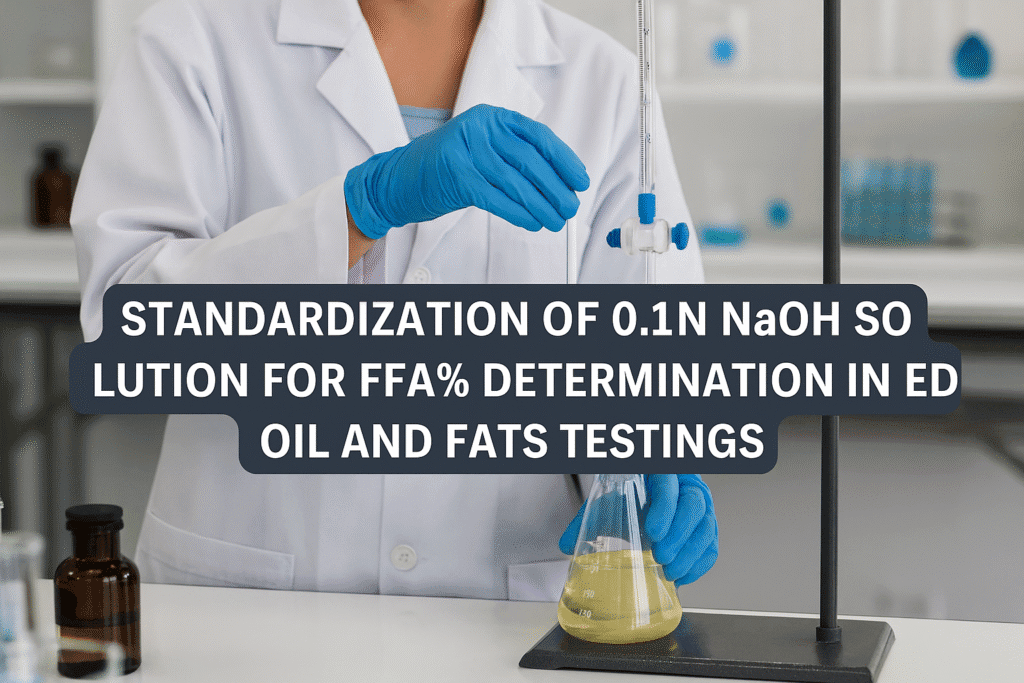
Apparatus Required: Preparation and Standardization of NaOH.
The following apparatus is required for the Preparation and Standardization of NaOH Solution.
- Analytical balance
- 1 L or 250 ml volumetric flask
- Beaker (250)
- Glass Rod
- Funnel
- Wash the bottle with distilled water
- Weighing boat or butter paper
- Stirring rod or magnetic stirrer
Chemicals Required:
The following chemicals are required for the preparation and Standardization of NaOH Solution.
- Sodium hydroxide (NaOH) pellets.
- Distilled water.
Calculation of Required NaOH:
Normality (N) = (Equivalent grams) / (Volume)
For NaOH, 1 mole = 1 equivalent (because it gives 1 OH negative ion).
- Molecular weight of NaOH = 40 g/mol
- For a 0.1 N solution:
Required mass = 0.1*40=4 gram / litre
| Volume Required | NaOH mass to use |
| 1000 ml (1 L) | 4.0g |
| 250 ml | 0.4g |
Procedure:
Using an analytical balance, after that, weigh 4.0 g of NaOH pellets (for 1L)
Be quick and careful, because NaOH absorbs moisture (hygroscopic) from the air.
Transfer the NaOH pellets into a clean beaker containing 100-200 ml of distilled water, as NaOH dissolves in water.
Stir slowly with a glass rod until the pellets fully dissolve.
The solution will become warm because it is an exothermic reaction.
After cooling to room temperature, pour the solution into a 1L volumetric flask using a funnel.
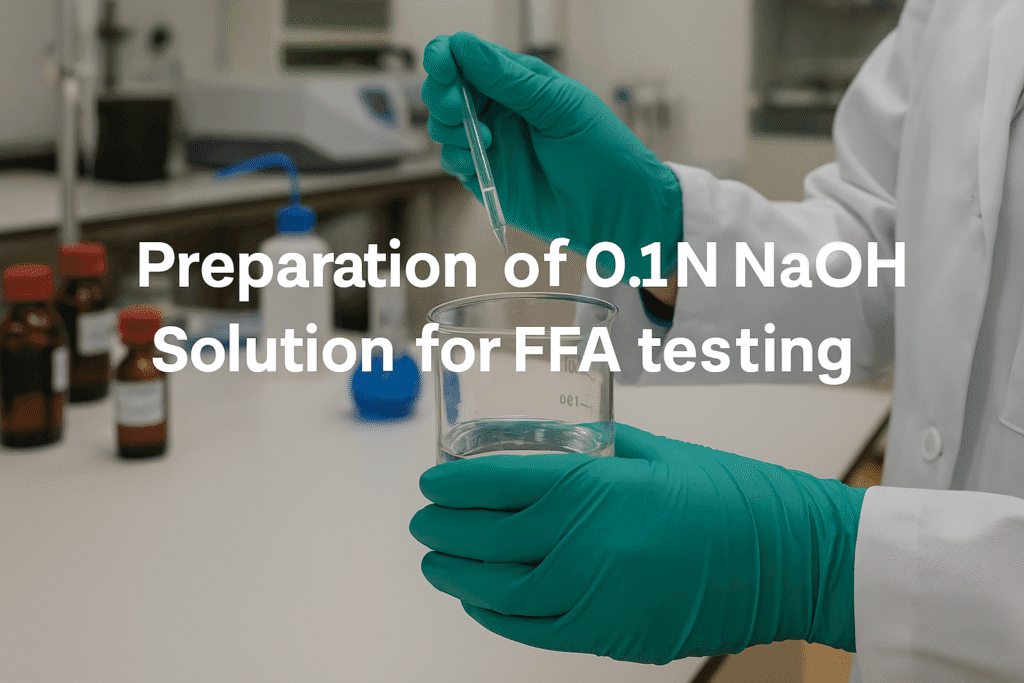
Rinse the beaker and funnel with distilled water, and add rinsing to the flask.
Add distilled water slowly until the bottom of the meniscus reaches the 1L mark.
Stopper the flask, and mix thoroughly by inverting several times until it mixes properly.
After that, allow it to stand for 24 hours.
After 24 hours, standardized with Potassium Hydrogen Phthalate KHP.
Standardization of NaOH Solution:
Motive Behind Standardization: Preparation and Standardization of NaOH
The basic purpose of standardizing a chemical solution is to determine its exact concentration.
The key reason behind standardization is accuracy in analysis, reliable results, calculations, and comparisons.
Primary standards always do it.
Since NaOH absorbs CO2 from the air and loses strength, it should be standardized using.
A primary standard acid, like Potassium Hydrogen Phthalate (KHP).
Use phenolphthalein as the indicator (end point: colorless to faint pink).
Objective: Preparation and Standardization of NaOH.
To determine the exact normality of (NaOH) solution by titrating against (KHP), a solid primary standard.
Chemicals Required:
- Sodium hydroxide solution (0.1N) was prepared before.
- Potassium hydrogen Phthalate (KHP): Equitant weight 204.
- Phenolphthalein indicator 1%.
- Distilled water.
Apparatus required:
- Burette (50 ml)
- Conical flask (250 ml)
- Analytical Balance
- Volumetric pipette (25 ml)
- Beaker and glass rod
- Funnel
- Wash bottle (containing distilled water).
Why KHP:
- It is a monobasic acid
- It reacts with NaOH in a 1:1 molar ratio.
Reaction Equation:
KHP + NaOH ——> KNaP + H2O
To standardize NaOH using 0.1 M.
- Use 0.2042g of KHP to react with 25 ml of 0.1 N NaOH
Mass of KHP = Normality × Eq. weight ×0.1 = 0.1×204.22×0.025 = 0.5108 g
Procedure:
- Accurately weigh about 0.51 g of KHP using an analytical balance.
- Transfer it to a 250 ml flask
- Add 50–100 mL of distilled water to dissolve KHP completely
- Swirl the flask gently
- Add 2-3 drops of phenolphthalein indicator
- The solution will remain colorless
- Rinse the burette and fill it with NaOH solution.
- Record the initial burette reading.
- Slowly add NaOH from the burette to the KHP solution, swirling continuously.
- As the pink color starts to appear and disappear, slow the titration
- The endpoint is a persistent pale pink color that lasts for 30 seconds.
- Note the final reading on the burette (the amount of NaOH used).
Calculations:
N=(Weight of KHP(g) × 1000)/(Eq. weight of KHP × volume of NaOH).

Comments are closed.