


Bleaching Earth Dosage: Introduction & Why Dosage Matters.:
Bleaching Earth Optimise Dosage removes pigments, trace metals, and polar impurities that darken oil and shorten shelf life.
First, a correct dose restores desirable colour and clarity; Second, it reduces the risk of later colour reversion; and third, it keeps oil loss within acceptable limits.
Therefore, you must treat dosage as a balance: enough clay to meet quality but not so much that you waste oil or slow filtration.
In short, a deliberate, data-driven approach yields a consistent product, lower costs, and fewer surprises on the plant floor.
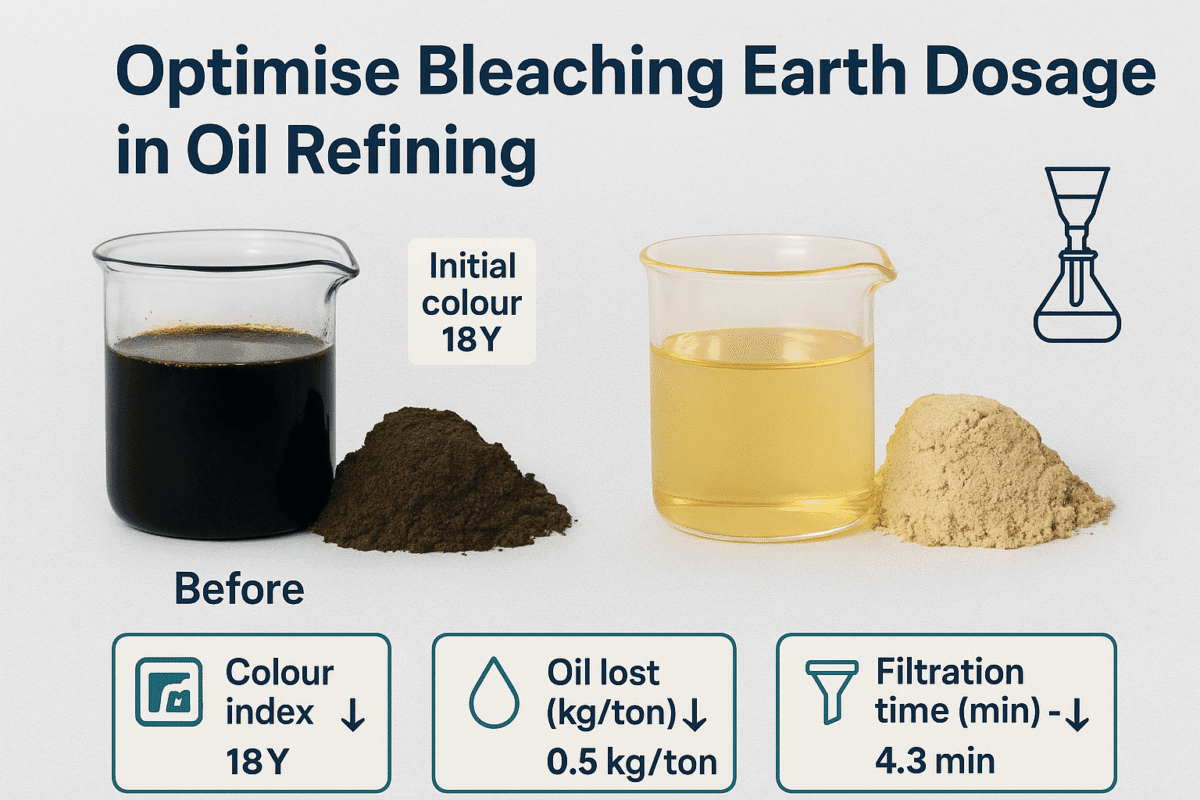
Role of Bleaching Earth in Colour Removal & Trace-metal Adsorption.
Bleaching earth adsorbs carotenoids, chlorophyll residues, and trace metals like iron and copper.
Consequently, it lowers pro-oxidants that catalyse colour reversion.
Because clays differ widely in activity, you cannot assume one product behaves like another.
So, test material on your actual crude before you set plant targets.
Effect on yield, oil quality, and processing cost:
Adding clay always costs money, and above all, it can trap oil.
Thus, your goal should be the point of diminishing returns: the dosage that provides the desired colour improvement without causing excessive oil retention.
To reach that point, measure the colour index, oil retention on spent earth, and the filtration rate during trials.
Types of Bleaching Earth and How to Choose:
| Clay type | Best for | Pros | Cons | Dosage notes |
| Acid activated | Heavily coloured/metal-contaminated oils | High activity – fewer kg used | Can darken oil or adsorb more oil if overdosed | Bench test: start low |
| Neutral | Light oils (soy, sunflower) & final polishing | Gentle in oil; lower darkening risk | Needs higher kg/ton | Expect a higher dosage |
| Engineered blends | Specific pigment/metal problems | Tailored performance; efficient removal | Costly; needs matching to feedstock | Pilot before scale-up |
Acid-activated vs neutral clays: pros and cons:
Acid clays work fast and use less mass, but they risk stronger oil adsorption. Conversely, neutral clays conserve oil but need larger quantities.
Therefore, bench test both and choose the best compromise for your plant.
Key selection properties: surface area, pore size, activity:
A high surface area and suitable pore size favour pigment capture, so focus on those specifications.
However, always validate in your lab because supplier numbers seldom tell the whole story.
How to Optimise Bleaching Earth Dosage Lab Tests and Trials:
Start small, then scale. First, run bench trials across a dosage range under controlled temperature and mixing conditions.
Next, measure Lovibond or colour index, turbidity, and oil retained on clay. Then, plot a dose-response curve so you can identify the knee where extra clay gives minimal benefit.
How to Optimise Bleaching Earth Dosage: Bench trials and small-scale point tests.:
Run at least five dosages with replicates. Keep mixing intensity, temperature, and settling time consistent so results mimic the planned behaviour.
After that, select three candidate dosages to test in pilot or limited plant runs.
Adsorption isotherms & dose-response studies.
Model the adoption curve to predict where adding more clay becomes uneconomic.
When the slope flattens, you know you have reached diminishing returns. Therefore, use that model to define your target dosage.
Sample handling, controls, and result interpretation:
Use fresh oil, shield samples from light and air, and include a no-clay control. Moreover, report results against commercial specs so your team understands trade-offs.
Quality of crude oil: Effect on Bleachability & Optimise Bleaching Earth Dosage
- Crude quality controls clay demand: oils with heavier contamination need more clay or stronger pre-treatment.
- Phospholipids: High levels increase clay requirement and foam risk, prioritise enzymatic or acid degumming.
- Pigments / initial colour: Darker crude needs higher-activity clay or larger doses to meet colour specs.
Free fatty acids (FFA): Elevated FFA can react with acidic clays, altering colour behaviour and potentially improving neutralisation.
Moisture: Access to water lowers clay activity and raises oil retention on spent earth. Dry or dewater feedstock first.
- Solvent residues/contaminants: Residues and particulates increase adsorption needs. Filter and remove solvents before bleaching.
- Action step: always run a feedstock analysis (FFA, moisture, phosphorus, Initial colour) and use the results to choose clay type and starting dosage for bench trials.
Moisture, FFA, and contaminant considerations:
Excess moisture reduces clay activity and increases oil retention.
Likewise, high FFA can interact with acid clays, causing unexpected colour changes.
Therefore, control pre-treatment degumming and neutralisation before you dose clay.
Process Parameters Effects:
Temperature, contact time, and agitation matter as much as clay selection. High-temperature adsorption often speeds up adsorption, but it can also generate new pigments if excessive.
Similarly, poor mixing creates blind spots where clay never comes into contact with contaminants. Consequently, optimise these parameters in tandem with dosage to reproduce lab results at scale.
Temperature, contact time, and agitation effects:
Raise the temperature moderately to improve kinetics, but monitor for thermal degradation.
Extend contact time only as far as filtration and throughput permit.
In practice, design the mixing system so that the clay disperses evenly without forming an emulsion.
Impact of oil composition and pre-treatment (degumming, neutralisation):
Better degumming removes phospholipids that stabilise foam and trap pigments. Thus, a cleaner feedstock often lets you cut clay use and improve filtration.
Optimise Bleaching Earth Dosage: Practical Dosage Optimisation Strategies:
Translate lab wins into plant reality. First, pick three candidate dosages from bench work: low, medium, and high.
Next, run each at production rate for several hours while logging key metrics. Finally, compare cost vs quality and adopt the dosage that meets specs with minimum loss.

Stepwise plant trial protocol and acceptance criteria:
- Plan trials with defined targets and sampling points.
- Run each dosage long enough to stabilise results.
- Sample at the inlet, outlet, and after the separator.
- Approve the dosage when colour, oil loss, and filtration meet criteria.
Cost-benefit analysis: balancing quality versus oil loss:
Calculate the clay cost per ton and the monetary loss from oil trapped in spent earth. Often, a small extra clay expense improves the finished product enough to justify the cost.
Reuse, regeneration, and spent earth economics.
Explore treatment or authorised reuse of spent clay to lower disposal costs. Sometimes, economic factors shift your optimal dosage decision.
Troubleshooting Common Bleaching Issues in Optimise Bleaching Earth Dosage:
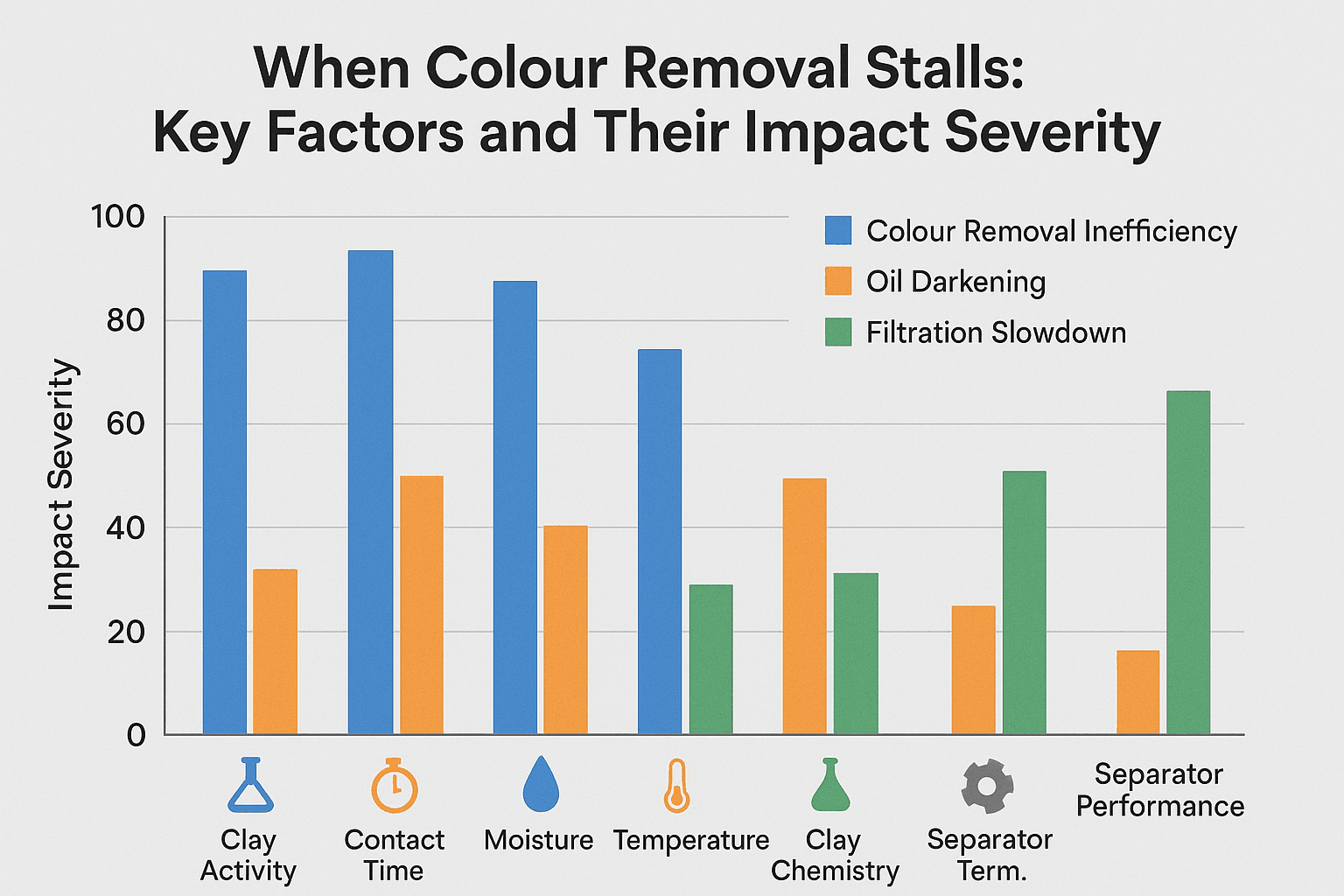
When colour removal stalls, investigate clay activity, contact time, and moisture. If oil darkens after bleaching, suspect excessive temperature or wrong clay chemistry.
Likewise, filtration slowdowns often indicate clay fines or poor separator performance. Therefore, maintain quick diagnostics and corrective SOPs.
Inadequate colour removal likely causes and fixes:
If the clay shows low activity, swap batches. If contact time is short, extend the mixing time. Also, check water carryover and upstream pre-treatment.
Excessive oil adsorption or post-bleaching darkening
Reduce dosage or switch to a milder clay grade when oil loss rises. Also, lower bleaching temperature and check for acid residues.
Key KPI’s to monitor (colour index, oil lost, clay carryover)
Track these KPI’s in real time where possible, and use them to trigger corrective actions before quality drifts.
Modern Research-based Data for: Optimise Bleaching Earth Dosage:
- Recent Studies highlight two clear trends.
- First, antioxidant pre-dosing, such as ascorbyl palmitate combined with tocopherols, slows pigment oxidation and reduces the need for heavy clay doses.
- Second, enzymatic degumming removes phospholipids more efficiently than traditional water degumming, which lowers clay demand and foam risk.
- Accordingly, pilot modern methods on your feedstock before making permanent changes.
Novel additives and process innovations:
Ensure that tailored antioxidant blends and milder thermal deodorisation maintain colour and reduce harmful by-products.
In addition, online monitoring of FT-NIR for peroxide trends and metal sensors for Iron spikes lets operators act early and reduce corrective overdosing.
Advanced analytical and monitoring techniques:
Use FT-NIR for real-time tracking of peroxide and moisture, GC for volatile profiling, and online metal monitors to detect Iron or copper spikes.
Then, set an action threshold so operators add antioxidants, adjust
deodorisation, or rework degumming, before problems escalate.
Thus, diagnostics shorten response times and cut waste.
Case Studies and Pilot Trials:
A small pilot often beats guesswork. For assistance, one refinery reduced clay usage by 12% after switching to a higher-activity neutral clay and increasing the mixing time slightly.
Another case combined antioxidant dosing and improved degumming to lower both clay need and odour complaints.
Therefore, always pilot before implementing on a plant-wide scale.
Environmental, safety, and compliance notes:
Handle bleaching earth as a dust hazard, install extraction, and provide PPE.
Also, follow local rules for spent earth disposal; Evaluate thermal treatment or authorised reuse to reduce landfill costs.
Moreover, document all changes and keep compliance records for audits.
Quick implementation checklist:
- Analyse crude: FFA, phosphorus, moisture, initial colour.
- Run bench trials and model adsorption curves.
- Select 3 plant dosages from lab data.
- Execute stepwise plan trials with KPIs.
- Review cost-benefit and finalise SOPs.
- Train operator and monitor KPIs continuously.
Optimise the bleaching or dosage conclusion, and provide a best-practice summary.
To repeat, test first, pilot second, then scale with monitoring and controls.
Above all, treat clay dosage as part of a system: pre-treatment, clay selection, process parameters, and monitoring must work together.
When you follow these steps and use diagnostics, you will hold colour, cut losses, and improve throughput.
Finally, keep records, run periodic trials, and train your team so the chosen doses stay optimal over time.


