Introduction of the Semi-Continuous Deodorisation Process:
The semi-continuous deodorization Process was introduced in 1948 in the United States by Girdler (subsequently Votator and now Desmet Ballestra).
A. E. Bailey designed the original deodoriser. This provided the vegetable oil industry with a significant boost in productivity.
The design of the Semi-Continuous Deodorisation Process includes some intriguing features as discussed below:
Intriguing features: Semi-Continuous Deodorisation Process
Semi-Continuous Deodorisation Process has the following features:
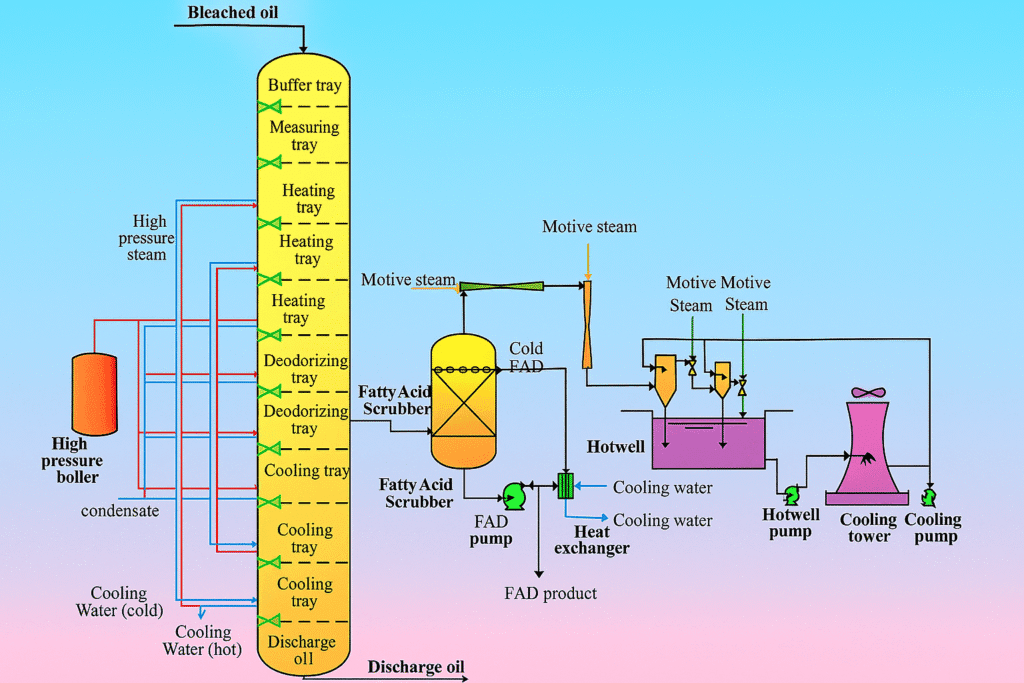
- There are five trays (in the original design) or six trays (in the newer design) stacked vertically. These trays perform several functions, such as:
- De-aeration.
- Heating.
- Deodorizing.
- Cooling.
- A schematic drawing of the modern Desmet Ballestra semi-continuous deodoriser is shown in Fig.
Operation: Semi-Continuous Deodorisation Process:
The oil is first measured and then de-arrested in an external measuring tank that operates under the same vacuum system as the deodoriser.
2. The oil is automatically discharged into the first tray when it goes empty.
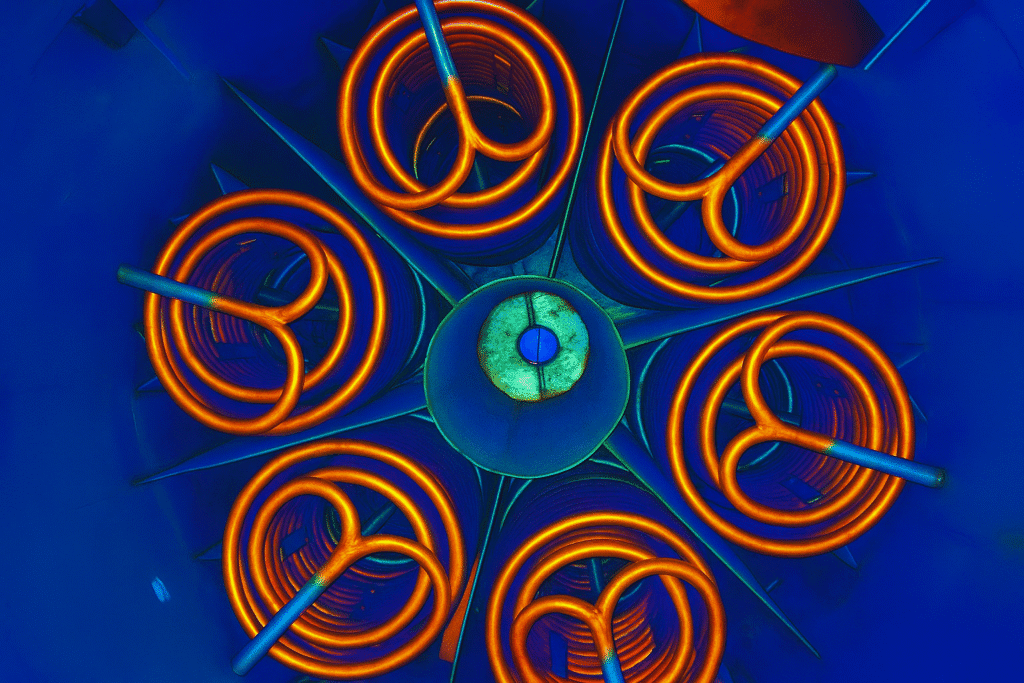
At this stage, the system further heats the oil through steam stripping.
The typical heating coils used in a semi-continuous deodoriser are shown in Fig.
3. The oil drains into the second tray, which is also used for heating and heat bleaching.
4. Then, after, the oil drains into the third tray.
After that, the set residence time, the oil flows down into the next tray.
5. And then, Deodorisation takes place in the third and fourth place. One can see the mammoth pumps for steam stripping and oil recirculation.
Fifth & Final Tray:
6. After that, the fifth tray is used for heat recovery from the hot oil by the oil in the first tray.
7. Then, after, the final tray is used for pre-cooling the oil, and for the addition of citric acid, and possibly other additives.
Buffer Tank:
8. The oil drops to the buffer tank at the bottom of the vessel before it is pumped out of the deodoriser.
1. The oil is cooled to a temperature.
Saturated with Nitrogen:
2. The oil is saturated with nitrogen and stored under nitrogen protection, to be discussed later.
3. The oil passes through a polish filter before it goes through the external cooler.
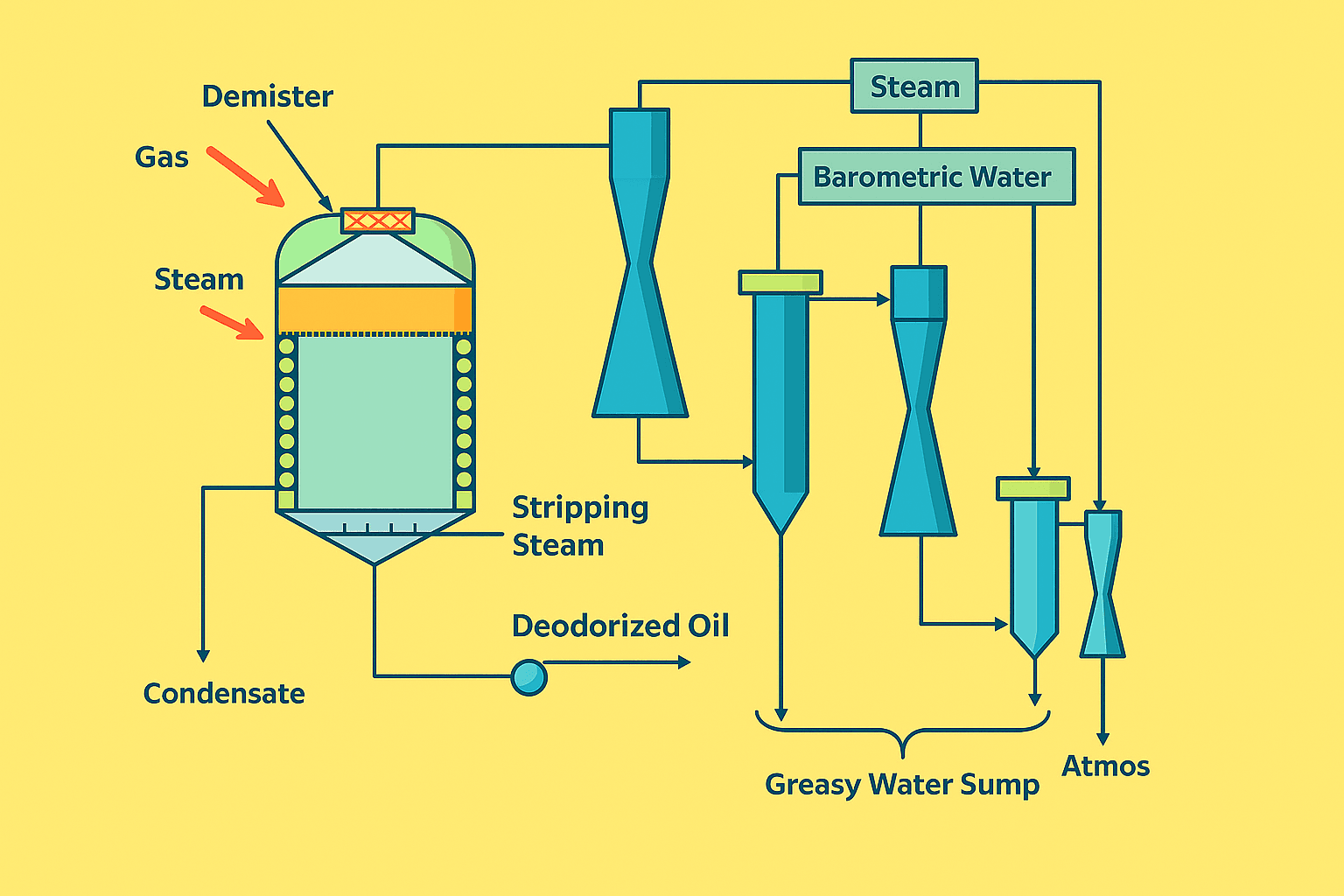
4. During the process, vapour from the deodoriser moves into the indirect contact condensing ejector, where volatile compounds like fatty acids and carried-over triglycerides condense into liquid.
Fatty Acids Settlement:
5. Next, the fatty acids settle at the bottom of the fatty matter separator, pass through an external cooler, and then return to the vapour line from the deodoriser.
This return ensures they make initial contact with the vapour before entering the separator.
Vacuum System:
6. The uncondensed vapour leaves the separator at the top and goes to the vacuum system.
7. Most modern ejectors have four stages. Some combinations of liquid ring vacuum pumps (or dry vacuum pumps) and steam ejectors are used.
Liquid ring vacuum pumps cannot reliably deliver the very low pressure required by modern ejectors.
8. The fatty acids are collected in stainless steel tanks and sold as a byproduct.
Dowtherm Heating System:
9. Dowtherm was used as the heating medium.
Every deodoriser relied on the Dowtherm boiler to complete this function.
The Dowtherm was heated by natural gas, either in a liquid boiler or a Dowtherm vaporiser.
Dowthermvaporiserss are still in use, except that the new thermal medium is different.
10. Finally, Steam spargers are located at the bottom of the coils.
Advantages of Semi-Continuous Deodorisers:
High Productivity:
1. First of all, a semi-continuous deodoriser has a higher production capacity than a batch deodoriser.
2. Then, after the stock changes, they do not pose any serious threats of cross-contamination of the products, unless there is a breakdown of the control system or there is human error.
3. After that, it uses much less energy than the batch deodoriser.
4. Finally, the deodorised oil quality is good.
Energy Recovery:
5. Of course, it offers a good opportunity for energy recovery.
Can recover 40 – 65% of the total energy. The older Votator design had a double shell.
The trays exist inside the sheel of a semi-continuous deodoriser.
The idea was to prevent any air from leaking from the bottom of the deodoriser.
Moreover, if a bottom air leak occurs, the design ensures that the air does not come into direct contact with the oil inside the trays.
Disadvantage:
The disadvantage was that the deodoriser tended to accumulate oil at the bottom of the outer shell, which was referred to as shell drain.
In constructing the deodoriser, a carbon sheet forms the outside, ensuring stability.
This caused the shell to drain very dark due to the reaction between the fatty acids in the oil and the carbon steel of the shell.
Plants experienced frequent shell leaks, requiring costly shutdowns and repairs.
Multi Stock Deodoriser:
Later, the design was replaced by Votator with a single-shell, stainless-steel construction, which was further improved by Desmet Ballestra, as shown in Fig.
Desmet first presented the concept of the multi-stock deodoriser in the early 1970s.
Finally, the system uses a unique concept in which six semi-continuous individual deodorisers operate within a single shell, giving it the appearance of a massive batch deodoriser.