Introduction to Standardisation of Sodium Thiosulfate:
Standardisation of Sodium Thiosulfate plays a vital role in volumetric analysis, especially in iodometric titrations such as the standardisation of Sodium Thiosulfate for the POV and iodine test in the edible oil and fats industries.
It serves as a reliable reducing agent, reacting quickly and cleanly with iodine. In analytical chemistry, accuracy matters more than anything, so preparing and maintaining a standard solution becomes essential.
That’s why standardising sodium thiosulfate ensures consistent, dependable results in laboratories.
This guide covers the background, reasons for standardisation, standard errors, and troubleshooting steps.
History of Standardisation of Sodium Thiosulfate:
The application of sodium thiosulfate in chemical analysis dates back to the 19th century.
Chemists discovered its value as a stable titrant in iodometry, especially for determining chlorine, copper, and dissolved oxygen.
Over time, standardised procedures were developed to reduce variations caused by impurities or instability.
Today, the standardisation of sodium thiosulfate remains one of the most widely practised techniques in analytical chemistry training and research labs.
Reason for Standardisation of Sodium Thiosulfate:
Freshly prepared sodium thiosulfate solution is not stable for long. Factors such as air oxidation, bacterial contamination, or light exposure can slowly degrade the solution.
Therefore, the solution must be standardised against a primary standard such as potassium dichromate or potassium iodate.
By standardising sodium thiosulfate, chemists can determine its exact concentration before using it in titrations, ensuring precision and reproducibility in experiments.
Types of Errors During Standardisation of Sodium Thiosulfate:
Various kinds of errors can occur during titration or preparation steps:
- Preparation Errors
- Improper weighing of chemicals, impure reagents, or inaccurate dilution causes deviations.
- Instrumental Errors
- Uncalibrated burettes, pipettes, or balances often lead to systematic mistakes.
- Procedural Errors
- Incorrect endpoint determination, poor mixing, or failure to follow standard methods can affect accuracy during the standardisation of sodium thiosulfate.
- Environmental Errors
- Temperature changes, light exposure, and reagent contamination also reduce reliability.
Troubleshooting Standardisation of Sodium Thiosulfate:
When results vary, systematic troubleshooting ensures consistency:
Check Solution Stability
Always prepare the sodium thiosulfate solution fresh and store it in amber bottles to prevent light degradation.
Verify Instruments
Calibrate burettes and pipettes before standardising sodium thiosulfate.
Improve Endpoint Accuracy
Use starch indicator at the correct stage to avoid premature colour changes.
Maintain Clean Glassware
Any contamination from soap, dust, or leftover chemicals can interfere with titration results.
By applying these troubleshooting steps, laboratories can maintain reliable titration results and enhance the credibility of experimental data.
Objective:
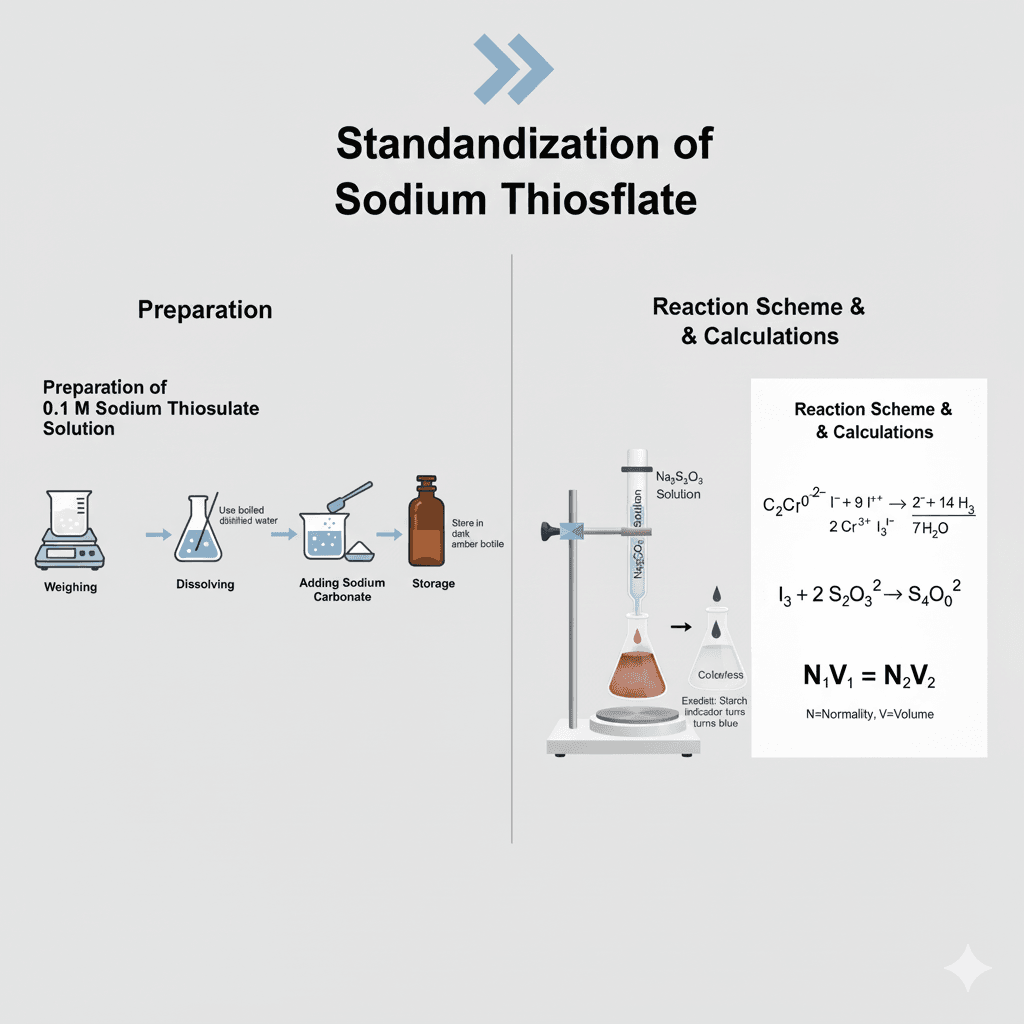
To prepare & standardise Sodium thiosulfate accurately, standardise a 0.1N Sodium thiosulfate solution using potassium dichromate (K2Cr2O7) as a primary standard by iodometric titration.
Preparation of 0.1 N Sodium Thiosulphate solution.
Chemicals Required:
For the Preparation & standardisation of Sodium thiosulfate, the following chemicals are required.
- Sodium thiosulfate pentahydrate (Na2S2O3.5H2O).
- Distilled water.
- Sodium carbonate (optional, to stabilise the solution).
Apparatus Required:
- Volumetric flask (1L).
- Beaker 500 ml.
- Glass Rod.
- Funnel.
- Analytical Balance.
- Brown reagent bottle / Amber flask (for storage).
Calculation:
Molar Mass of Na2S2O3.5H2O = 248.18 g/mol
1 mole = 1 Equivalent in redox reaction (I2+2S2O32- =2I–+S4O62- )
To prepare 1L of 0.1N solution:0.1×248.18 =24.82 g
Procedure:
- Weigh 24.82 g of Sodium thiosulfate pentahydrate accurately using an analytical balance.
- Dissolve the solid in 500 mL of cooled, freshly boiled distilled water (to remove dissolved oxygen).
- (Optional) Add a pinch of sodium carbonate to improve solution stability.
- Transfer the solution to a 1 L volumetric flask and make up the volume with more cooled, boiled distilled water.
- Store the solution in a dark amber bottle, tightly stoppered and labelled.
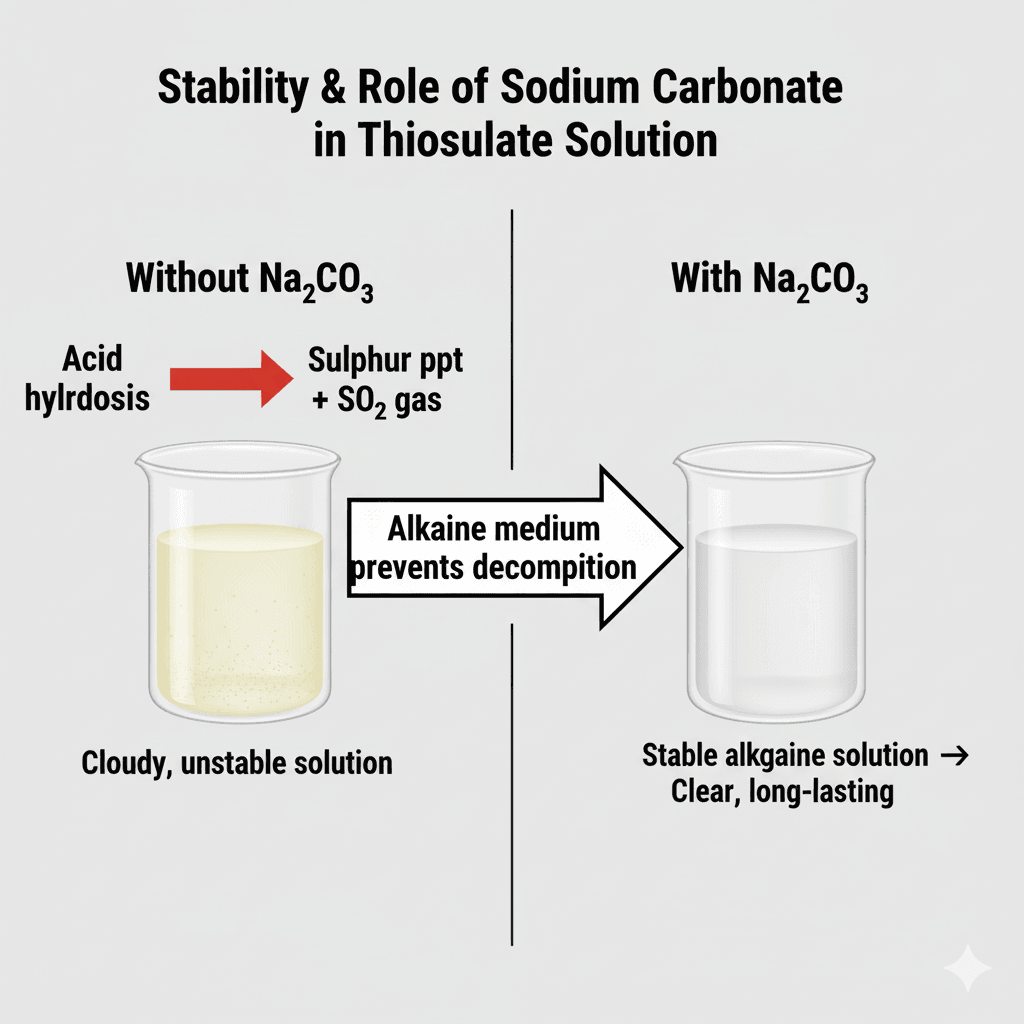
- Role of sodium carbonate in the stability of sodium thiosulfate solution.
For Longer Period:
Sodium thiosulfate is prone to acid hydrolysis in acidic environments or upon absorbing CO2 from the atmosphere, resulting in the formation of unwanted sulfur (settles as ppt) and SO2 gas.
Sodium carbonate suppresses hydrolysis by keeping the solution alkaline. An alkaline medium slows down the oxidative decomposition of thiosulfate.
This helps the solution remain clear and compelling for longer.
Standardisation of Sodium Thiosulphate Solution Using Potassium Dichromate.
Principle:
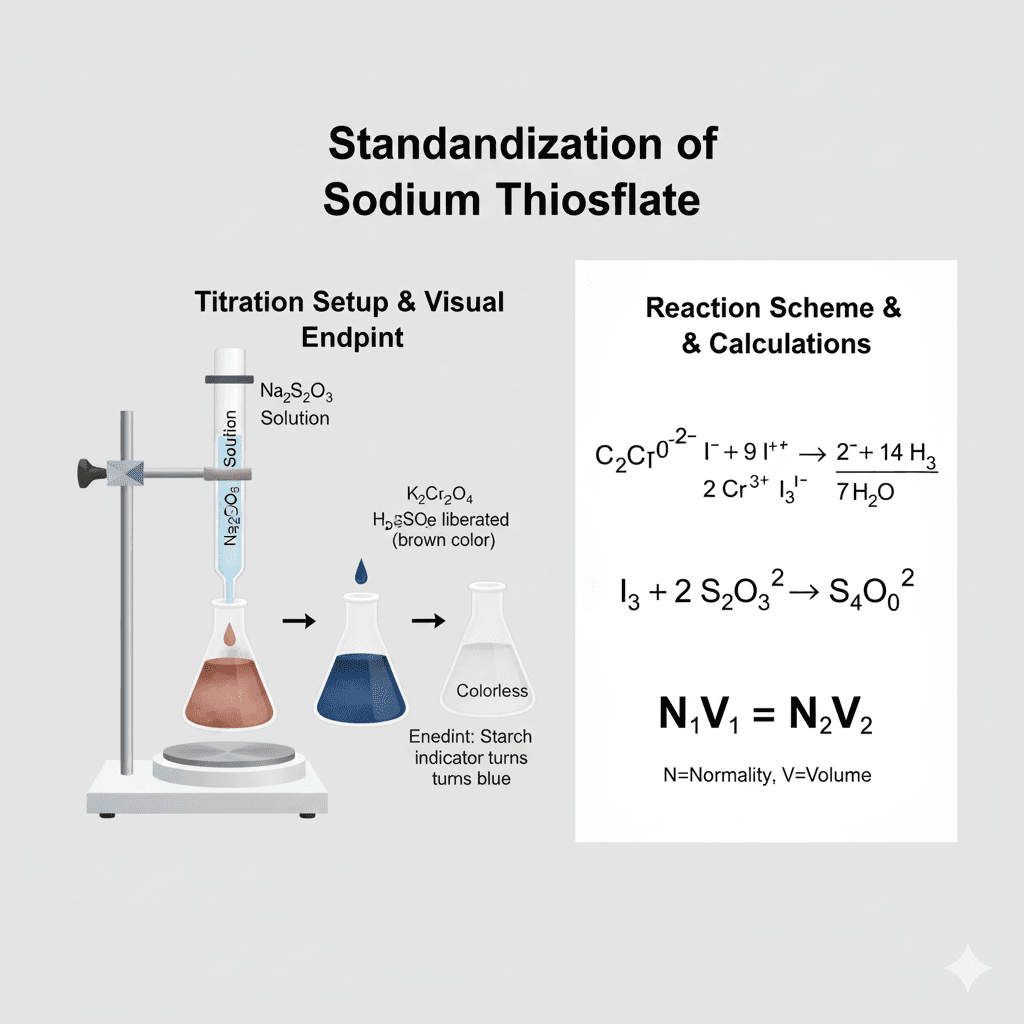
Potassium dichromate reacts with excess potassium iodide in an acidic medium to liberate iodine, which is then titrated with sodium thiosulfate.
Chemicals Required:
- Standard potassium dichromate (K2Cr2O7).
- Potassium Iodide (KI).
- Dilute sulfuric acid.
- Freshly prepared 1% starch solution (1% w/v).
- Sodium thiosulfate solution (which is to be standardised).
Apparatus:
- Burette.
- Pipette (25 ml).
- Analytical balance.
- Volumetric flask.
- Funnel.
- Wash bottle (Containing distilled water).
Preparation of Standard K2Cr2O7 Solution (0.1 N).
Molar Mass of K2Cr2O7 =294.18 g/mol
In redox , 1 mole=6 equivalents ( Cr6+Cr3+ )
Equivalent weight=294.18 / 6=49.03 g
For 1L 0.1 N solution
- ×03=4.903 g
- Weigh 4.903g of K2Cr2O7
- Dissolve in distilled water and make up to 1L
Titration Procedure:
- First, pipette out 25 mL of K2Cr2O7 solution into a conical flask.
- Then, after, 5 ml of 10% potassium iodide.
- After that, 10 ml of dilute sulfuric acid (1:1 H2SO4).
- Then, after, the solution will turn brown due to liberated iodine.
- After that, take the initial reading on the burette and start titrating immediately with the prepared Na2S2O3 from the burette.
- After that, as the colour fades to pale yellow, add 1,2 ml of freshly prepared starch indicator, and the solution will turn blue.
- After that, continue the titration until the blue colour disappears, indicating the end point.
- Finally, record the burette reading.
Calculation:
N1V1=N2V2
Where,
- N1 = Normality of K2Cr2O7
- V1 = Volume of K2Cr2O7 taken ( 25 ml )
- N2 = Normality of Na2S2O3
V2 = Volume of Na2S2O3 used during titration.