


Purpose of the Refining Process of Edible Oil:
In the Refining Process of Edible Oil, the term “refining” implies that it removes certain undesirable impurities from crude oil.
The primary goal is to produce high-quality edible oil that delivers satisfactory results across all applications.
The refining process of Edible Oil either reduces or removes the major and minor non-triglycerides (impurities) from the crude oil to make it suitable for food use.
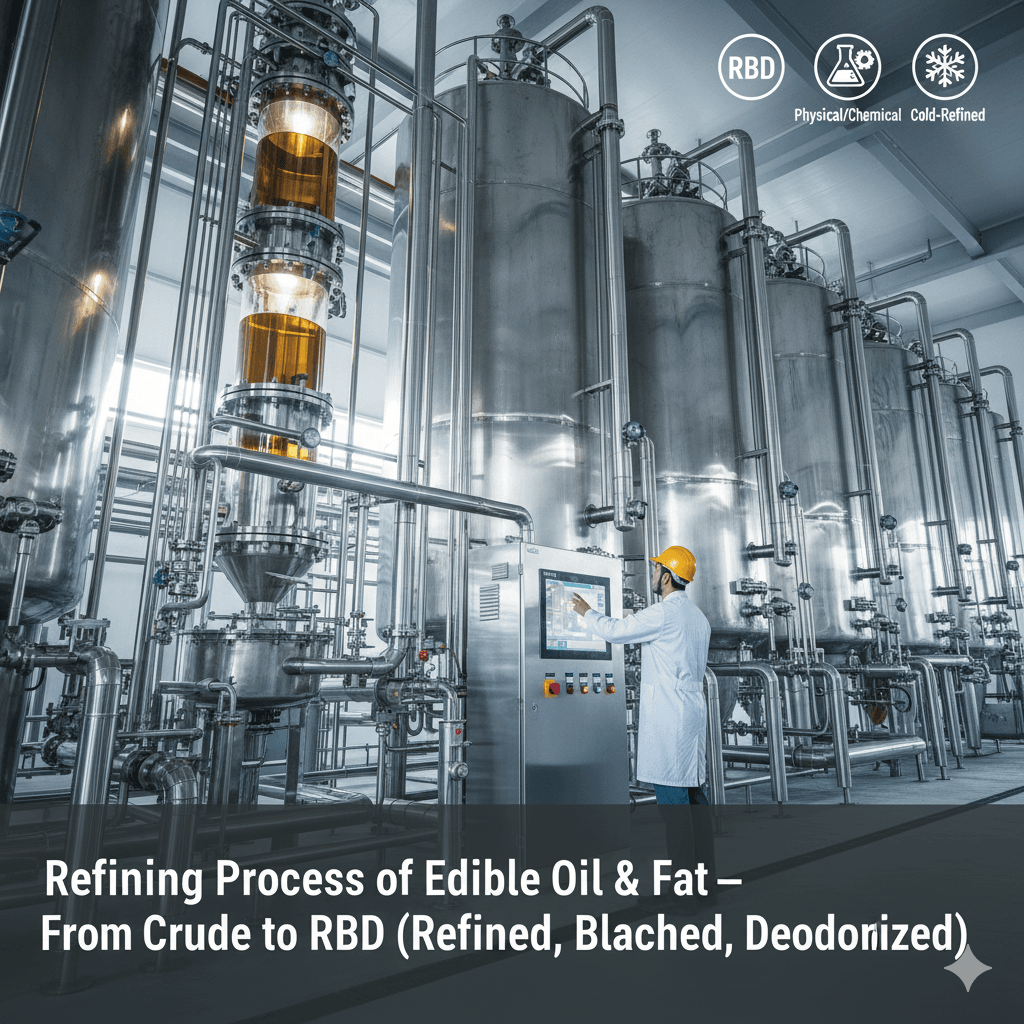
Major Non-Triglycerides: Refining Process of Edible Oil.
The major impurities in the crude oil are present in relatively high levels. Examples of the major impurities are:
Free fatty acid (FFA)
Phospholipids
Diglycerides
Monoglycerides
Impurities & filtration:
In addition, the crude oil contains some impurities.
The Refining Process filters impurities from crude oil before it enters the refining process.
Without filtration, these impurities tend to plug the centrifuge bowl, requiring frequent process shutdown to clean it.
All major impurities are undesirable in the finished oil at levels above certain thresholds.
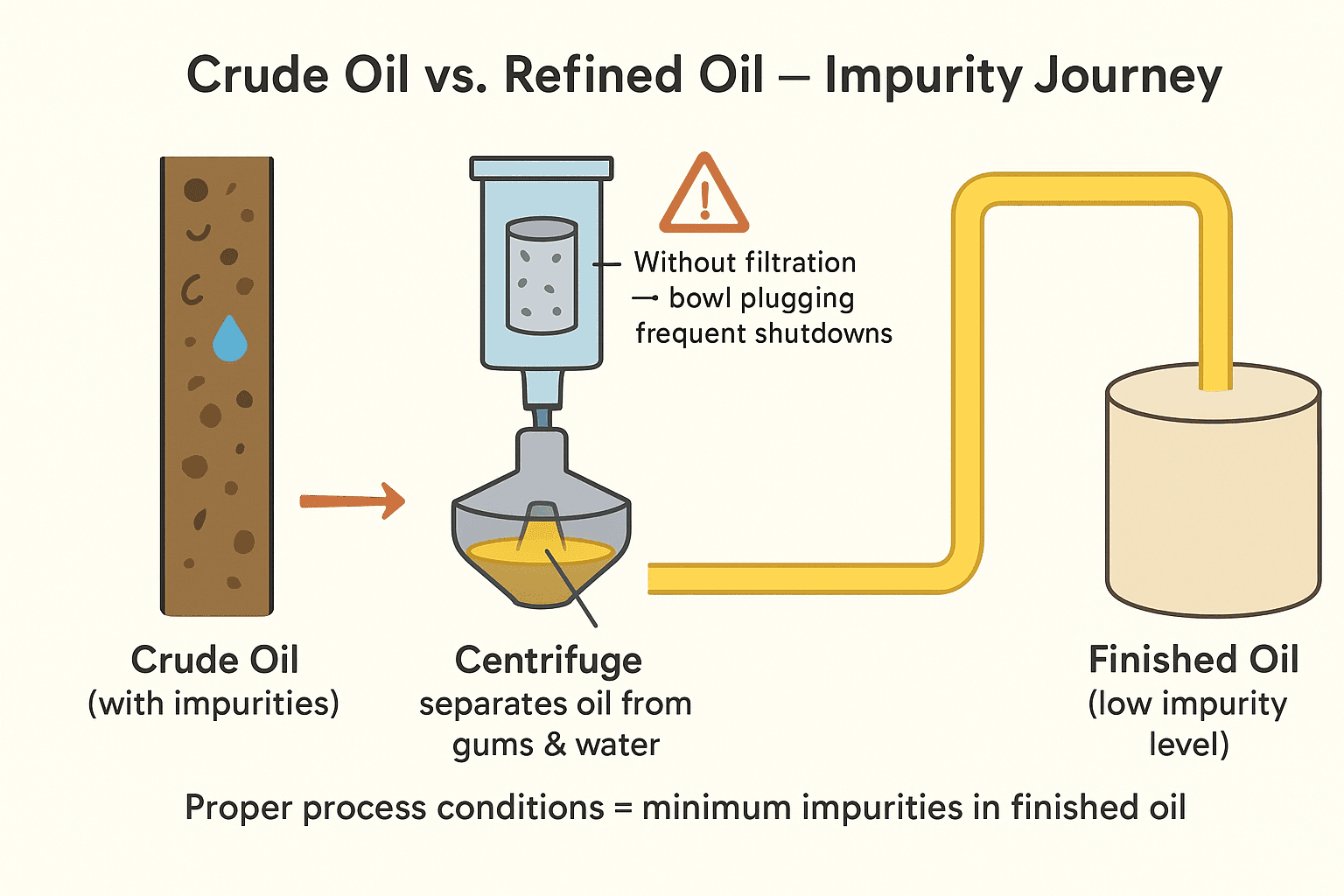
The refiner should maintain process conditions within the prescribed limits to obtain finished oils with the lowest levels of the above impurities.
Minor Non-Triglycerides:
These impurities are present in crude oil at parts-per-million (PPM) levels.
The minor non-triglycerides present in the oil include the following components:
Tocopherols
Tocotrienols in palm oil and rice bran oil
Sterols and sterol esters
Color compounds
Oil decomposition products, such as:
- Polar compounds
- Polymers
- Aldehydes
- Ketones
- Other volatile and non-volatile compounds.
Natural Antioxidants.
Tocopherols, tocotrienols, and sterols are natural antioxidants.
They also provide nutraceutical value to the oil and foods made with it.
It is desirable to retain these components in the refined, bleached, and deodorised (RBD) oil at the highest levels possible to maintain the oil’s high oxidative stability.
Oxidative Stability:
The Refining Process for Edible Oil colour compounds and oil oxidation components must reduce them to very low levels.
Some colour compounds are reduced to improve the oil’s appearance, while others are reduced to enhance its oxidative stability.
Colour in Crude Oils.
For example, the red colour in crude palm oil is contributed by several carotenoid compounds.
In most commercial operations, the carotenoids are bleached at high temperature under vacuum.
However, the “Red Palm Oil” marketed for its nutritional value contains high levels of carotenes.
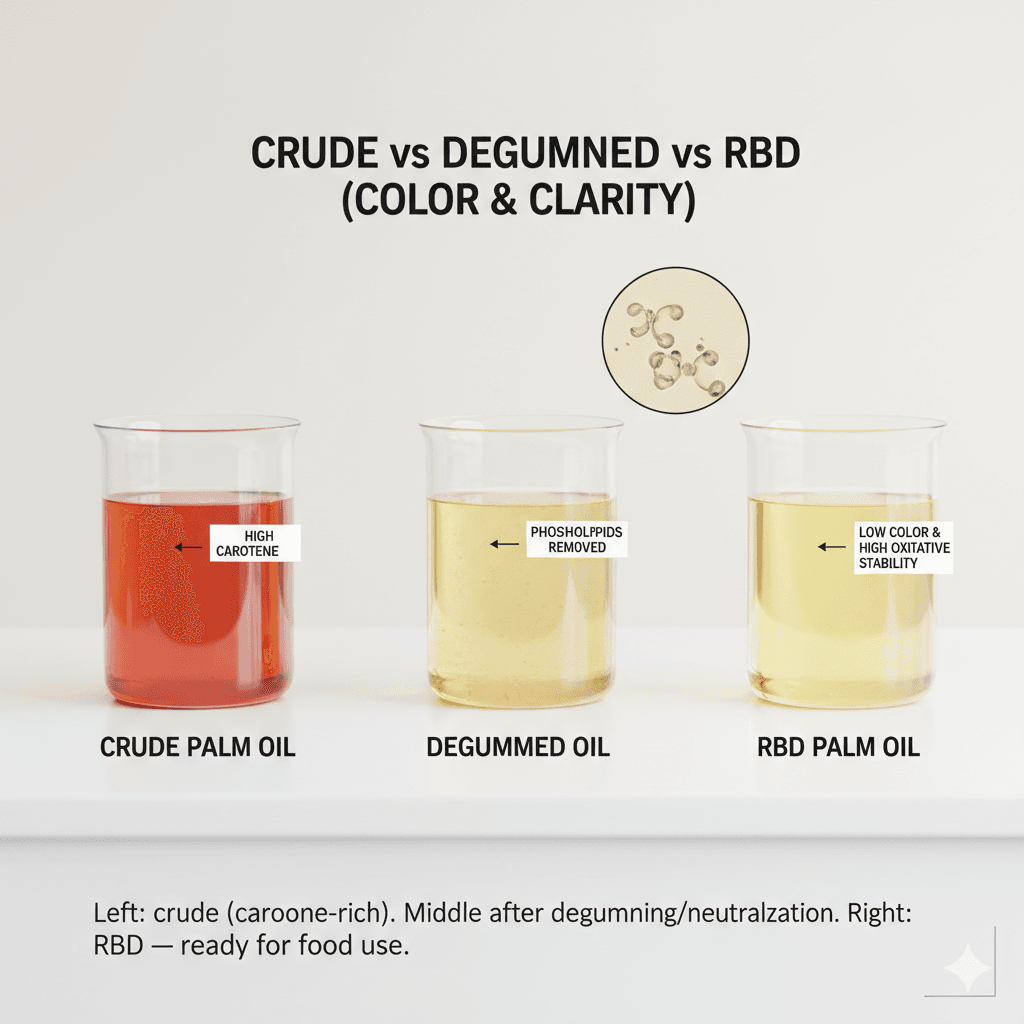
This oil is processed through careful bleaching and deodorisation to retain most of the original carotenoids.
Methods of Refining Process of Edible Oil.
There are two primary methods for refining vegetable oil.
They are
Continuous refining process.
Physical refining process.
Chemical refining processes.
Batch refining process.
Another Refining Process:
In addition, another refining process, known as cold refining, is used primarily for sunflower oil and other wax-bearing oils.
Generally, other processes are slight modifications of the physical or chemical refining methods.
These are known as:
Modified physical refining process
Modified chemical refining process
Semi-physical refining process
The crude oil refining process depends on the following steps:
- Type of crude oil
2. Quality of crude oil undergoing refining.
The Chemical Refining Process:
Initially, the chemical refining process, which dominated the oil processing field,
came under scrutiny when the environmental requirements in many parts of the world became stringent.
The chemical refining process produces soap as a byproduct, which is treated with sulfuric acid to reclaim the fatty acids.
This generates a plant effluent that is very rich in COD and BOD.
To alleviate this situation, the oil processing industry developed what is widely known today as the physical refining process.
Low in non-hydratable Phospholipids:
This process has been found suitable for crude oils low in non-hydratable phospholipids and high in FFA.
The process is especially beneficial for refining crude palm oil and coconut oil, given their low phospholipid and high FFA contents.
Chemical refining of either of these oils yields substantial soap and results in excessive loss of neutral oil in the soap.
Physical Refining Process:
In addition, the physical refining process is suitable for the super-degummed canola oil (with a phospholipid content of < 750 PPM).
This process is unsuitable for seed oils due to their higher phospholipid content.
Sunflower or safflower oil:
Sunflower or safflower oil can be refined using this process, in which the phospholipids in these oils are reduced to a very low level (< 750 PPM) via acid pretreatment of the crude oil.
Many processors refine soybean oil using the physical refining process, but the results are highly questionable.
Soybean oil can be successfully refined via the physical refining process if the phospholipids are reduced to < 400 PPM (Phosphorus content <10 PPM).
Following is the list of Oils:
Generally, the following is a list of oils for which the physical refining process can effectively produce high-quality refined oil.
- Super-degummed canola oil with phosphorus content of< 25 PPM( roughly 750 PPM of phospholipids)
- Sunflower oil
- Safflower oil
- Palm oil
- Coconut oil
- Palm kernel oil
- Ultra-degummed soybean oil ( Phosphorus Content< 10 PPM).

Comments are closed.