


Introduction to the Water Degumming Process:
Water degumming is a standard process in edible oil industries.
Phospholipids are a vital component of the cell structures of vegetable seeds.
Commonly referred to as “gums”, these compounds are extracted alongside crude oil during processing. Since they are oil-soluble, they remain within the oil after extraction.
Water degumming in vegetable oil aims, among other things, to significantly lower its phospholipid content.
Elevated levels of the compounds can negatively affect the oil’s performance, especially during frying.
Phospholipid Level: Water degumming process,
In the Water degumming process, the oil processing industry typically expresses phospholipid levels in parts per million (ppm) of phosphorus, as phosphorus and phospholipids are directly related.
For example:
% phosphorus = ((phosphorus in oil (ppm) × 31.7) × 104
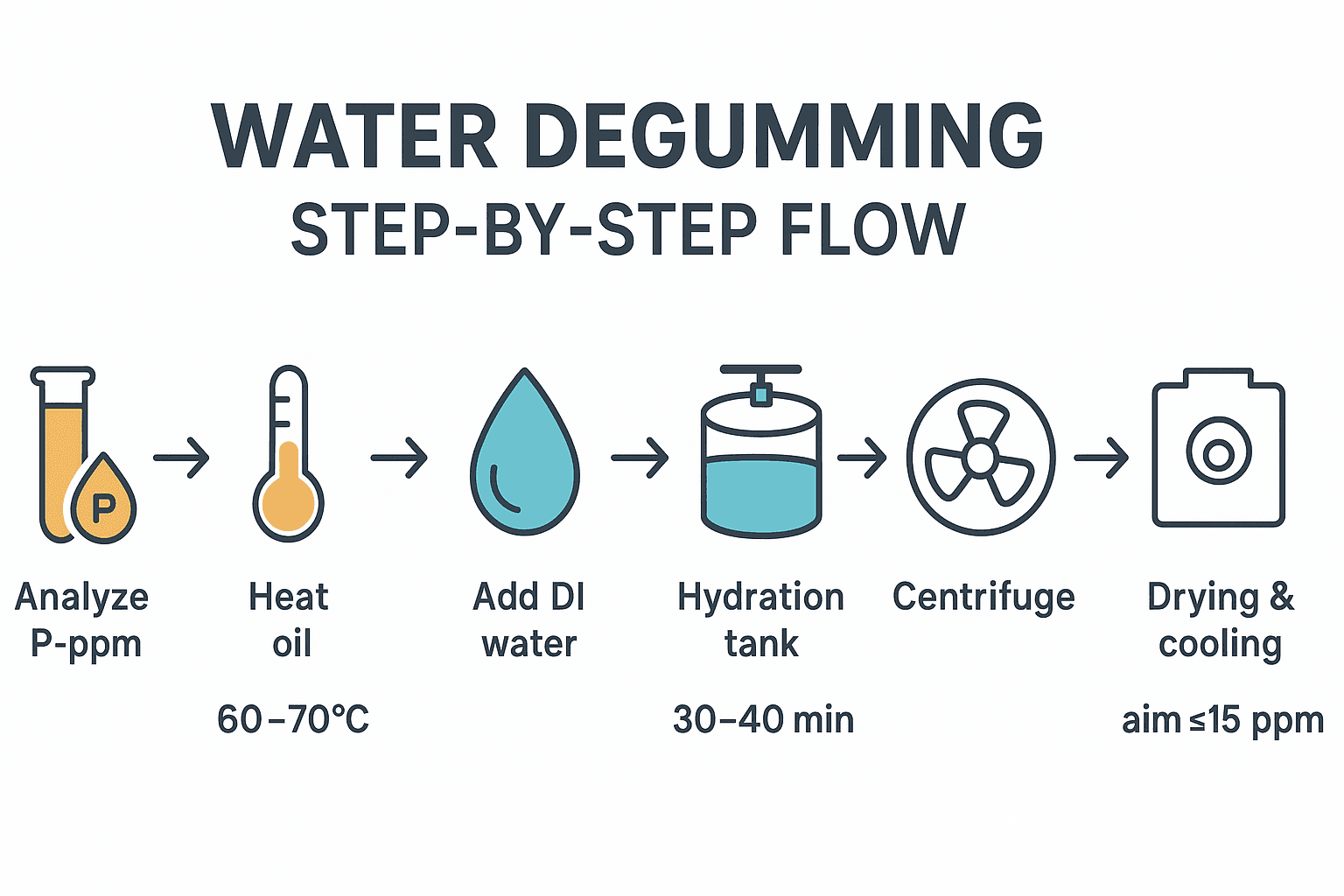
Table:
| Oil Type | Crude soybean oil | Phosphorus Content (PPM) |
| Crude soybean oil | 1-3 | 320-970 |
| De-gummed Soyabean oil | 0.32-0.64 | 110-210 |
| Crude corn oil | 0.7-0.9 | 220-280 |
| Crude canola oil | 1.8-3.5 | 515-1100 |
| Super-de-gummed Canola oil | 0.13-0.16 | 40-50 |
| Crude Sunflower oil | 0.5-0.9 | 100-150 |
Purpose of Degumming:
Water degumming process:
Water degumming in edible oil industries, which reduces the phosphorus content in crude oil, is essential because high phosphorus levels adversely affect the flavour stability of the final refined, bleached, and deodorised oil.
Additionally, refining becomes more challenging when phosphorus remains high beyond the bleaching phase.
Lecithin production:
The water degumming process in crude oil serves multiple purposes.
For instance, soybean oil undergoes water degumming to facilitate lecithin production.
Meanwhile, canola oil is routinely degummed to meet the market standards, either as degummed or super-de-gummed crude oil.
Canola Gum:
However, canola gum is dark and lacks commercial appeal compared to soy lecithin, so it’s typically added to animal feed.
Corn oil, produced via wet milling, is also degummed to enhance crude oil quality and make it easier to refine.
Effluent Discharge:
Furthermore, stringent environmental regulations across various countries have forced oil processing plants to minimise effluent discharge.
As a result, many facilities now use acid degumming methods for oils that are more challenging to refine.
These methods also help reduce phosphorus levels to a point that enables the use of physical refining techniques.
Phosphorus Content:
While some experts suggest that soybean oil becomes suitable for physical refining.
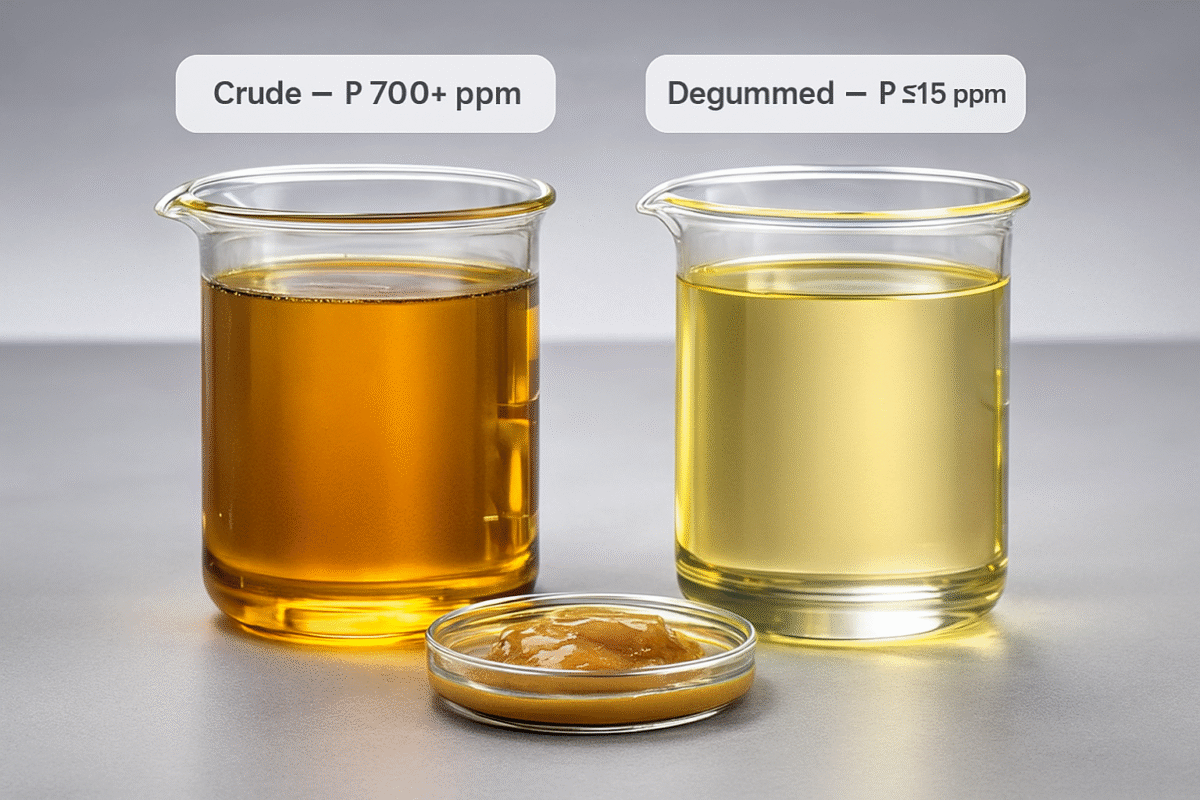
When phosphorus content drops to 15 ppm or lower, others argue that the level must reach 10 ppm or ideally be under 5 ppm for optional results.
Hydratable & Non-Hydratable Phospholipids:
Crude oil contains more hydratable and non-hydratable phospholipids. Hydratable phospholipids can be removed from crude oil by treating it with deionised water.
In contrast, non-hydratable phospholipids require treatment with acids such as phosphoric acid, citric acid, maleic acid, or citric anhydride.
These acids react with the metal complexes of non-hydratable phospholipids, converting them into hydratable forms that can then be removed from the oil.
Acid Treatment:
While gum removed by the acid treatment can still be used to produce lecithin, the clarity is usually compromised.
Consequently, this type of lecithin is blended into animal feed.
In the United States, integrated crusher-refiners degum soybean and corn oil immediately after extraction.
Doing so reduces soap formation during refining, easing the load on soap acidulation systems.
COD & BOD:
Additionally, the practice significantly lowers the biological oxygen demand (BOD) and chemical oxygen demand (COD) of plant effluents, making it more environmentally friendly.
Cottonseed oil is typically refined using micelle refining, which naturally produces less soap.
Methods of Degumming:
The vegetable oil industry employs several degumming methods, including;
- Water degumming
- Acid conditioning
- Acid degumming
Water Degumming:
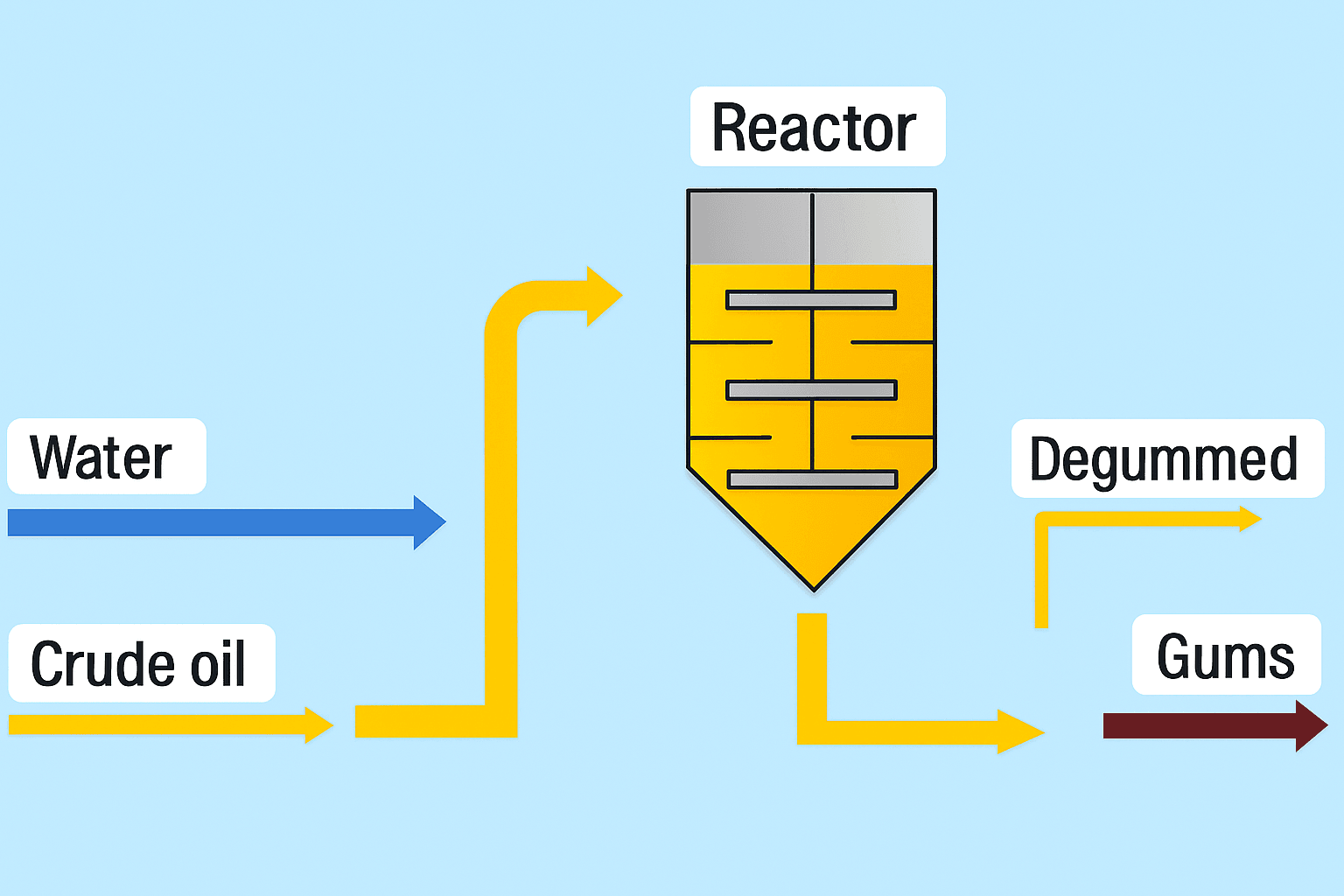
In the water-degumming process, hydratable phospholipids absorb water and are removed from the oil.
This property is used in the water-degumming process, which removes most hydratable phospholipids from crude oil.
When crude oil is fresh and sourced from high-quality soybeans, it yields better separation.
However, poor-quality soybeans tend to produce crude oil with higher levels of non-hydratable phospholipids, necessitating acid degumming or acid pretreatment.
Water Degumming Process Steps:
Analyse the crude oil to determine phosphorus ppm.
Heat the crude oil to 60-65 degrees Celsius.
Add deionised water (in an amount equivalent to the phospholipid content) through an inline mixer.
Gently mix oil and water in a hydration tank for 30-40 minutes to allow the gum to hydrate and agglomerate.
Gently pump the oil from the tank into a centrifuge for separation.
Collect hydrated gum in the heavy phase.
Maintain the oil temperature at 60–70 degrees Celsius after leaving the centrifuge.

Since the oil contains 0.4-0.8% moisture, heat it to 90–95 degrees Celsius before vacuum drying.
Use a vacuum dryer set to a maximum absolute pressure of 50 mm Hg to reduce moisture to ≤0.05%.
Cool the oil below 50 degrees Celsius for storage.
If lecithin production is planned, dry the hydrated gum in a wiped film.
Vacuum dryer equipped with a missed eliminator to prevent product loss due to foaming.

Comments are closed.