


Introduction: Why the Winterization Process in Edible Oils Matters.
The Winterization process in edible oils removes high-melting components, keeping the oils clear when chilled.
For example, salad oils must stay transparent after refrigeration; otherwise, consumers notice cloudiness and judge product quality as poor.
Consequently, producers apply cold stabilization, commonly called dewaxing, which improves appearance, mouthfeel, & functionality.
In short, the winterization process converts cloudy feedstock into customer-ready oils for cooking, frying, and use in formulations such as margarines and shortenings.
Key Goals of The Process:
First, lower wax and higher melting triglyceride levels. Next, ensure the oil passes the standard col test (a defined refrigeration period when no cloudiness appears).
Finally, separate and recover the solids so the remaining liquid fraction meets product specifications. Therefore, Winterization enhances shelf appeal and extends marketability.
Dewaxing (Cold Stabilisation) vs Fractionation: Definitions & Differences:
Although taxing and fractioning both chill oils, they differ in their aims and scales
The waxing or winterization process in edible oils targets waxes & minor high-melting components to make salad oil clear.
Conversely, fractionation separates oils into Olean and stearin functions to tailor melting profiles for shortenings, margins, or specialty fats.
Thus, while both use cold and filtration, fractionation often yields marketable solid fractions used in formulations.
Typical Oils Treated by Each Method:
- Dewaxing Collins and flower, safflower, canola, coin, and cottonseed (to remove stearines)
- Fractionation: palm oil, partially hydrogenated soybean, and other oils where distinct Olean/stearin functions have commercial value.
How the Winterization Process in Edible Oils Works Step by Step:
Below is a practical, stepwise description of the winterization process in edible oils, written so plant operations can follow it easily.
Feed Preparation and Melting:
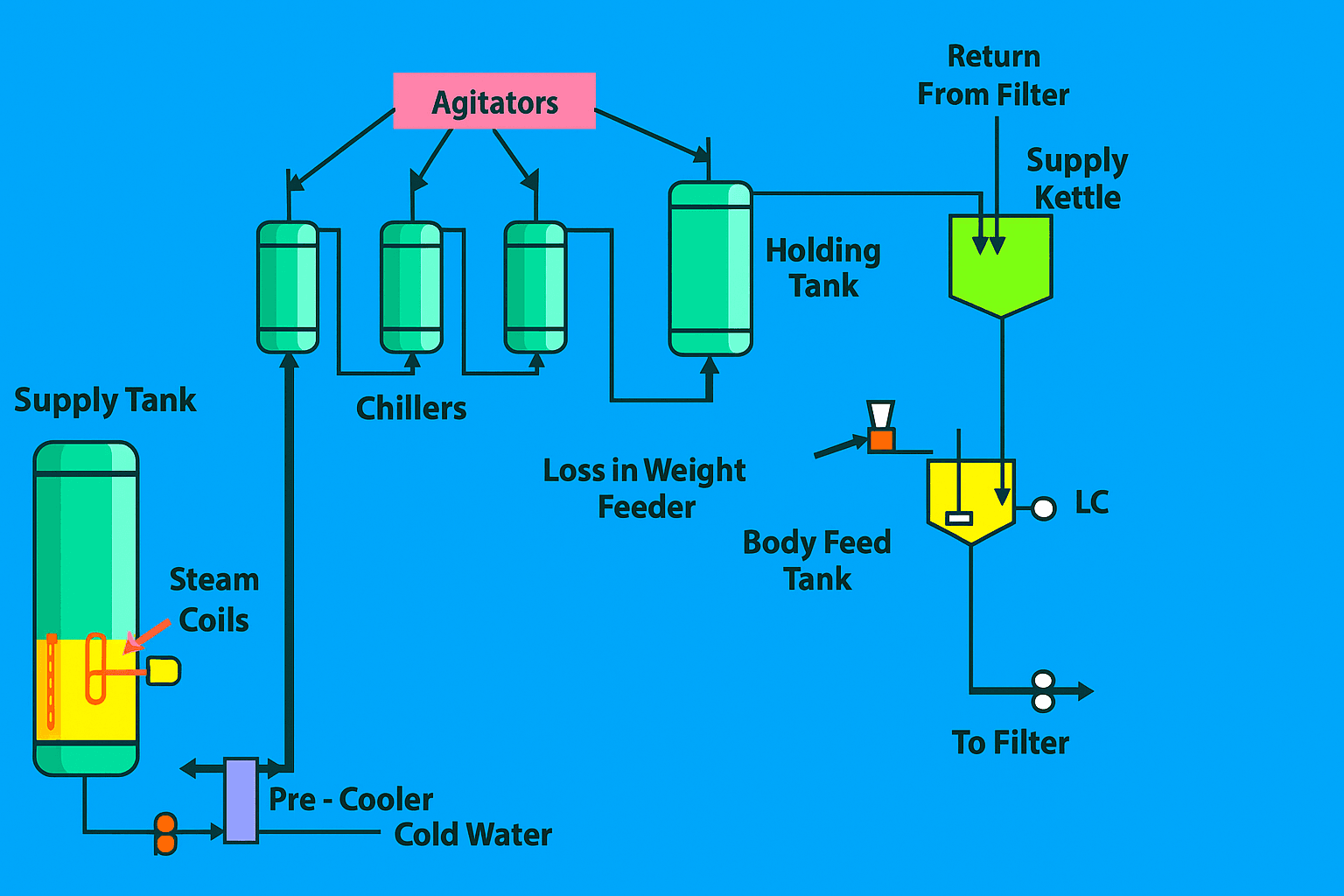
First, ensure the feed oil is uniform. Therefore, use a large supply tank with mechanical agitation to maintain a consistent composition.
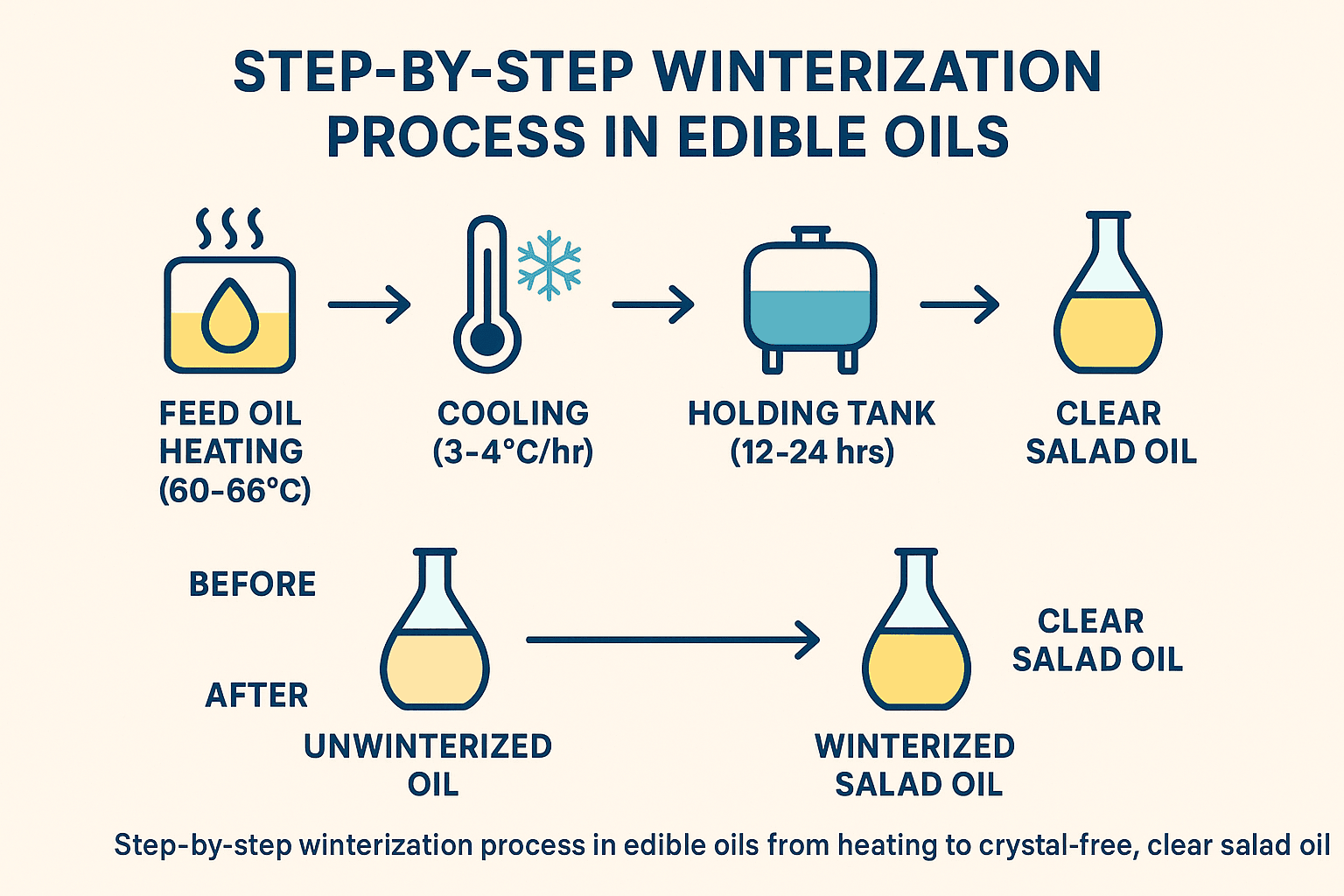
Next, heat the oil to melt the waxes fully: typically heat to around 60-66°C (140-150°F).
Control Pre-Cooling and Chilling:
Then, pump the heated oil through a pre-order to about 40.6°C (104°F) before it enters the chiller.
Inside the stainless-steel chill tank, controlled cooling at roughly 3-4°C per hour helps slow crystal growth.
Meanwhile, our top-entering scrape ball agitator runs slowly, at 5-10 RPM, to keep solids suspended and maintain effective heat transfer.
Holding, Maturation, and Warming:
After cooling to about 6-7°C (42-45°F), hold the oil in tanks for 12 to 24 hours. During this hold, crystals grow to sizes suitable for filtration.
Next, warm the oil to 10-12°C (50-54°F) to reduce viscosity for pumping and filtration.
Filtration and Cake Handling:
Finally, filter the oil through a pressure-leaf filter pre-coated with diatomaceous earth (DE).
Maintain a continuous body feed of DE to protect the filter medium and extend cycle time. Stop filtration when the differential pressure reaches 30-35 psi.
Then, purge & dry the cakes, recover residual Oil, and separate Max from the E for further use or disposal.
Winterization of Sunflower Oil: Practical Observations:
Crude sunflower oil often contains 300 to 400 PPM wax; poor seed decoration can push this up to 2000 PPM.
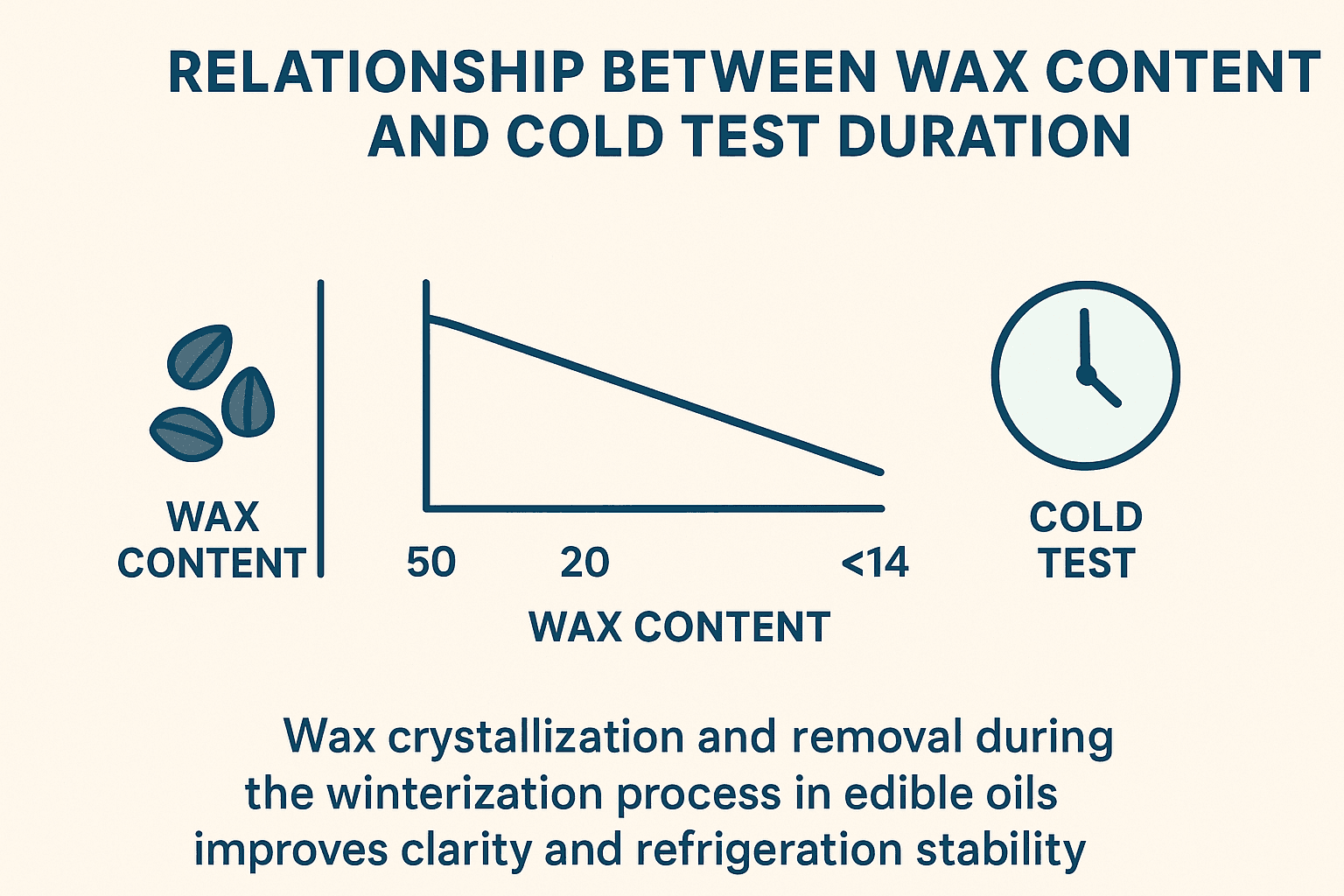
Therefore, the winterization process in edible oils reduces wax to below target levels. Industry experience shows that wax content less than 14 PPM typically yields a cold test of <24 hours for sunflower salad oil.
Hence, consistent feed quality and precise control of cooling and holding times are essential.
Equipment & Operational Tips (Dewaxing and Cold Stabilisation Best Practices):
Use these practical tips to improve yield and reduce downtime.
- Maintain feed uniformity; column-store large batches with agitation to keep composition steady.
- He controls cooling rate: slow, steady cooling procedures for larger crystals that philtre more easily.
- Use wall scraping to prevent fouling and maintain thermal efficiency.
- Pre-code correctly: good DE Pre-coat prevents rapid clogging: otherwise, filter cycles shorten.
- Schedule hot oil washes: periodic hot oil washing removes residual wax from philtre media and clothes.
- Record call test results: correlate wax PPM to colt S towers, then adjust process parameters.
Reason for Winterization process in edible oils: Customer Point of View and Quality:
From the customer’s perspective, clarity equals trust.
Therefore, when consumers buy salad oil, they expect a crystal-clear bottle both in the store and after refrigeration.
If oil clouds or flakes, buyers often assume it’s pure over quality or improper handling, and consequently, brands lose credibility. Moreover, chefs and food service buyers expect predictable frying behaviour and consistent mouthfeel.
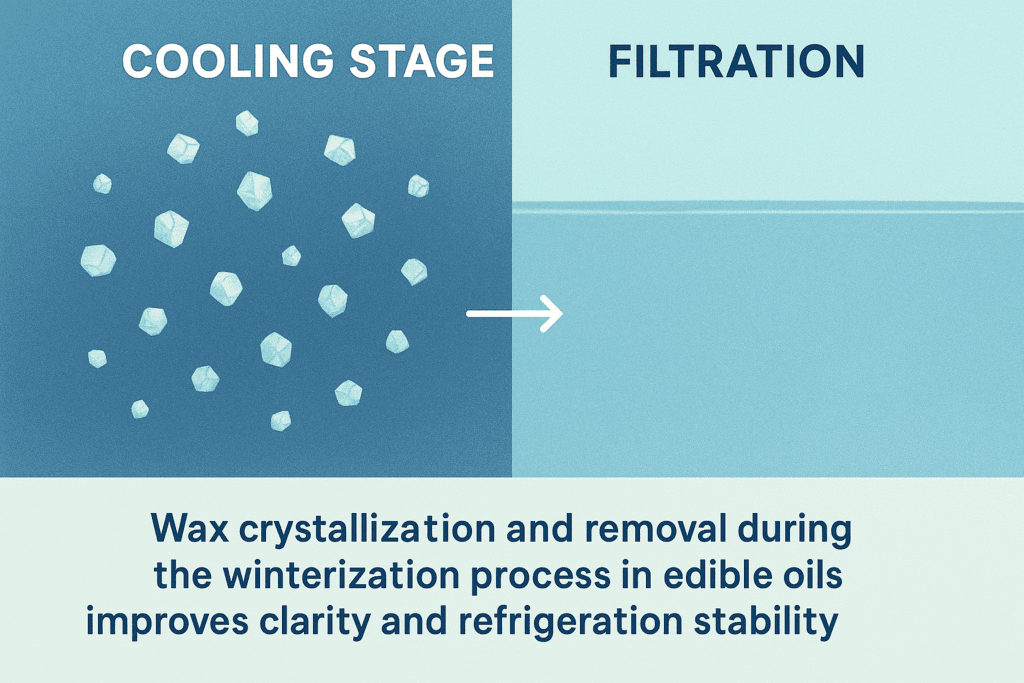
Thus, the winterization process and edible oils matter not only for aesthetics but also for performance. In addition, retailers require inventory that looks stable and won’t display sediment or haze on cold shelves.
Finally, from a quality standpoint, winterization removes components that can affect texture, aroma, and shelf stability; thus, it directly contributes to sensory acceptance, regulatory compliance, and brand reputation.
Cold Test and Quality Criteria: How to Verify Winterization process in edible oils:
The American Oil Chemists’ Society cold test determines whether the winterization process in edible oil has been successful.
Especially, filtered, deaerated oil in sealed glass bottles sits at 0°C (32°F) until cloudiness appears.
For many sunflower oils, our 24-hour cold test is standard; however, some cottonseed oils require a 5.5-hour minimum in certain regions.
Thus, document the coldest result for each patch to ensure compliance and to track process performance over time.
Troubleshooting common problems in the Winterization process in edible oils
If the oil still clouds after winterization, check the following and act accordingly.
- Feed variation: variability in wax content can cause inconsistent results in the column; therefore, blend batches to uniformity.
- Insufficient holding time: Allow crystals time to mature, Colin; otherwise, fitness will be passed through the philtres.
- Too-fast cooling accelerates crystal nucleation but produces small crystals that foul philtres.
- Improper DE feed: insufficient pre-coat or body feed causes rapid clogging and breakthrough.
- Inadequate washing: clock screens and residual wax reduce efficiency; schedule hot-oil wash cycles.
Economics, Sustainability, and By-product Value:
Beyond clarity, the winterization process in edible oils affects economics and sustainability. For instance, recovered wax and stearin functions offer a secondary revenue path.
Recovered wax can be blended into shortening or refined for industrial uses; stearin functions may improve margarine formulation.
Consequently, plants that optimise recovery often see improved margins; additionally, efficient DE use and periodic maintenance reduce energy and material waste.
Therefore, treat winterization as both a quality & a business process.
Process Control & Automation:
Modern plants increasingly automate sellers, agitator speeds, and dosing.
By doing so, they reduce human error and improve repeatability. Start with sensors for temperature, differential pressure, and viscosity, then establish PID loops to maintain cooling rate and hold times.
As a result, throw put increases and filter cycles lengthen the photo stop; moreover, integrating SCADA with quality data enables rapid correlation between wax PPM and cold test outcomes, helping engineers refine set points quickly.
Quality Control Checklist:
| No | QC Group | What to measure/how | Target/ specification | Frequency | Responsible | Notes |
| 1 | Feed & pre-heat checks | Wax concentration (ppm) from lab sample; feed temp(°C/°F); agitator running/RPM | Wax <14 ppm (sunflower typical)-adjust/oil; Melt: 60-66°C (14-150°F); mixer at set RPM | Each batch (pre-winterization), continuous monitoring during charging | QC lab/ plant operator | The schedule includes hot oil wash when needed; recover residual oil from cake; drag DE consumption |
| 2 | Chilling & holding control | Temperature profile/ °C/hour in chiller; holding time in (hours) & holding tank in temp (°C) | Cooling rate ~3-4°C/hr (5-7°F/hr); hold 12-24 hrs; Holding temp ~6-7°C (42-45°F) | Hourly during chilling; record start/end of hold per batch | Process engineer/ Operator | Slow cooling + adequate hold larger crystals & easier filtration |
| 3 | Filtration & DE management | Differential pressure (psi); DE pre-coat/ body feed amount; filter cycle Monitoring | Stop filtration ◇P 30-35 psi; follow DE dosing recipe | Continuous during filtration; log at intervals | Filter operator/ Maintenance | Keep bottles sealed & deaerated; Retain results for traceability & corrective actions |
| 4 | Final QC-cold test & traceability | Cold test at 0°C (32°F): hours until cloudiness; batch record & QC log | Target: >24 hrs (sunflower) – 5.5hr min for some cottonseed; record wax ppm, temps, ◇P | Per processed batch (post-filtration) | QC Lab/ Quality manager | Each batch (pre-winterization), continuous monitoring during charging |
Troubleshooting Addendum Fast Fixes:
- When immediate correction is necessary, try these fixes:
- Increase holding time by a few hours to encourage crystal growth.
- Reduce the cooling rate slightly if the filters show a fitness breakthrough.
- Add a short hot oil flush of filtered clothes to restore permeability.
- Blend a high-melt fraction with the incoming feed to normalise wax PPM.
Conclusion: Practical Benefits and Final Recommendations:
In summary, the winterization process in edible oils ensures clear, consumer-acceptable salad and cooking oils.
Moreover, the process increases product value and widens market opportunities. To succeed, aim for consistent feed, precise temperature control, sufficient holding time, and proper filtration practice.
Finally, keep records of wax PPM and cold test hours. By doing so, you will steadily refine operations and maintain reliable product quality.
Remember, when you optimise the winterization workflow, you not only improve clarity but also strengthen your bottom line.

Leave a Comment