


Introduction:
Determination of Free fatty acids is the amount of sodium hydroxide solution necessary to neutralize the acid, calculated by the weight of free fatty acid of specified molecular weight.
What are Free Fatty Acids?
Definition and Basic Concept:
Determination of Free fatty acids (FFA) is the measurement of fatty acid molecules that are no longer attached to glycerol in the triglyceride structure of oil and fats.
In normal conditions, edible oil contains triglycerides, where three fatty acids are bonded to one glycerol molecule.

However, due to hydrolysis, oxidation, or poor handling, these bonds can break, releasing fatty acids in a “free” form.
How FFAs Forms:
FFA formation increases when oils are exposed to moisture, enzymes, heat, microbes, or prolonged storage.
Mechanical extraction delays, damaged oilseeds, and poor processing conditions also lead to the breakdown of triglycerides.
Measurement of Free Fatty Acids:
FFA levels are expressed as a percentage (commonly as oleic acid) and serve as a key quality indicator in the edible oil industry.
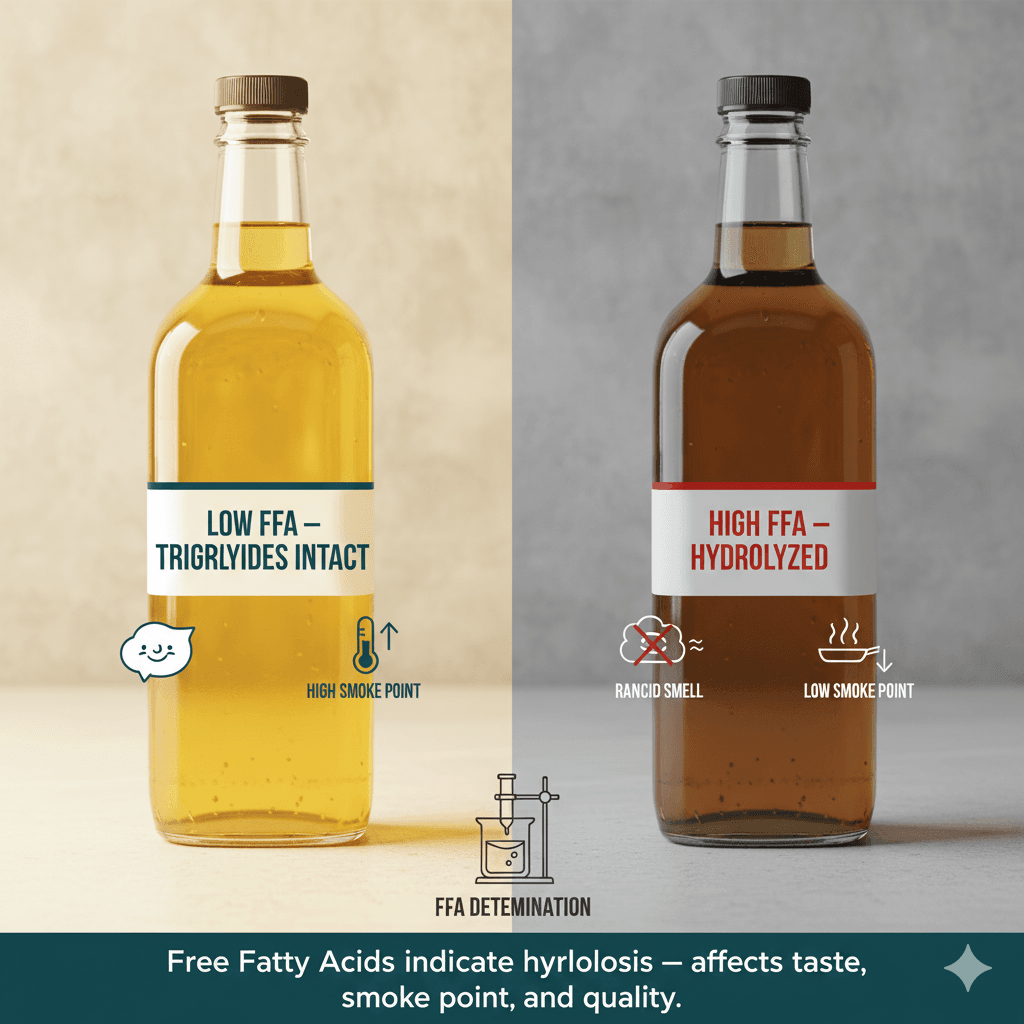
High FFA shows degradation and loss of freshness.
Sources of Free Fatty Acids:
All crude vegetable oils, such as sunflower, palm, soybean, rape, and cottonseed, contain some level of FFAs.
Animal fats such as tallow and lard can also develop FFAs if stored improperly.
Why Understanding FFAs Matters:
- Free fatty acids affect taste, odor, stability, processing cost, and consumer safety. Knowing what FFAs are helps processors, quality controllers, and buyers evaluate oil freshness and suitability.
Importance of Free Fatty Acids in Edible Oils and Fats:
Indicator of Oil Quality
FFA level is one of the most critical quality parameters. High levels signal poor handling, extended storage, or hydrolytic breakdown, all of which directly impact usability.
Impact on Refining Efficiency
During neutralization, high FFAs require more alkali, leading to increased soap formation and oil loss. This reduces yield and raises production cost.
Effect of Flavor and Aroma
Excessive FFA causes rancidity and the development of off-flavors. Oils with high FFAs degrade quickly during frying and storage.
Regulatory Limits and Standards:
- Food safety authorities set strict FFA limits. For refined oils, acceptable levels are typically between 0.05% and 0.3%, while crude oils may start at higher values before refining.
Shelf Life and Stability
FFA increases oxidation rates, reducing the oil’s shelf life. Lowering FFA improves aroma, frying performance, and consumer acceptance.
Nutritional and Processing Value
Low FFA levels indicate greater triglyceride stability and better resistance to high-temperature cooking. It also ensures consistent performance in food manufacturing.
Why We Minimize FFA in Edible Oils and Fats:
Preventing Rancidity and Oxidation
Free fatty acids oxidize faster, producing unpleasant odors and harmful compounds. Reducing FFA enhances taste, safety, and sensory quality.
Reducing Refining Costs
- High FFA levels indicate greater caustic soda consumption and higher oil loss in soapstock. In physical refining, extra distillation is needed, increasing costs. Lower FFA improves efficiency and profitability.
Improving Smoke Point and Cooking Stability
Oils with high FFA tend to smoke at lower temperatures, making them unsuitable for frying. Minimizing FFA ensures better thermal resistance and food quality.
Meeting Food Safety Standards:
Edible oils comply with international and national standards. High FFA can result in rejection, reprocessing, or reduced market value.
Extending Shelf Life
Lower FFA levels slow oxidation and extend storage stability, benefiting both consumers and manufacturers.
Methods to Control FFA
Good harvesting practices, quick processing, temperature control, moisture management, and proper storage conditions help reduce FFA formation in crude oils.
Principle:

The fat is dissolved in our appropriate solvent (Ethanol), and the solution is then titrated with sodium hydroxide solution.
APPARATUS:
1. 0.1N NaOH
2. Phenolphthalein Indicator (1% in ethanol)
3. Ethanol.
Procedure:
First, take about 50ml of alcohol into a conical flask.
Then warm it, and put a few drops of the phenolphthalein indicator.
After that, neutralize it with 0.1N sodium hydroxide.
Weigh 10g of the oil sample in another flask. Pour neutral alcohol into the sample flask.
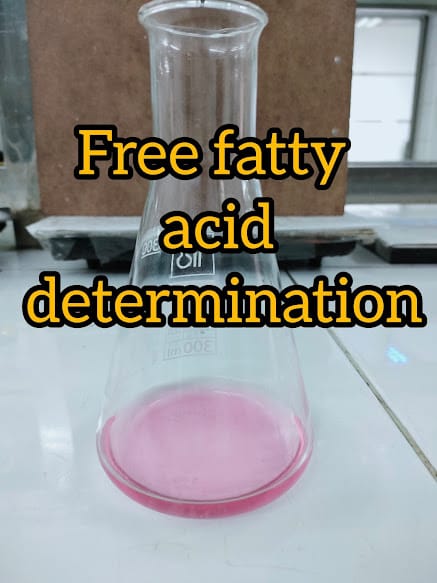
Then, Titrate with 0.1N NaOH.
Till the light pink color appears, note the reading.
Calculation:
FFA%=(Burette reading* N of NaOH*282*100)/1000*wt of sample
*282= Mol wt of oleic acid.
Precautions:
A sample taken from a Tank with a capacity of 50 MT must be noted as uniform. If RBD Palm Oil, it should melt in form.
Remember: for Canola, soybean, Sunflower, and cottonseed, multiply the factor by 282, as they are Oleic-based.
While RBD Palm Oil & Olein uses the factor 256 as its palmitic acid.
For FFA determination, note the following points
- If the sample has high FFA, suppose 1%
- In this case, we will take less weight of the sample. A less than 3g sample is ok.
- In this case, we can use another option: a high concentration of NaOH, above 0.5N.
- If a sample has less than 0.5% FFA, use 0.1N NaOH.

Comments are closed.