


Introduction to Origins of Vegetable Oils:
Early Beginnings of the Origins of Vegetable Oils:
The origins of vegetable oils date back thousands of years, when early civilizations first discovered that seeds, nuts, and fruits could yield valuable fats through simple pressing.
Long before industrial refining began, ancient cultures in Egypt, Mesopotamia, China, and the Indus Valley used sesame, olive, and flaxseed oils for cooking, lighting, medicine, and religious rituals.
These natural sources provided one of the earliest forms of edible fats, especially in regions where animal-based oils were scarce or reserved for specific uses.

Global Development and Evolution Origins of Vegetable Oils:
Over time, trade routes allowed different communities to access new oil-bearing crops.
In Asia, coconut and groundnut oils became common, while the Mediterranean region thrived on olives.
Africa relied on palm fruit and shea kernels, while the Americas introduced crops like soybeans, sunflowers, and maize much later.
Origin of Vegetable Oils:
Ancient Era of Edible oil and fats.
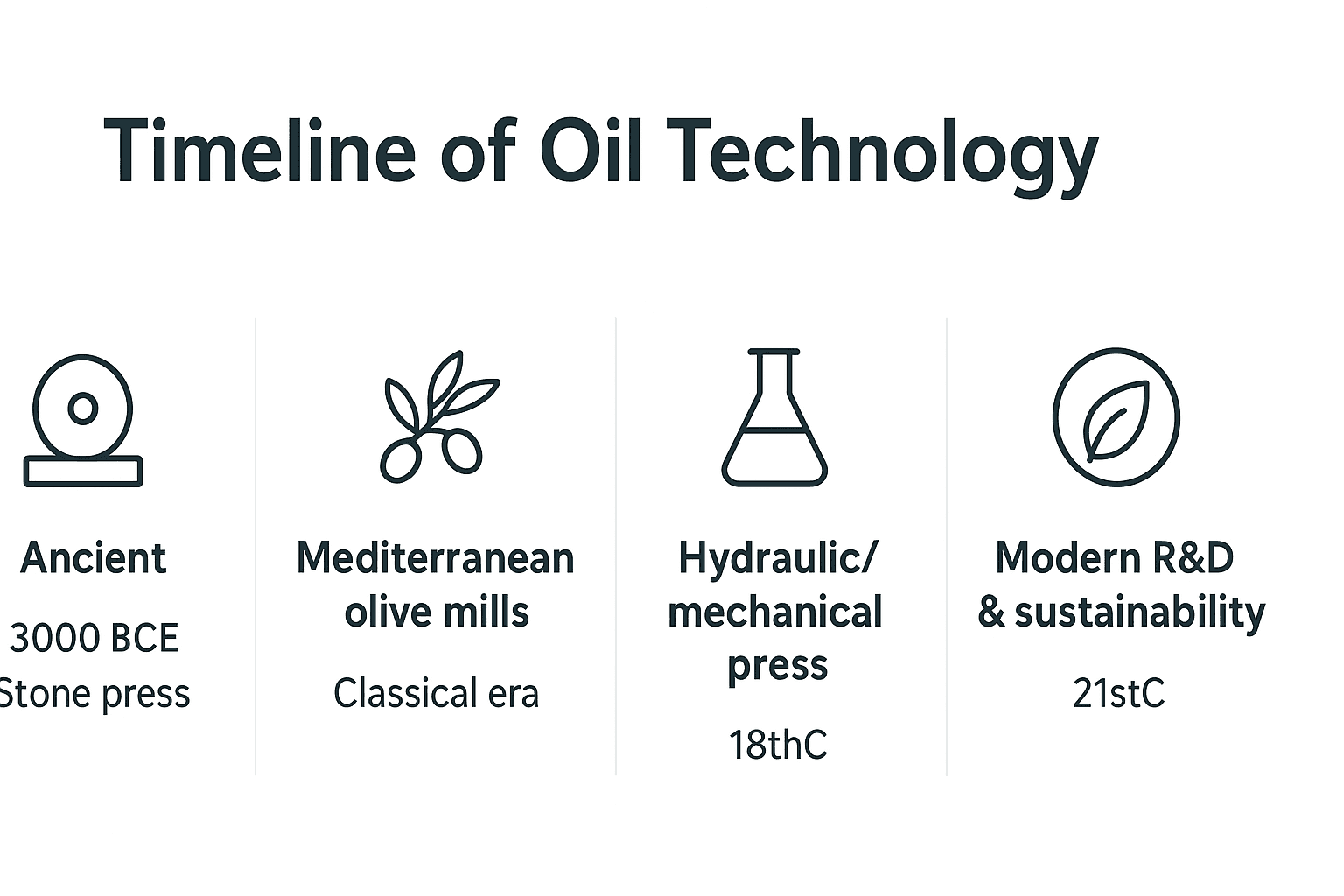
The use and Origins of Vegetable oils and fats date back to at least 3000BCE, with early records showing that Sumerian,
Chinese and Egyptians were among the first to extract oils from seeds and fruits.
Other Early Oils:
As early as 2000 BCE,
People in India used
Sesame oil is used in medicine and religious practices.
China cultivated soybeans and extracted soybean oil.
Olive Oil:
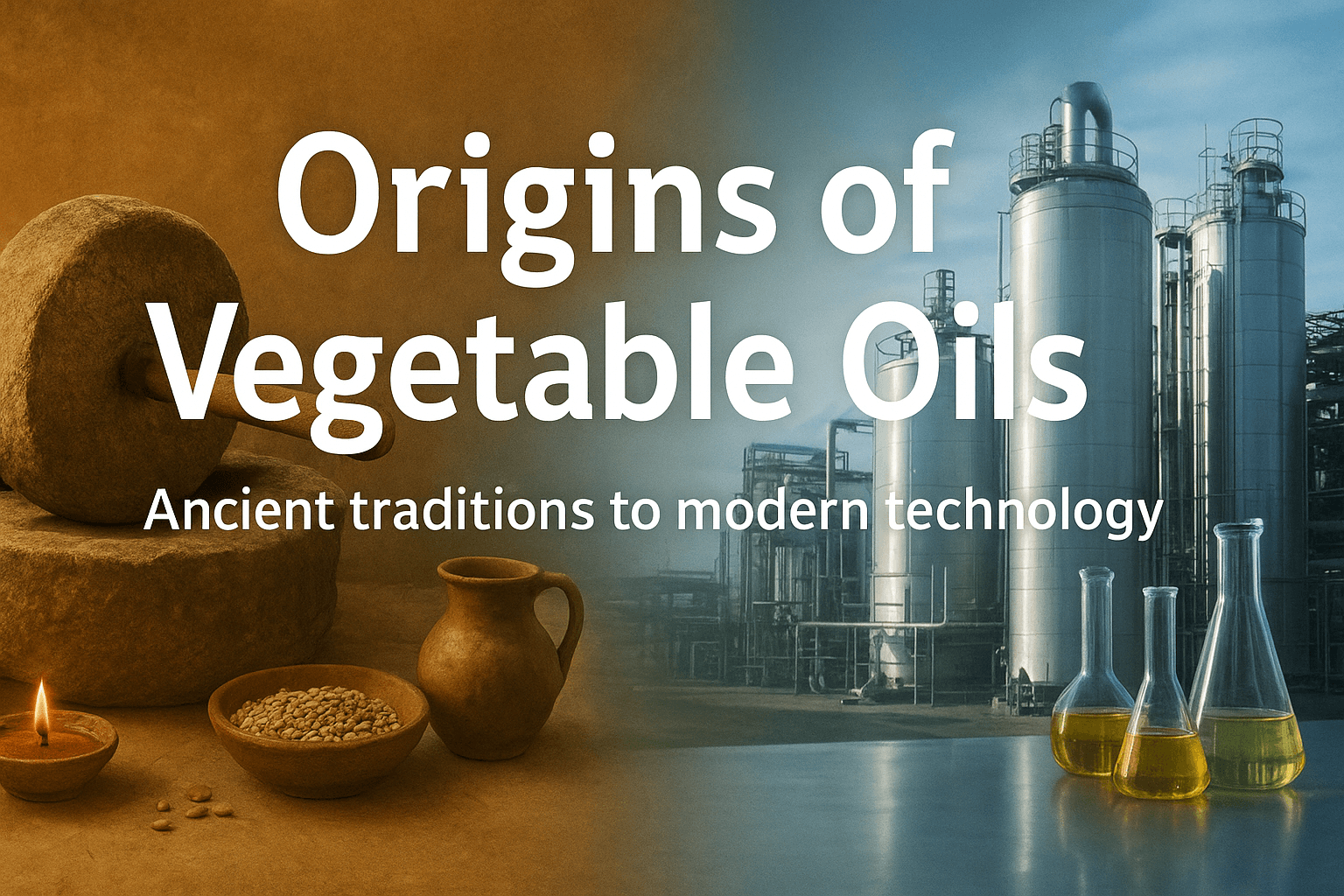
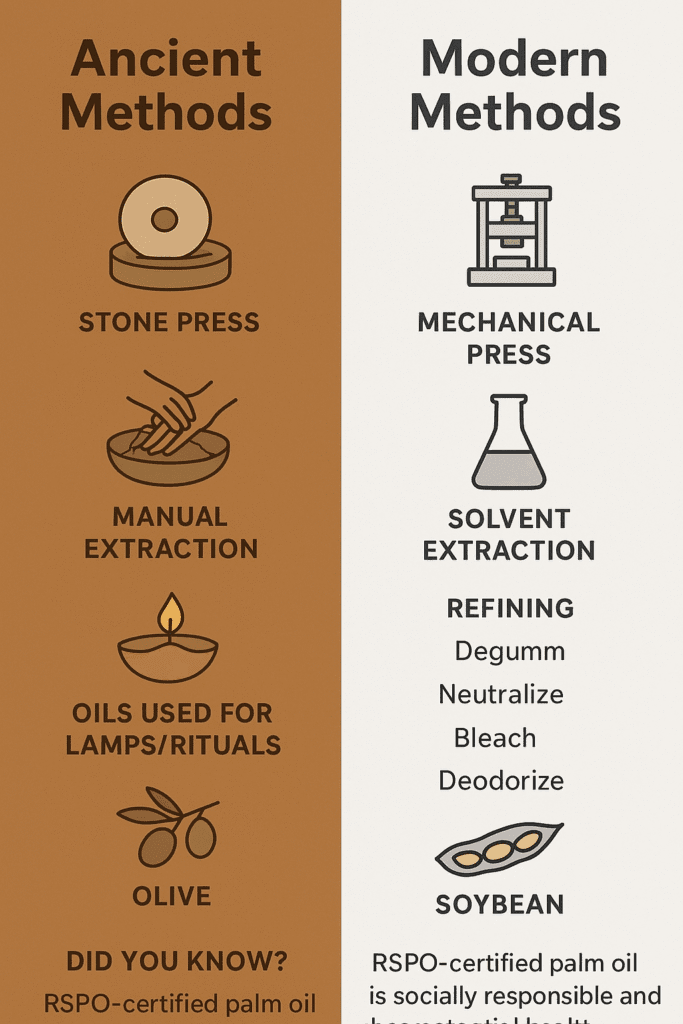
People used stone mills to press olive oil, which they used for cooking and to light lamps. Pre-Industrial Era, Middle Ages:
Between the 5th and 18th centuries, vegetable oil production expanded across continents.

Oil beyond food:
People used oil for lighting, medicine, textile processing, and as a food preservative.
Industrial Revolution: Oil processing. (18th-19th Century). Mechanical press:
In addition, the hydraulic press, invented in the 18th Century, significantly boosted oil extraction efficiency.
New sources and uses:
Cottonseed oil and rapeseed oil became widely used for industrial lubrication, paints, and varnishes. Later in the USA, cottonseed oil was used for cooking purposes: 20th century, Modern Oil Industry. In the 20th Century, vegetable oils were scientifically refined.
Introduction of Chemical Refining:
Degumming, neutralization, bleaching, and deodorization became standard practices for producing refined, odourless, tasteless oils.
New Oil Types and Mass Production:
Widespread consumption of soybean oil, corn oil, sunflower oil, and palm oil.
Canadian scientist developed Canola Oil.
Moreover, global demand has skyrocketed as the fast-food, meal processing, and frying industries continue to expand.
Solvent Extraction and R&D:
As technology advanced, hexane extraction enabled the efficient processing of oil from seeds with low oil content.
Moreover, oil refineries introduced laboratory testing, quality control, and R&D, thereby improving both oil yield and purity.
Modern Day Health, Sustainability, and Innovation
Today’s vegetable oil and fat industry is a complex global network driven by nutrition science, technology, and sustainability efforts.
Nutritional Science:
Awareness of saturated vs. unsaturated fats, omega-3 and omega-6 fats, and the risks of trans fats has changed how oils are formulated.
Many health-conscious consumers now prefer cold-pressed, extra virgin, organic, and non-GMO oils.
Sustainable Palm Oil and GMO Debate:
The RSPO (Roundtable on Sustainable Palm Oil) promotes responsible palm cultivation.
Genetically modified soy and canola have raised debates over food safety and environmental impact.
R&D and Specialty Oils:
R&D continues on oil fortification (Vitamin A, D) and antioxidant addition, as well as alternative fat substitutes (such as oleogels).
There is growing interest in algal oils, rice bran oil, and high-oleic oils for health and industrial use.
Conclusion:
The history of vegetable oils and fats is a story of human ingenuity from stone presses to solvent extraction, from ritual oils to health-optimized products.
Today, vegetable oils are more than just a cooking medium; they represent health, economy, technology, and sustainability.
Therefore, understanding their history empowers food scientists, quality experts, and R&D teams to make smarter choices in product development and consumer education.
Ancient civilizations produced olive oil and processed it using traditional methods.
Over time, innovation in tools and techniques enhanced their quality.



Comments are closed.